
How to Migrate Legacy PBX Systems to Modern VoIP Platforms
A practical guide to modernizing business communications with minimal disruption and maximum efficiency

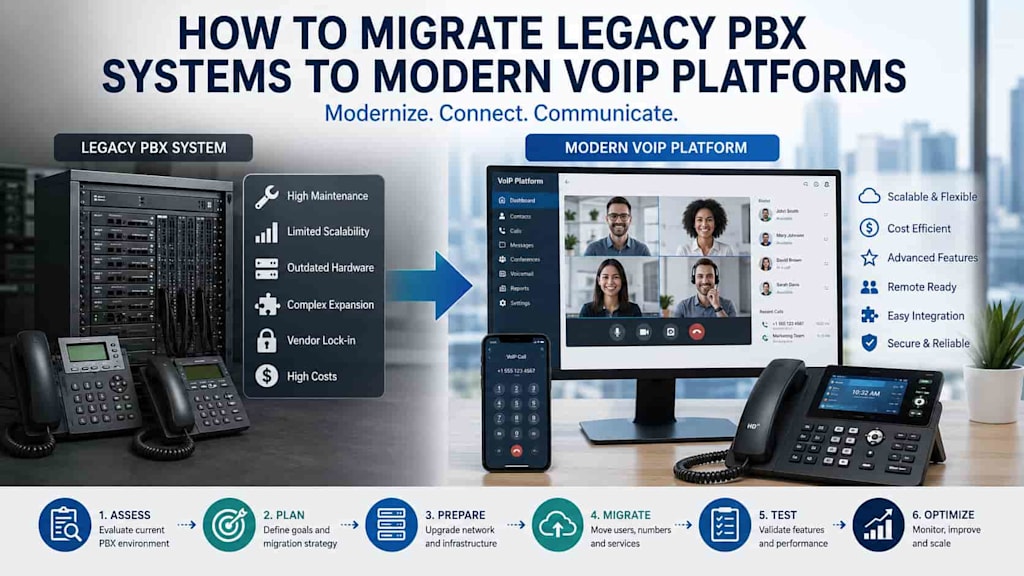
For many organizations, legacy PBX systems have served as the backbone of business communications for years. While these systems were once considered reliable and cost-effective, they increasingly struggle to meet the demands of today's digital workplace. Remote work, cloud applications, video conferencing, unified communications, and AI-driven automation require a level of flexibility that traditional PBX infrastructure simply cannot provide.
Migrating from a legacy PBX system to a modern VoIP platform is no longer just a technological upgrade—it is a strategic investment in business agility, operational efficiency, and future growth. However, a successful migration requires careful planning, technical expertise, and a well-defined implementation strategy to avoid downtime and ensure a seamless transition.
This guide explores the key stages of migrating legacy PBX systems to modern VoIP platforms, highlights common challenges, and outlines best practices that help organizations maximize the value of their communications infrastructure.
Why Businesses Are Moving Beyond Legacy PBX Systems
Private Branch Exchange (PBX) systems have been widely used for decades to manage internal and external telephone communications. Traditional PBX hardware was designed for voice traffic over dedicated telephone lines and often required expensive maintenance, specialized hardware, and proprietary software.
As organizations adopt digital transformation initiatives, these older systems reveal several limitations:
High maintenance costs
Limited scalability
Outdated hardware
Difficult integration with modern business software
Reduced vendor support
Complex expansion processes
Security vulnerabilities
Modern communication platforms address these limitations by delivering greater flexibility, cloud connectivity, and simplified management.
Understanding Modern VoIP Platforms
Voice over Internet Protocol (VoIP) replaces traditional telephone networks by transmitting voice data over IP networks. Modern platforms extend far beyond voice calls, offering unified communication features that combine messaging, conferencing, collaboration, and mobility.
Today's VoIP telephony solutions support businesses of all sizes through features such as:
HD voice quality
Video conferencing
Mobile applications
Presence management
Call recording
Intelligent call routing
CRM integration
Remote workforce support
Because these capabilities operate over existing IP networks, businesses often reduce infrastructure costs while improving user experience.
Assessing the Current PBX Environment
Before planning any migration, organizations must thoroughly evaluate their existing communication infrastructure.
A comprehensive assessment should include:
PBX hardware inventory
Software versions
Telephone endpoints
Call routing configurations
Numbering plans
Voice mail systems
Contact center functionality
Existing integrations
Network topology
Security configurations
Understanding how employees use the current system helps identify which features should be retained, improved, or replaced.
Define Clear Migration Objectives
Every migration project should begin with clearly defined business goals.
These objectives may include:
Reducing operational costs
Supporting remote employees
Improving scalability
Increasing reliability
Enhancing security
Simplifying administration
Enabling future digital initiatives
Technical decisions become much easier when they align with measurable business outcomes.
Choose the Right Migration Strategy
There is no universal migration approach suitable for every organization.
The most common strategies include:
Complete Replacement
A full migration replaces the legacy PBX system in a single deployment.
Advantages include:
Faster modernization
Simplified infrastructure
Immediate access to new features
However, this approach carries higher implementation risks if not carefully planned.
Phased Migration
Many organizations prefer gradual migration.
Departments, offices, or user groups move to the new platform in stages.
Benefits include:
Lower operational risk
Easier troubleshooting
Reduced business disruption
Better user adoption
This approach is particularly suitable for large enterprises.
Hybrid Deployment
Hybrid environments temporarily operate both systems simultaneously.
Legacy PBX equipment continues supporting certain users while modern VoIP services gradually expand across the organization.
Hybrid migration minimizes downtime while providing flexibility during transition.
Evaluate Network Readiness
Voice communication depends heavily on network performance.
Before migration, organizations should assess:
Internet bandwidth
Internal LAN performance
Wi-Fi coverage
Router capacity
Switch performance
Firewall configuration
Quality of Service (QoS)
Latency
Packet loss
Network redundancy
Poor network quality directly impacts call performance, making optimization an essential preparation step.
Modernize Network Infrastructure
Migration often presents an opportunity to improve the overall network architecture.
Organizations frequently upgrade:
Ethernet switches
Wireless access points
Firewalls
Internet connections
SD-WAN solutions
Redundant network links
These improvements benefit not only VoIP but also other critical business applications.
Select the Right VoIP Platform
Choosing the right platform involves much more than comparing feature lists.
Decision-makers should evaluate:
Reliability
Vendor reputation
Security certifications
Integration capabilities
Scalability
Management tools
Technical support
Licensing models
Disaster recovery capabilities
The selected platform should support both current requirements and future business growth.
Preserve Existing Business Processes
Communication systems often support numerous business workflows.
Examples include:
Customer support
Sales call routing
Executive assistants
Call recording
Compliance reporting
Emergency calling
Interactive Voice Response (IVR)
Each workflow should be reviewed to ensure it functions correctly after migration.
Plan Number Porting Carefully
Telephone numbers represent valuable business assets.
Number porting requires coordination between service providers and careful scheduling.
Organizations should verify:
Existing contracts
Porting timelines
Regulatory requirements
Backup communication plans
Unexpected delays in number transfer can significantly disrupt operations.
Integrate Business Applications
One of the greatest advantages of modern communication platforms is seamless integration.
Organizations commonly connect VoIP systems with:
CRM platforms
ERP systems
Helpdesk software
Collaboration platforms
Identity management systems
Analytics tools
These integrations improve productivity by reducing manual tasks and centralizing communication workflows.
Implement Strong Security Measures
Voice communications carry sensitive business information.
Security should be built into every phase of migration.
Key security measures include:
Multi-factor authentication
Encryption
Secure user provisioning
Access control
Session monitoring
Vulnerability assessments
Regular software updates
Organizations should also establish clear security policies governing remote access and mobile devices.
Build a Reliable SIP Architecture
A well-designed SIP infrastructure plays a central role in ensuring stable and scalable communications. Proper session management, load balancing, failover mechanisms, redundancy, and secure signaling allow businesses to maintain high availability even during peak traffic or unexpected outages. Investing in a resilient architecture significantly reduces downtime while supporting future expansion.
Test Before Full Deployment
Testing minimizes surprises during production rollout.
Testing activities should include:
Internal calling
External calling
Emergency dialing
Voice mail
Call forwarding
Conference calls
Mobile applications
Remote connectivity
Security validation
Performance testing
Pilot deployments involving a limited group of users often uncover issues before organization-wide implementation.
Train Employees
Technology adoption depends on user confidence.
Training should cover:
Basic calling functions
Mobile applications
Video meetings
Presence indicators
Voicemail management
Call transfer
Conference features
Providing quick-reference guides and help desk support accelerates adoption.
Monitor the Migration Process
Once deployment begins, continuous monitoring becomes essential.
IT teams should monitor:
Call quality
System availability
Network utilization
Registration failures
Authentication attempts
Packet loss
User feedback
Real-time visibility allows administrators to identify and resolve issues quickly.
Optimize After Deployment
Migration should not be considered complete immediately after the system goes live.
Continuous optimization may include:
Fine-tuning call routing
Improving QoS policies
Updating security settings
Expanding integrations
Automating administration
Reviewing user feedback
Regular optimization ensures the platform continues delivering long-term business value.
Common Migration Challenges
Despite careful planning, organizations may encounter obstacles.
Common challenges include:
Legacy hardware dependencies
Incomplete documentation
Network limitations
User resistance
Compatibility issues
Regulatory compliance
Vendor coordination
Budget constraints
Addressing these challenges early reduces implementation risks considerably.
Best Practices for a Successful Migration
Successful organizations generally follow several proven principles.
First, document the existing environment thoroughly before making any changes.
Second, establish realistic project timelines with contingency plans.
Third, involve both technical teams and business stakeholders throughout the project.
Fourth, prioritize security from the beginning rather than treating it as a final step.
Fifth, maintain clear communication with employees to reduce uncertainty during the transition.
Finally, adopt an incremental improvement mindset instead of viewing migration as a one-time event.
Preparing for the Future
Modern communication technologies continue evolving rapidly.
Organizations should choose platforms capable of supporting future innovations, including:
Artificial intelligence
Intelligent call analytics
Voice automation
Predictive routing
Real-time transcription
Cloud-native services
Advanced collaboration tools
A flexible architecture enables businesses to adopt new capabilities without repeating large-scale infrastructure replacements.
Conclusion
Migrating legacy PBX systems to modern VoIP platforms is a strategic initiative that delivers benefits far beyond replacing outdated telephone equipment. A successful migration improves communication, enhances operational efficiency, strengthens security, and creates a scalable foundation for future innovation.
The key to success lies in careful planning, comprehensive infrastructure assessment, thorough testing, and continuous optimization. Rather than rushing the transition, organizations should adopt a structured migration strategy that minimizes business disruption while maximizing long-term value.
As digital communication continues to evolve, businesses that modernize their PBX environments today will be better positioned to support hybrid workforces, integrate emerging technologies, and remain competitive in an increasingly connected world.
About the Creator
Chudovo
Chudovo is a custom software development company, focused on complex systems implementation.
Enjoyed the story? Support the Creator.
Subscribe for free to receive all their stories in your feed.
Comments
There are no comments for this story
Be the first to respond and start the conversation.