
How to Choose Between .NET MAUI, Flutter, and React Native in 2026
A practical guide to selecting the right cross-platform mobile framework for scalability, performance, and long-term business goals

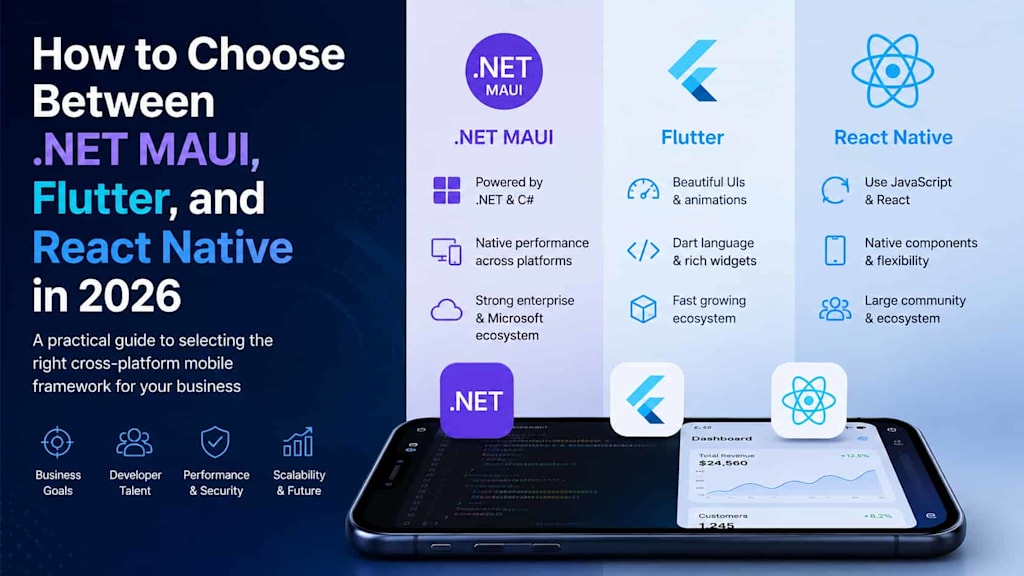
Cross-platform mobile development has become the standard approach for companies that want to deliver applications faster while controlling engineering costs. In 2026, three frameworks continue to dominate discussions among CTOs, startups, and enterprise development teams: Microsoft’s .NET MAUI, Google’s Flutter, and Meta’s React Native.
Each framework has matured significantly over the last few years, but choosing the right option is no longer just about performance benchmarks or UI flexibility. Businesses must now evaluate broader factors such as developer ecosystem stability, long-term maintenance costs, security requirements, AI integration capabilities, and global hiring availability.
The decision also depends heavily on current IT market trends, which show that companies increasingly prioritize unified development workflows, reusable codebases, and faster deployment cycles across mobile, desktop, and web environments.
Understanding the Core Differences Between .NET MAUI, Flutter, and React Native
Although all three technologies support cross-platform development, their architectures and development philosophies differ substantially.
.NET MAUI is the evolution of Xamarin and is deeply integrated into the Microsoft ecosystem. It allows developers to build Android, iOS, macOS, and Windows applications using C# and .NET. The framework is especially attractive for enterprises already relying on Microsoft technologies such as Azure, SQL Server, and ASP.NET Core.
Flutter uses the Dart programming language and renders its own UI engine rather than relying on native platform controls. This gives Flutter exceptional consistency across platforms and strong performance for visually rich applications.
React Native is based on JavaScript and React. It uses native components while enabling developers to share significant portions of code between platforms. React Native remains extremely popular due to the size of the JavaScript ecosystem and its large developer community.
The architectural differences influence:
- app startup speed;
- rendering performance;
- native hardware integration;
- maintainability;
- testing workflows;
- hiring strategies.
For example, Flutter often excels in highly customized interfaces and animation-heavy applications, while .NET MAUI performs strongly in enterprise environments with complex backend integration. React Native, meanwhile, remains attractive for teams already experienced with React web development.
Evaluating Business Goals and Product Requirements
Before selecting a framework, organizations should first define their product strategy rather than focusing only on technology popularity.
A startup building a consumer-focused social application may prioritize rapid iteration and UI flexibility. In such cases, Flutter or React Native may offer faster experimentation cycles.
A financial institution developing internal enterprise applications may lean toward .NET MAUI because of its compatibility with Microsoft infrastructure and existing C# development expertise.
The choice also depends on the expected lifespan of the product. Applications intended for long-term enterprise use often require predictable vendor support, stable release cycles, and enterprise-grade tooling. Microsoft’s ecosystem gives .NET MAUI strong credibility in that area.
Another important consideration is integration with emerging AI services and cloud infrastructure. Modern mobile applications increasingly depend on:
- AI-powered personalization;
- real-time analytics;
- edge computing;
- cloud synchronization;
- advanced identity management.
In 2026, market conditions and technology trends show growing demand for frameworks capable of integrating seamlessly with AI-driven backend services and scalable cloud-native environments.
Security requirements also play a major role in framework selection. Industries such as healthcare, fintech, and government services require strong authentication mechanisms, secure API communication, and device-level protection strategies. Many enterprises now incorporate zero trust principles for mobile apps into their development lifecycle to minimize security risks associated with distributed mobile environments.
Performance-sensitive applications require additional analysis. If an application depends heavily on graphics rendering, animation, or game-like interactions, Flutter’s rendering engine can provide smoother visual consistency. On the other hand, applications deeply integrated with native APIs may benefit from React Native or .NET MAUI.
Developer Availability and Hiring Challenges in 2026
Technical excellence alone does not guarantee project success. One of the most overlooked factors in framework selection is developer availability.
Global hiring patterns have shifted dramatically over the past several years. Companies increasingly evaluate regional talent maturity before committing to a specific technology stack.
For example:
- Eastern Europe has strong C# and .NET engineering communities;
- India maintains massive React Native and JavaScript talent pools;
- Flutter adoption is growing rapidly in Southeast Asia and Latin America.
These regional differences directly affect:
- hiring speed;
- salary expectations;
- outsourcing opportunities;
- onboarding costs;
- project scalability.
Organizations that already employ Microsoft engineers may find .NET MAUI significantly easier to adopt because internal teams can reuse existing C# expertise.
Understanding the main skills of .NET MAUI engineers is particularly important for enterprises considering migration from legacy Microsoft environments. Strong MAUI developers typically possess:
- advanced C# knowledge;
- experience with XAML interfaces;
- understanding of native mobile APIs;
- cloud integration expertise;
- familiarity with Azure services;
- cross-platform debugging experience.
Meanwhile, React Native developers often come from web development backgrounds and can transition more quickly between frontend web and mobile projects.
Flutter developers usually specialize more deeply in mobile UI architecture and custom rendering systems, which makes them valuable for design-intensive products.
Businesses should also evaluate the maturity of each framework’s ecosystem. React Native has one of the largest plugin ecosystems, but dependency fragmentation can occasionally create maintenance complexity. Flutter offers rapidly expanding tooling and excellent documentation, while .NET MAUI benefits from Microsoft’s long-term enterprise support strategy.
Performance, Scalability, and Long-Term Maintenance
Performance discussions around cross-platform frameworks have become more nuanced in 2026. The differences between frameworks are often less dramatic than they were several years ago.
Instead of asking which framework is “fastest,” organizations should ask:
- Which framework best supports our scaling strategy?
- Which ecosystem aligns with our engineering capabilities?
- Which platform minimizes technical debt over time?
Flutter’s rendering engine gives it a performance advantage in many graphics-heavy scenarios. Its consistency across platforms simplifies UI testing and reduces platform-specific design issues.
React Native continues improving through architectural modernization and better native bridging systems. It remains highly effective for content-driven applications and products requiring rapid feature deployment.
.NET MAUI benefits from tighter integration with native operating systems and strong desktop application support. Businesses seeking unified desktop and mobile experiences may find MAUI especially appealing.
Long-term maintenance costs are equally important. Many companies underestimate the operational burden associated with:
- dependency updates;
- plugin compatibility;
- platform-specific fixes;
- operating system changes;
- security patching.
A framework with strong corporate backing may offer better long-term stability. Microsoft, Google, and Meta all continue investing heavily in their ecosystems, but their priorities differ.
Microsoft positions .NET MAUI as part of its broader enterprise and cloud strategy. Google uses Flutter across multiple device categories, including mobile, web, embedded systems, and desktop environments. Meta focuses React Native primarily on product velocity and ecosystem flexibility.
Scalability also involves team organization. Larger engineering teams may prefer frameworks with clearer architectural standards and stronger tooling support. Smaller startups may prioritize developer productivity and rapid prototyping.
Which Framework Is the Best Choice in 2026?
There is no universally superior framework because the “best” choice depends entirely on business priorities, engineering culture, and product requirements.
Choose .NET MAUI if:
- your company already uses Microsoft technologies;
- enterprise integration is critical;
- you need desktop and mobile support together;
- your engineering team specializes in C#.
Choose Flutter if:
- UI consistency and visual quality are top priorities;
- your application depends heavily on animation or custom design;
- you want a rapidly growing ecosystem with strong cross-platform rendering.
Choose React Native if:
- your developers already work with React and JavaScript;
- fast iteration and web/mobile code sharing matter most;
- you need access to a massive open-source ecosystem.
The strongest strategy is usually not to follow hype cycles blindly. Many businesses make poor technology decisions by chasing short-term popularity instead of evaluating operational realities.
Successful framework adoption requires balancing:
- product goals;
- engineering capabilities;
- hiring conditions;
- ecosystem stability;
- long-term maintenance costs.
The companies achieving the best results in 2026 are those making framework decisions based on realistic business needs rather than marketing narratives.
Conclusion
Choosing between .NET MAUI, Flutter, and React Native in 2026 requires more than comparing feature lists. Each framework has evolved into a mature ecosystem capable of supporting enterprise-grade and consumer-facing applications.
The right decision depends on your company’s technical background, hiring strategy, scalability goals, and product vision. Businesses already invested in Microsoft infrastructure may gain substantial advantages from .NET MAUI. Companies prioritizing highly polished interfaces may benefit from Flutter, while organizations seeking flexibility and rapid development cycles may continue favoring React Native.
As cross-platform development becomes increasingly central to modern software strategy, organizations must evaluate not only technical performance but also ecosystem maturity, workforce availability, and long-term sustainability.
Companies that align framework selection with business objectives rather than temporary industry hype will be far better positioned for long-term success.
About the Creator
Markus Koch
I am a professional IT consultant with 5+ years of experience.
Enjoyed the story? Support the Creator.
Subscribe for free to receive all their stories in your feed.
Comments
There are no comments for this story
Be the first to respond and start the conversation.