
How to Apply Zero Trust Principles Across Web and Mobile Applications
A practical approach to securing modern applications with identity-first architecture and continuous verification

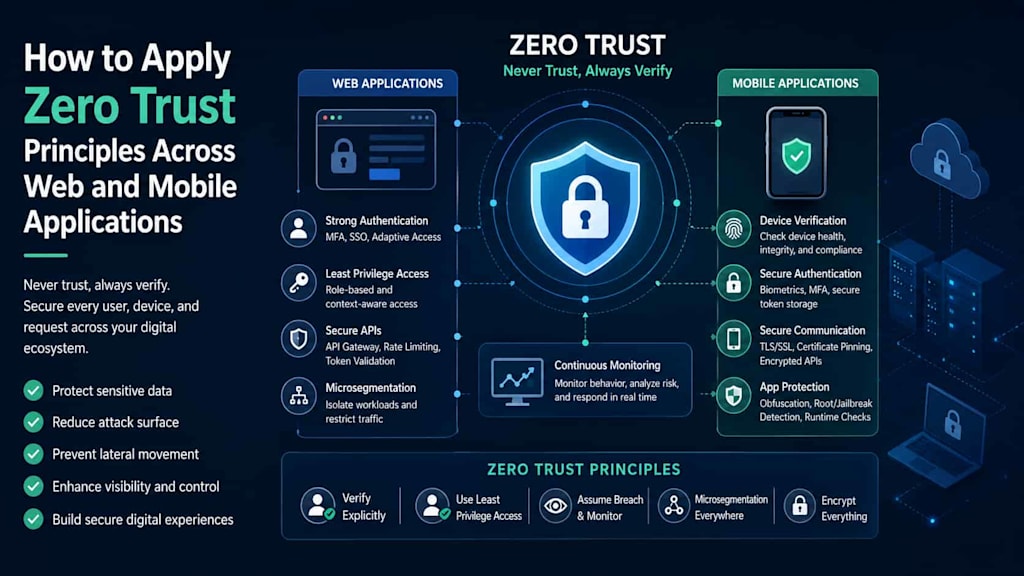
As businesses expand their digital ecosystems, traditional perimeter-based cybersecurity models are becoming increasingly ineffective. Employees access systems remotely, customers interact with applications from multiple devices, and cloud services distribute infrastructure across regions and providers. In this environment, assuming that internal networks are inherently safe creates serious security risks.
Zero Trust has emerged as one of the most important modern security frameworks for protecting applications, users, and infrastructure. Instead of trusting devices or users based on their location inside a network, Zero Trust assumes that every request could be malicious until verified. This principle fundamentally changes how organizations design, secure, and maintain web and mobile applications.
Modern development teams must now integrate identity validation, access segmentation, encryption, and continuous monitoring directly into application architecture. Security can no longer exist only at the network level. It must become a core component of the development lifecycle itself.
This article explores how organizations can apply Zero Trust principles across web and mobile environments, the technologies involved, the implementation challenges, and the operational benefits of adopting this security model.
Understanding the Core Principles of Zero Trust
Zero Trust is built around the concept of “never trust, always verify.” Every user, application, API, device, and network interaction requires authentication and authorization regardless of where the request originates.
Traditional security models relied heavily on perimeter defenses. Once users entered the network, they often gained broad access to internal systems. Modern distributed infrastructures make this approach increasingly dangerous because attackers who gain initial access can move laterally through poorly segmented environments.
Zero Trust minimizes this risk by enforcing several key principles:
- Continuous identity verification
- Least-privilege access control
- Device validation
- Microsegmentation
- Real-time monitoring
- Encryption of data in transit and at rest
- Context-aware access policies
These principles apply equally to internal employees, third-party vendors, customers, APIs, and automated systems.
For development teams, this means security considerations must influence architecture decisions from the beginning of the project lifecycle. The growing importance of zero trust in software development reflects a broader industry shift toward integrating security directly into engineering workflows rather than treating it as a separate operational layer.
Organizations must also understand how application architecture influences exposure risks. Different platforms, frameworks, and deployment models create unique attack surfaces that require tailored protection strategies.
A strong understanding of the fundamentals and types of software development becomes especially important when implementing Zero Trust because monolithic applications, microservices, cloud-native systems, and mobile ecosystems all introduce different authentication and authorization challenges.
Applying Zero Trust to Web Applications
Web applications are among the most common targets for cyberattacks because they expose services directly to users and external networks. Applying Zero Trust principles to web platforms requires moving beyond basic login systems and implementing layered verification mechanisms.
Identity and access management should form the foundation of the architecture. Multi-factor authentication (MFA), single sign-on (SSO), and adaptive authentication systems help ensure that users are continuously validated rather than trusted indefinitely after initial login.
Modern applications should also adopt least-privilege authorization policies. Users, APIs, and services should only receive the permissions necessary to perform their specific tasks. Excessive permissions remain one of the most common causes of privilege escalation attacks.
API security is another essential component. Since modern web applications rely heavily on APIs for frontend-backend communication and third-party integrations, these endpoints require strict protection measures such as:
- Token-based authentication
- Rate limiting
- API gateways
- OAuth 2.0 frameworks
- Request validation
- Behavioral monitoring
Encryption must also extend across all communication layers. HTTPS alone is no longer sufficient for advanced environments. Sensitive internal service communications should also use encrypted channels and certificate validation.
Microsegmentation strengthens web application security further by isolating workloads and services. Instead of allowing unrestricted communication between internal systems, Zero Trust architectures restrict interactions based on explicit policies.
Monitoring and analytics play a critical role as well. Zero Trust systems continuously evaluate user behavior, access patterns, and device activity to detect anomalies in real time. Suspicious sessions can trigger additional authentication requirements or automatic session termination.
Cloud-native infrastructures add another layer of complexity because applications often span multiple providers and distributed environments. Security teams must ensure consistent policy enforcement across containers, serverless services, databases, and orchestration systems.
Implementing Zero Trust in Mobile Applications
Mobile environments present unique security challenges because devices operate outside controlled corporate networks and frequently connect through unsecured public infrastructure.
A successful mobile security model starts with strong device verification. Applications should assess device integrity, operating system status, encryption settings, and security posture before granting access to sensitive resources.
Authentication systems for mobile applications should incorporate:
- Biometric authentication
- MFA support
- Secure token storage
- Session expiration policies
- Device binding techniques
Token management becomes especially important because improperly stored credentials create major exposure risks. Sensitive data should never be stored insecurely on the device itself.
Secure communication is another essential requirement. Mobile applications should use encrypted APIs, certificate pinning, and secure transport protocols to prevent interception attacks.
Application-level protections are equally critical. Attackers often target mobile apps through reverse engineering, code tampering, or malicious runtime modifications. Developers can reduce these risks through:
- Code obfuscation
- Runtime integrity checks
- Root and jailbreak detection
- Application shielding technologies
One of the most important best practices for mobile security involves minimizing trust assumptions about the device environment itself. Mobile applications should continuously validate user sessions and monitor for abnormal behavior patterns instead of relying solely on login credentials.
Organizations should also carefully manage third-party SDKs and dependencies. Many mobile security incidents originate from vulnerable or poorly maintained external libraries integrated into applications.
Mobile Zero Trust architectures must additionally account for BYOD (Bring Your Own Device) policies. Since employees often access enterprise systems through personal smartphones and tablets, organizations need secure access controls that protect corporate data without compromising user privacy.
Containerization and mobile application management (MAM) solutions can help separate business data from personal device environments while maintaining policy enforcement.
Creating a Practical Zero Trust Implementation Strategy
Implementing Zero Trust successfully requires more than simply deploying new security tools. Organizations need a phased implementation strategy aligned with infrastructure, workflows, and business priorities.
The first step is identifying critical assets and mapping data flows across systems. Security teams must understand:
- Which systems store sensitive information
- How users access applications
- Which APIs exchange data
- Where trust assumptions currently exist
This visibility helps organizations prioritize the highest-risk areas for initial protection efforts.
Identity management typically becomes the starting point for most Zero Trust initiatives. Centralized identity providers, MFA enforcement, and role-based access controls establish the core verification layer necessary for broader adoption.
Next, organizations often focus on segmentation. Internal networks and services should be divided into smaller security zones that restrict lateral movement opportunities for attackers.
Automation is increasingly important in modern Zero Trust deployments. Manual policy management becomes impractical across large cloud-native environments. Automated orchestration tools help maintain consistent enforcement across dynamic infrastructure.
Security monitoring also needs continuous improvement. Zero Trust environments generate large amounts of telemetry data from applications, APIs, endpoints, and identity systems. AI-driven analytics and behavioral detection tools help security teams identify suspicious activities more efficiently.
Organizations should also integrate security directly into CI/CD pipelines. Modern DevSecOps practices ensure that:
- Vulnerability scanning occurs automatically
- Secrets management remains secure
- Dependency risks are monitored continuously
- Security testing becomes part of deployment workflows
Executive alignment is another essential factor. Security transformations often require changes in user workflows, authentication processes, and operational procedures. Leadership support helps organizations maintain consistency during implementation.
For many enterprises, Zero Trust adoption also aligns with broader digital transformation strategy initiatives focused on cloud migration, remote work enablement, and modernization of legacy infrastructure.
Challenges Organizations Commonly Face
Although Zero Trust offers significant security advantages, implementation can become complex without careful planning.
Legacy systems often present major obstacles because older applications may lack modern authentication standards or API compatibility. Retrofitting Zero Trust controls into outdated environments can require substantial architectural changes.
User experience is another common concern. Excessive authentication prompts or overly restrictive policies may frustrate employees and customers if not designed thoughtfully. Successful Zero Trust systems balance strong security with usability.
Integration challenges also emerge in multi-cloud environments where organizations rely on multiple providers and third-party services. Maintaining consistent policy enforcement across distributed infrastructure requires careful coordination.
Cost and operational complexity can increase during the transition period as organizations adopt new identity systems, monitoring platforms, and access control tools.
Skills gaps present another challenge. Security teams need expertise in:
- Identity architecture
- Cloud security
- API protection
- Threat analytics
- DevSecOps workflows
Without sufficient training and governance, Zero Trust deployments may become fragmented or inconsistently enforced.
Despite these difficulties, many organizations view Zero Trust as a long-term investment in resilience rather than a short-term technology project.
Conclusion
Zero Trust has become one of the most important security models for modern web and mobile application ecosystems. As organizations continue adopting cloud infrastructure, remote work environments, and distributed architectures, traditional perimeter-based defenses no longer provide adequate protection.
By continuously verifying users, devices, and services, Zero Trust significantly reduces the risks associated with unauthorized access and lateral movement inside networks. Successful implementation requires a combination of identity management, least-privilege access control, encryption, monitoring, and application-level security practices.
For web applications, this means securing APIs, segmenting services, and enforcing strong authentication policies. For mobile platforms, it involves protecting devices, securing tokens, encrypting communications, and validating runtime integrity continuously.
The transition to Zero Trust can be technically and operationally challenging, especially for organizations with legacy infrastructure. However, companies that integrate security directly into development workflows and infrastructure design will be better prepared to handle the evolving cybersecurity landscape.
As digital ecosystems continue growing in complexity, Zero Trust principles will likely become a standard foundation for secure application development and operational resilience.
About the Creator
Markus Koch
I am a professional IT consultant with 5+ years of experience.
Enjoyed the story? Support the Creator.
Subscribe for free to receive all their stories in your feed.
Comments
There are no comments for this story
Be the first to respond and start the conversation.