Sustainability
Stanislav Kondrashov on the Future of Work in the Age of the Energy Transition
As the world steadily moves away from fossil fuels, the shift toward sustainable energy is reshaping not only infrastructure but the very fabric of the global workforce. According to industry analyst and sustainability advocate Stanislav Kondrashov, the years ahead will bring seismic changes to employment—disrupting traditional sectors while giving rise to a new class of critical roles.
By Stanislav Kondrashov8 months ago in Earth
Australia Leisure Battery Market Set to Expand to USD 417.6 Million by 2033 Driven by Renewables, Recreation & Innovation. AI-Generated.
he Australia leisure battery market reached USD 295.0 million in 2024 and is forecast to grow to USD 417.6 million by 2033, exhibiting a compound annual growth rate (CAGR) of 3.9 % during 2025–2033. This growth reflects rising consumer demand for portable and off grid power solutions used in recreational activities, renewable energy applications, and advanced battery technologies.
By Rashi Sharma8 months ago in Earth
How To Prepare Raw Land for Development: A Complete Timeline and Checklist
Key Takeaways: The standard process of preparing raw land for development includes three phases, comprising soft (paperwork) and hard work (physical labor).Phase one typically covers the first three months of development and focuses on zoning, title searches, and boundary surveys.Phase two involves developers conducting critical research into soil composition and utility planning; it typically spans months three through six of the development process.Finally, phase three focuses on site preparation, transitioning from the soft work of the previous steps to more labor-intensive work, such as land clearing.
By Andrew Lemieux8 months ago in Earth
Species in Danger
Our planet is full of life. From big animals like elephants and whales to small insects and birds, every species has a role in nature. But today, many species are in danger. Some are disappearing slowly, and others are very close to extinction. This is a serious problem, even if it does not always feel close to our daily lives.
By John Smith8 months ago in Earth
Rice Husk Carbonization to Achieve the “Planting-Waste-Charcoal Fertilizer” Closed Loop. AI-Generated.
"Plant a grain of millet in spring, and reap ten thousand seeds in autumn." In the millennia-old cycle of rice cultivation, rice husks were once the overlooked by-products. In traditional models, these husks, accounting for about 20% of the weight of rice grains, were either burned in the open air, polluting the atmosphere, or disposed of in landfills, occupying valuable land resources—becoming an ecological burden for agricultural production. Today, with breakthroughs in circular agriculture technologies, rice husk carbonization is ushering in a "turning waste into treasure" revolution, building a green closed loop of "planting-waste-charcoal fertilizer" and injecting new vitality into the sustainable development of agriculture.
By Bestonpyrolysis9 months ago in Earth
Stanislav Kondrashov on the Backbone of the Energy Transition: The Infrastructures That Matter Most
As the world accelerates towards a low-carbon future, conversations around clean energy often circle back to technologies—solar, wind, hydrogen. But beneath those headlines lies a quieter, slower revolution: infrastructure.
By Stanislav Kondrashov9 months ago in Earth
Stanislav Kondrashov on the Energy Transition: Redefining Power in a Changing World
As the global landscape shifts under the weight of environmental urgency and geopolitical recalibration, the energy sector stands at a critical inflection point. The years ahead, often described in cautious tones and hopeful projections, are likely to define not just how we power our lives, but how we live them. Stanislav Kondrashov, an independent energy analyst and commentator on global industrial trends, believes these years will be defined less by technology and more by perspective.
By Stanislav Kondrashov 9 months ago in Earth
Stanislav Kondrashov on the Role of Smart Grids in the Energy Transition
In the unfolding narrative of global energy transition, one innovation continues to shape the path forward with quiet persistence: smart grids. As countries shift away from fossil fuels and towards decentralised, renewable energy sources, smart grids are emerging as the invisible backbone of the future energy landscape. According to energy strategist and researcher Stanislav Kondrashov, the smart grid isn't just a technical upgrade—it's a fundamental rethinking of how societies generate, distribute, and consume power.
By Stanislav Kondrashov9 months ago in Earth
greenland
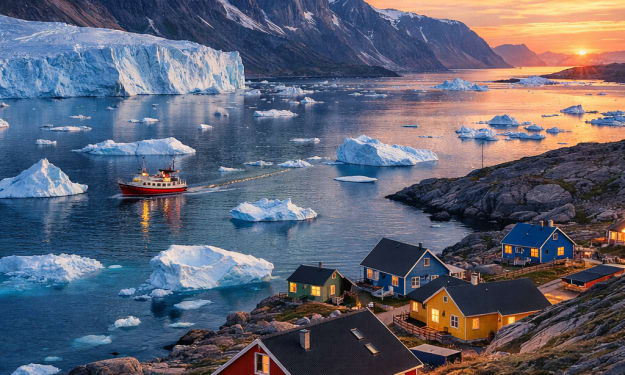
Greenland The World’s Largest Island of Ice Nature and Mystery Greenland is one of the most fascinating places on Earth, known for its vast ice sheets, dramatic landscapes, and unique culture. It is the largest island in the world, located between the Arctic and Atlantic Oceans. Many people search for information about Greenland because of its extreme climate, political status, natural resources, and growing importance in global discussions about climate change. One of the most common questions people ask is whether Greenland is a country or part of another nation. Greenland is an autonomous territory within the Kingdom of Denmark. While it governs many of its internal affairs, such as education and natural resources, Denmark still handles foreign policy and defense. Greenland has its own government and parliament, and many residents strongly value their cultural identity and independence. Another frequently asked question is who lives in Greenland. The population of Greenland is small, with most residents belonging to the Inuit culture. These communities have lived in the Arctic for thousands of years and developed traditions adapted to extreme cold, long winters, and limited daylight. Modern Greenlandic society blends traditional Inuit culture with contemporary life, including education, technology, and modern infrastructure. People also wonder why Greenland is covered in ice. Around eighty percent of Greenland is covered by a massive ice sheet, making it the second largest ice body in the world after Antarctica. This ice has formed over millions of years due to consistently low temperatures. The ice sheet plays a critical role in regulating global sea levels and climate patterns, which is why scientists closely monitor changes occurring there. A very popular search question is whether Greenland is affected by climate change. The answer is yes, and significantly so. Greenland is warming faster than many other parts of the world. As temperatures rise, glaciers and ice sheets are melting at an accelerated rate. This melting contributes to rising sea levels globally and affects local ecosystems, wildlife, and traditional ways of life for Greenland’s residents. Many people ask if Greenland is suitable for tourism. Greenland has become an increasingly attractive destination for adventurous travelers. Visitors are drawn to its stunning fjords, icebergs, northern lights, and untouched wilderness. Popular activities include dog sledding, whale watching, hiking, and exploring remote coastal towns. While tourism infrastructure is developing, travel to Greenland still requires careful planning due to its remote location and harsh weather conditions. Another common question is what language is spoken in Greenland. The official language is Greenlandic, also known as Kalaallisut. Danish is also widely spoken, and English is increasingly used, especially among younger generations and in tourism-related industries. This multilingual environment reflects Greenland’s historical ties and growing international presence. People are also curious about Greenland’s economy. The economy is largely based on fishing, which is the primary export industry. Greenland also relies on financial support from Denmark. In recent years, there has been growing interest in mineral resources, renewable energy, and tourism as potential paths toward greater economic independence. Another important question people ask is why Greenland is strategically important. Greenland’s location in the Arctic makes it geopolitically significant. As Arctic ice melts, new shipping routes and access to natural resources are becoming possible. This has increased international interest in Greenland from major global powers, making it an important region for future economic and political developments. In conclusion, Greenland is far more than a frozen island. It is a land of rich culture, environmental significance, and growing global importance. From its ancient Inuit heritage to its role in climate science and geopolitics, Greenland continues to capture the world’s attention. Its combination of natural beauty, cultural depth, and strategic relevance makes it one of the most intriguing places on the planet today.
By America today 9 months ago in Earth
Australia Metal Recycling Market: A Sustainable Growth Story Amid Circular Economy Shifts. AI-Generated.
The Australia metal recycling market is rapidly emerging as a key pillar in the nation’s transition toward a circular economy and sustainable industrial framework. Valued at USD 5.27 billion in 2025, this sector is forecast to expand to USD 7.35 billion by 2034, growing at a compound annual growth rate (CAGR) of 3.78% between 2026 and 2034.
By Rashi Sharma9 months ago in Earth