short story
Flower Moon 2025: How and When to See May’s Full Moon
On Monday, May 12, 2025, skywatchers around the world will be treated to the Flower Moon, May’s full moon, which will reach its peak illumination at 12:56 p.m. EDT (10:26 p.m. IST) . Although the peak occurs during daylight hours in India, the moon will appear full and bright on the nights of May 11 through May 13, offering ample opportunity for observation.
By Abjol Hussain Laskarabout a year ago in Earth
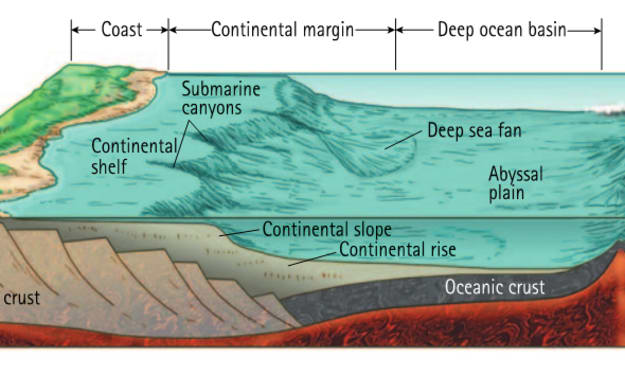
The Structure and Layers of the Ocean Floor
The ocean, covering over 70% of Earth’s surface, is a vast and mysterious realm. Beneath its surface lies the ocean floor—an intricate landscape that rivals the complexity of the continents. This underwater terrain is not flat or uniform, but composed of a variety of features shaped by geological processes over millions of years. Understanding the structure and layers of the ocean floor is crucial for marine science, geology, and environmental studies.
By Mubasshir Haque about a year ago in Earth
As gold prices soar, Americans rush to sell or melt down their jewelry—even family heirlooms from the 1800s
As gold prices soar, Americans rush to sell or melt down their jewelry—even family heirlooms from the 1800s **Americans Cash In as Gold Prices Soar: A Modern Gold Rush**
By GLOBAL NEWSabout a year ago in Earth
The Forgotten Map That Led Me to a Hidden World
Last summer, I stumbled upon something that changed my life forever—a tattered, hand-drawn map tucked inside an old book I bought from a dusty shop in Darjeeling. The shopkeeper, an elderly man with a weathered smile, handed me the book with a cryptic warning: “Some things are meant to be found, but not by everyone.” I didn’t think much of it at the time. I was just a restless 30-year-old looking for an escape from my mundane job as a graphic designer. But that map, with its faded ink and cryptic symbols, felt like a call to adventure. It led me on a journey deep into the Himalayas, where I discovered a hidden world that taught me the true meaning of connection, courage, and wonder.
By Ahmed Jubayerabout a year ago in Earth
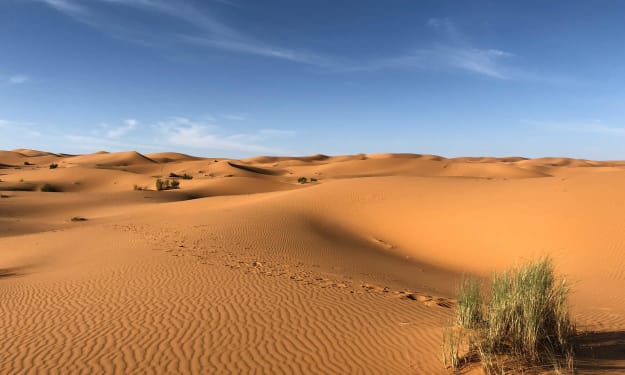
"The Earth's Spreading Desert"
More than one third of the earth's land is desert very hot, dry and difficult to live in. Today, the earth's, deserts are spreading and getting larger. In some countries, the farm land along the edges of the desert is turning into desert too. Why is it happening? What can be done to save productive land?
By its_ishfaq_ahmadabout a year ago in Earth
Kosmos 482: The Soviet Venus Probe Returning to Earth After 53 Years. AI-Generated.
Kosmos 482: The Soviet Venus Probe Returning to Earth After 53 Years On March 31, 1972, the Soviet Union launched Kosmos 482, a spacecraft intended to explore Venus. However, due to a malfunction, it failed to escape Earth's orbit and has been circling our planet ever since. Now, after 53 years, this relic of the Cold War space race is making headlines as it prepares to re-enter Earth's atmosphere. A Glimpse into the Past: The Venera Program Kosmos 482 was part of the Soviet Union's ambitious Venera program, which aimed to study Venus. Launched just four days after its twin, Venera 8, which successfully reached Venus, Kosmos 482 was designed to deliver a lander to the planet's surface. The spacecraft was built to withstand Venus's extreme conditions, including high temperatures and pressures. Unfortunately, a malfunction during the launch prevented Kosmos 482 from achieving the necessary velocity to break free from Earth's gravity. As a result, it was stranded in an elliptical orbit around our planet. In keeping with Soviet naming conventions, spacecraft that failed to leave Earth's orbit were designated as "Kosmos" missions, hence the name Kosmos 482. The Long Wait: Decades in Orbit Since 1972, Kosmos 482 has been orbiting Earth, a silent testament to the era of intense space exploration. Its descent module, weighing approximately 495 kilograms and encased in titanium, was built to endure the harsh conditions of Venus, making it remarkably resilient. This durability has allowed it to survive in space for over five decades. Over the years, parts of the spacecraft have re-entered Earth's atmosphere. Notably, in April 1972, four titanium spheres believed to be from Kosmos 482 landed in New Zealand, causing minor damage but no injuries. These incidents highlighted the potential risks associated with space debris. The Impending Re-entry: What to Expect As of May 10, 2025, Kosmos 482 is expected to re-enter Earth's atmosphere. Due to its robust construction, experts believe that parts of the spacecraft, particularly the descent module, may survive the fiery descent and reach the Earth's surface. The exact time and location of re-entry remain uncertain, with predictions ranging from the Gulf of Oman to Borneo. The spacecraft's parachute system is unlikely to function, potentially leading to a hard impact.
By MD Minhaj Uddin Shopnilabout a year ago in Earth