short story
The Resilience of Mother Earth
Deep in the guts of some wild, half-forgotten forest—honestly, the kind of place most people just wander past without a second thought—Mother Earth stretched herself awake. She didn’t look young anymore, not by a long shot. Ages old, carrying scars from storms and floods and fires that would’ve sent most things packing. Yet, she stuck around, stubborn as ever. This was her domain. Life thrummed in the weirdest places—cracked logs sprouting mushrooms no one had names for, rabbits pouncing around like they owned the joint, the wind talking smack to the leaves. Everything knit together, messy but tough, surviving ’cause that’s what nature does.
By Cotheeka Srijonabout a year ago in Earth
Guardians of Our Living Planet
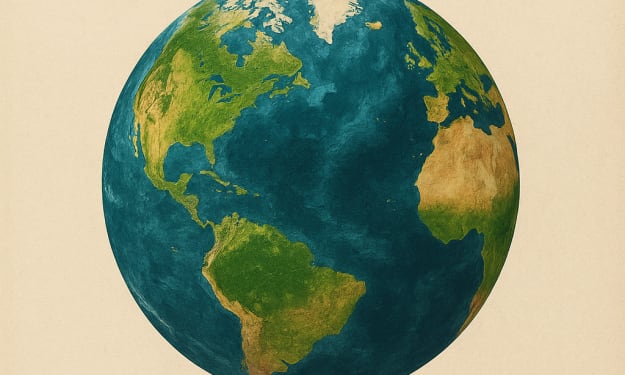
Earth—our vibrant, blue-green home—is a living planet teeming with life, ecosystems, and beauty beyond imagination. From lush rainforests and coral reefs to soaring mountain ranges and rolling savannas, every inch of our planet supports a delicate web of life. But today, our home is under threat like never before.
By Mukhtiar Ahmadabout a year ago in Earth
Ivory King Part 1. Content Warning.
Setting: Atka Island, Alaska, 1955 Caleb Hansen did not grow up like most kids. Born to a young couple in 1919 in Waco Texas, he was left at the local fire station when he was just a few months old. He would never know who or where his parents were. Upon being discovered by the firefighters, he was taken to a monastery because the chief, who was a devout catholic, believed that would be the best place for him. He stayed there until he was 11 years old before being taken to a children's shelter. The men complained that he refused to study would constantly run off into the nearby woods. They didn't want his behavior to have a negative impact on the other young boys.
By Stonecreekabout a year ago in Earth
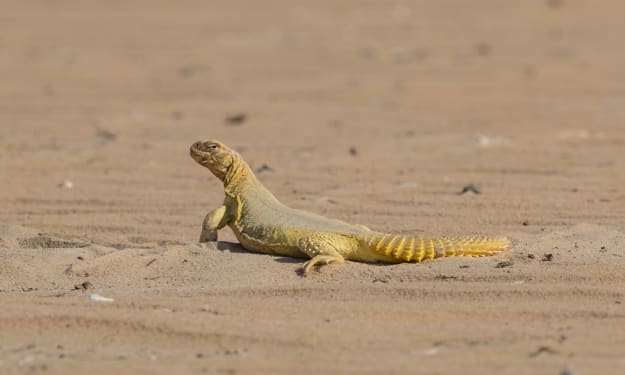
The Life Cycle of - Saara Hardwickii. AI-Generated.
Introduction Saara Hardwickii, commonly known as Hardwicke's spiny-tailed lizard or the Indian spiny-tailed lizard, is a unique reptile found in the arid and semi-arid regions of South Asia, particularly in India, Pakistan, and Afghanistan. This species is well-adapted to desert environments and is known for its distinctive spiny tail, which it uses for defense. Understanding its life cycle provides insight into its survival strategies in harsh conditions.
By Imtiaz Mahmud (Ratul)about a year ago in Earth
One Side of the Moon is Much Hotter Than the Other. AI-Generated.
One Side of the Moon is Much Hotter Than the Other The Science Behind the Moon’s Extreme Temperatures When you look up at the Moon, it seems like a calm, cold, and constant companion in the sky. But beyond its peaceful glow lies a startling truth: temperatures on the Moon vary wildly, and one side can be significantly hotter than the other. In fact, the surface of the Moon can go from boiling hot to freezing cold, depending on which side faces the Sun. This dramatic difference in temperature isn’t just interesting trivia—it’s a real challenge for scientists, space agencies, and future lunar explorers. So, why is one side of the Moon much hotter than the other? The answer lies in the Moon’s rotation, sunlight exposure, and lack of atmosphere. The Moon's Strange Day-Night Cycle To understand the Moon’s temperature differences, we first need to understand its rotation. Unlike Earth, which completes a full day every 24 hours, the Moon takes about 27.3 Earth days to rotate once on its axis. But because of its orbit around Earth, a full lunar "day"—from sunrise to sunrise—actually lasts about 29.5 Earth days. This means any given spot on the Moon experiences two weeks of continuous sunlight, followed by two weeks of complete darkness. That’s right—on the Moon, "daytime" lasts 14 Earth days, and "nighttime" lasts another 14. As a result, the side of the Moon facing the Sun during those two weeks becomes extremely hot, while the side in darkness becomes extremely cold. Tidal Locking and the Two Faces of the Moon The Moon is tidally locked with Earth. That means it always shows the same face—the near side—to us. The far side, often called the "dark side" of the Moon (though it gets just as much sunlight), always faces away. However, the temperature extremes are not caused by which side is facing Earth. Instead, they depend entirely on which side is facing the Sun during that two-week period. Still, there are some long-term average differences between the near and far sides. This is due to the Moon’s composition and surface features. Surface Differences: Why the Near Side Warms Up More If you compare the two sides of the Moon, they’re surprisingly different. The near side has large, dark plains known as maria—basaltic lava fields that formed from ancient volcanic activity. These darker surfaces absorb more sunlight and heat up more quickly. The far side is covered in lighter-colored highlands, which reflect more sunlight and don’t heat up as fast. This means the near side can be slightly hotter on average during the lunar day, simply because it absorbs more solar energy. Over time, this adds to the perceived difference between the two sides. The Role of Atmosphere—Or Lack of It Here on Earth, our atmosphere acts like a protective blanket. It helps: Distribute heat between the day and night sides Trap warmth during the night Protect us from the Sun’s radiation The Moon, however, has no significant atmosphere. That means it cannot hold heat once the Sun goes down, and it has no way to regulate surface temperature. As a result: Lunar daytime temperatures can soar to 127°C (260°F) Lunar nighttime temperatures can drop to -173°C (-280°F) This makes the Moon one of the most extreme environments in our solar system. Why This Matters for Lunar Missions These temperature swings aren’t just academic—they have real-world impacts on space missions. Satellites, rovers, landers, and future Moon bases need to survive both the scorching lunar day and the freezing lunar night. That requires: Special materials that can withstand high and low temperatures Thermal insulation systems Energy sources (like solar panels and batteries) that can work through the dark, cold weeks This is one reason many space agencies, including NASA’s Artemis program, are targeting the Moon’s poles for exploration. In these regions, some areas receive nearly constant sunlight, while others—especially within deep craters—may contain permanently shadowed ice. These polar regions offer a more stable temperature range and access to potential water sources—two key factors for building sustainable lunar habitats. Final Thoughts: A Harsh, Beautiful Neighbor The Moon may appear still and quiet, but it’s a world of extremes. With two-week-long days and nights, no air to hold warmth, and huge differences in terrain, the lunar surface challenges every assumption we have about planetary life. While no side of the Moon is always hot or cold, whichever side faces the Sun becomes blistering hot, and the side in darkness turns deathly cold. On average, due to surface composition, the near side does tend to absorb more heat—but both sides are equally extreme depending on the time of the lunar cycle. As we prepare to return to the Moon, these details are more important than ever. Every mission must be carefully planned, every structure thoughtfully engineered, to survive in one of the most extreme environments we've ever attempted to call home. So next time you look up at the Moon, remember—beneath its calm glow lies a harsh, complex world, full of secrets still waiting to be uncovered.
By Pranto Ahmedabout a year ago in Earth
Scientists Discover Thousands of Hidden Planet-Forming Disks at the Milky Way’s Center. AI-Generated.
Scientists Discover Thousands of Hidden Planet-Forming Disks at the Milky Way’s Center In a landmark astronomical breakthrough, scientists have uncovered thousands of previously hidden planet-forming disks in the very heart of our galaxy. This discovery is transforming what we know about how planets form—and where. Using advanced observational technology, astronomers have detected over 3,000 protoplanetary disks in the center of the Milky Way. These disks, often referred to as “proplyds,” are swirling clouds of gas and dust that encircle newly born stars. Over millions of years, the material in these disks can clump together and form planets, moons, and other celestial bodies. Until now, scientists believed that such fragile formations couldn’t survive the extreme conditions at the galaxy’s core. A Harsh Galactic Neighborhood The center of the Milky Way is a chaotic and violent environment. It is dominated by a supermassive black hole known as Sagittarius A*, surrounded by intensely packed stars, massive gravitational forces, and high-energy radiation. For decades, astronomers assumed this region was too unstable and harsh for the delicate process of planet formation. Yet the recent observations, conducted using the Atacama Large Millimeter/submillimeter Array (ALMA) in Chile, have turned that assumption on its head. ALMA’s powerful radio antennas allowed scientists to peer through the thick dust clouds that block visible light from reaching telescopes. By observing millimeter-wavelength radiation, which can pass through the dense interstellar material, researchers uncovered a hidden population of planet-forming disks. “The discovery of these disks was completely unexpected,” said Dr. Maya Rodríguez, an astrophysicist at the University of California and co-leader of the study. “We didn’t think the galactic center had the right conditions to support early planetary development, but these observations prove otherwise.” The Role of ALMA in the Discovery ALMA, located high in the Chilean Andes, is one of the world’s most advanced observatories for studying cold, dusty regions of space where stars and planets form. Its ability to detect the faint thermal glow of dust in protoplanetary disks makes it uniquely suited to this kind of research. By focusing on a small portion of the galactic center, the team identified thousands of these disks, many of which appear similar to those seen in calmer regions of the galaxy, such as the Orion Nebula or the Taurus Molecular Cloud. This suggests that planet formation is not limited to peaceful stellar nurseries. Some of the disks found near the galactic core are orbiting massive stars that produce strong ultraviolet radiation and stellar winds—forces that could easily strip material from a developing disk. That these disks still exist, and appear stable, points to a surprising level of resilience in the early stages of planetary evolution. Implications for Planetary Science This discovery has major implications for our understanding of how and where planets can form. Previously, scientists believed that strong radiation and gravitational turbulence would disrupt the formation of disks around young stars. The presence of thousands of such disks in this extreme environment challenges that theory. “If planets can begin to form here, then the process may be much more widespread and robust than we thought,” said Dr. Rodríguez. “It raises the possibility that planetary systems are forming throughout the galaxy, even in regions we previously considered too chaotic.” This could also change estimates of how many planetary systems exist in the Milky Way. If even the galactic center is home to such activity, the number of planets in our galaxy could be significantly higher than current models suggest. Are These Disks Cradles of Life? While it is far too early to tell whether any of the disks in the galactic center will eventually form habitable planets, the discovery does open exciting new lines of inquiry. Could some of these systems evolve in ways that support life, even in such a hostile environment? Conditions near Sagittarius A* are extreme, and radiation levels are high. However, scientists believe that with the right atmospheric protection and magnetic fields, some planets in these disks could potentially support life, or at least the ingredients necessary for it. Looking Ahead This discovery is just the beginning. Astronomers hope to use next-generation instruments such as the James Webb Space Telescope (JWST) and future ground-based observatories to study these disks in more detail. They aim to analyze the chemical compositions of the disks, track their evolution over time, and determine whether planet formation is already underway within them. In the grand quest to understand how our own solar system came to be, and how common such systems might be in the cosmos, the galactic center may now serve as a new frontier. What once seemed an unlikely nursery for planets has revealed itself to be a hidden cradle of creation—reminding us that the universe still holds many secrets, waiting to be uncovered.
By Pranto Ahmedabout a year ago in Earth
The Shift Finale. Content Warning.
Setting: Central California, 2020 Since going on her first hunt with Chase a few years ago, Laura did whatever she could to develop her skills as a hunter. She continued to hunt alongside Chase and learned as much as she could from her. During her junior year of college, Chase helped Laura get her hunting license so she could start hunting for herself. After getting her license, Laura bought herself a compound bow. She believed that a bow and arrow was a more honorable weapon choice compared to a firearm.
By Stonecreekabout a year ago in Earth
The Shift Part 2. Content Warning.
Setting: Northern California, 2017 Laura's sophomore year of college had finally come to an end. Her first couple years of college were tough, especially since changed her major before she started. All throughout her high school career, she had prepared herself to go into the psychology field in order to be a therapist. But after her encounter with Chase a couple years ago, her interest in humane farming practices became her priority. Now she has since turned her focus on biology with a minor in nutrition. Compelled both by Chase's words and her own desire to be as healthy as possible.
By Stonecreekabout a year ago in Earth
The Shift Part 1. Content Warning.
Central California, 2015 Laura Bennett, a high school senior, returns home after a long day of planning the upcoming spirit week. After a full day of school and dealing with the planning committee, she wanted nothing more than to go home and rest. Especially since it was Friday and she had told her friends that she would join them for a bonfire on the beach this weekend. But her hopes of a quiet, relaxing evening were dashed as soon as she stepped into the foyer. Martin, her father and owner of a large vineyard, was yelling and cursing upon the news of feral hogs destroying a third of his newly planted grapes. When she heard all the commotion her father was making, she went to him and was informed of what happened. Now feral hogs were not a new problem for Martin and the vineyard. In fact this was something he had been dealing with ever since he bought the vineyard 9 years ago. But this time he had 2 new problems that he had never faced before.
By Stonecreekabout a year ago in Earth
Scientists detect signature of life on a distant planet
In a groundbreaking discovery that would redefine humanitys knowledge of the universe, scientists have detected what seems to be the signature of existence on a far off exoplanet. Using current area telescopes and spectrometry techniques, a group of global researchers found atmospheric markers that strongly endorse the presence of organic activity.
By Prottasha Alamabout a year ago in Earth