Science
White shirt, green pear
For years, I was afraid to wear a plain white shirt because of a woman. It all starts with a movie. Can not remember what kind of a movie, only remember the play as a devolved educated young actor fell in love with the mayor's daughter, and unexpectedly, but was strongly opposed by the stubborn mayor. Helpless two people had to every moonlight hazy, ran to the village outside the river secretly meet. Say, every day in the river side, and that night, the heroine did not appear, the male protagonist against the wind of the countryside melancholy, he wore a white shirt, and the shirt in the trouser mouth, a hand fork in the waist, that posture, is still my heart's immortal idol!
By Randall Raisch3 years ago in Earth
Missing Titanic
The Missing Titanic Sub Search Continues as Oxygen Runs Out Deep in the vast expanse of the Atlantic Ocean, a high-stakes search operation was underway. The goal: to locate and retrieve a long-lost relic of history—the submersible that had ventured into the depths to explore the wreckage of the infamous RMS Titanic. Months had passed since the sub went missing, and hope was dwindling as oxygen reserves aboard the search vessel were rapidly depleting.
By Deepeshwar Dwivedi3 years ago in Earth
The Shape of Dreams. Content Warning.
Dreaming in Virtual Reality: The Future of Dream Shapes Introduction : Virtual reality (VR) technology has advanced significantly in recent years, offering immersive and interactive experiences. While primarily used for gaming and entertainment, there is growing interest in exploring its potential for enhancing dream experiences. This article delves into the concept of dreaming in virtual reality and how it could shape the future of dream experiences. By combining the power of virtual reality with the limitless possibilities of dreams, researchers and developers are uncovering exciting new avenues for exploring the shape and nature of our dreamscapes.
By Swapnil Patel3 years ago in Earth
How long you live in other planets?
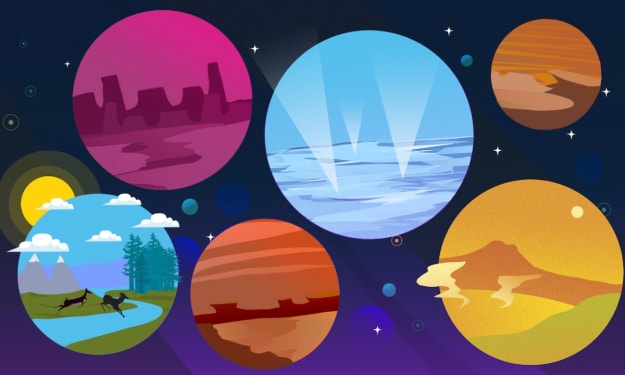
If you went to Mercury, you'd notice that it's really close to the sun. It's actually the closest planet to the sun and the smallest one too. But even though it's close, it's not the hottest planet. Venus is hotter! It takes Mercury 88 days to orbit the sun, which is more than three months. During the day, it's really hot on Mercury, with temperatures over 800 degrees Fahrenheit! But at night, it gets really cold, like negative 300 degrees Fahrenheit. That's because Mercury doesn't have an atmosphere to hold in the heat. It's like a desert, which is why there's no moisture, clouds, or rain. If you could somehow stay in between the hot and cold parts of the planet, you could survive. But there's no oxygen in Mercury's atmosphere, so you can only hold your breath for so long. Plus, there are plasma tornadoes from the sun that create a magnetic field. Venus is even hotter than Mercury, with temperatures almost reaching 1,000 degrees! But the gravity is similar to Earth's, so you could walk around and go jogging. However, the extreme heat and pressure would crush you like a can. Mars is called the red planet, but it's actually really cold. It takes almost two years to orbit the sun and has 25 hours in a day, just like Earth. The atmosphere is thin and unbreathable, with lots of dust storms and carbon dioxide on the polar caps. You wouldn't freeze, but you'd need some thick clothes to survive.
By Julio Javier3 years ago in Earth
The Black Hole
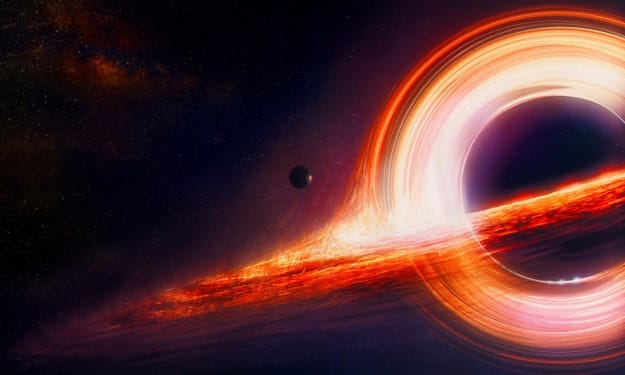
A black hole is a space zone that possesses immense gravitational force. This force is so strong that nothing, including light or other forms of electromagnetic waves, possesses adequate energy to break free from it. According to the theory of general relativity, a sufficiently condensed mass can distort spacetime to create a black hole. The event horizon is the boundary from which no escape is possible. Despite its significant influence on the destiny and circumstances of any matter that crosses it, the event horizon has no locally detectable features according to general relativity. In several aspects, a black hole functions like an ideal black body since it does not reflect any light. Additionally, quantum field theory in curved spacetime predicts that event horizons radiate Hawking radiation, with a similar spectrum as a black body of a temperature inversely proportional to its mass. This temperature is approximately a few billionths of a kelvin for stellar black holes, making it almost impossible to observe directly.
By Julio Javier3 years ago in Earth
How High Jumping on Different Planets?
Gravity is responsible for keeping our feet firmly planted on the ground. This is why the average person can only jump about one and a half feet straight up. However, if we were to live on another planet, such as Venus or Saturn, we would face a variety of difficulties. Let's take a look at Mercury first, as it is the closest planet to the sun. The gravity on Mercury is less than half of that on Earth, allowing you to jump about four feet high. However, the temperatures on the sunny side are scorching, reaching 800 degrees, making it feel like standing neck-deep in dark red lava on the slopes of a volcano. The night brings little respite, as the scorching air quickly chills to minus 280 degrees. Furthermore, a day on Mercury lasts 176 Earth days. If we were to hop from this inhospitable place to an even less welcoming planet like Venus, we would see Earth from there, if not for the whirling mass of clouds above. These clouds create a monstrous greenhouse effect as well as immense atmospheric pressure. If you were to jump on Venus, you would only make it just shy of 1.7 feet high because the mass and size of Earth and Venus are almost similar, with Venus being slightly smaller. Besides the constant temperature of a blazing furnace, rain on Venus wouldn't bring relief as the clouds up there are made of sulfuric acid. Skipping our home planet, let's go straight to its moon, Luna. Here, gravity is less than a fifth of that on Earth, allowing you to jump almost nine feet in the air and not touch the ground again for several seconds. It's hard to believe that this desolate piece of space rock impacts the tides on Earth. If you were to stay on the moon long enough, a couple million years, you would see how much further it's gone from our home planet. Moving on, our next destination is Mars, the red planet.
By Julio Javier3 years ago in Earth
Discovery of "Pisodonophis kalinga"
The Zoological Survey of India (ZSI) recently made an exciting discovery in the waters of Odisha's Ganjam district. A team of dedicated scientists from ZSI embarked on an expedition to explore the marine biodiversity of the region, and their efforts yielded an astonishing result. During their underwater exploration, the scientists stumbled upon a previously unknown species of eel, which has now been officially named Pisodonophis kalinga.
By Pravin Avhad3 years ago in Earth
Discovery of "Gomphonema rajaguruii", May 30, 2023
Researchers at the Agharkar Research Institute (ARI) in Pune have made an exciting discovery in the field of diatoms. A new species of diatom, named Gomphonema rajaguruii, was found in a semi-aquatic environment along the wet walls of Maharashtra’s picturesque hill station, Mahabaleshwar.
By Pravin Avhad3 years ago in Earth
The crises of the ice
In the frozen expanse of the Arctic, where the ice and snow merged into a world of dazzling white, a heartbreaking tale unfolded. It was a story of a mother polar bear named Aurora and her two precious cubs, Blizzard and Frost. They were a family bound by love and survival, navigating the ever-changing landscape of a rapidly melting Arctic.
By Gibson Amaechi3 years ago in Earth
I'll tell you about drinks besides coffee that can make you dehydrated during a heat wave.
As a result of temperatures reaching up to 30 degrees Celsius in many regions of the globe, many of us are finding it difficult to maintain our body temperature, both during the day and at night. There is a lot of emphasis placed on the things that you should be doing, such as consuming a lot of water to ensure that you remain hydrated and making use of creative techniques to ensure that you remain cool.
By Jacob Damian3 years ago in Earth
Lunar Communication and Navigation
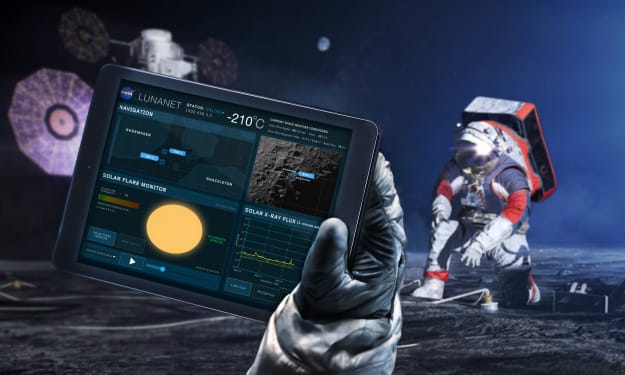
As we embark on lunar missions, establishing reliable communication and navigation systems becomes crucial for the success of robotic and human exploration on the moon. The challenges of operating in the lunar environment necessitate advanced technologies for data transmission, establishing communication networks, and precise navigation. In this article, we will delve into the technologies and systems used for lunar communication and navigation, highlighting their importance for successful lunar missions.
By Nankyep Goldun Petong3 years ago in Earth