Science
Catalysts of Change:
In the heart of a bustling city, a small community named Brooksville was facing a myriad of challenges. Unemployment rates were high, infrastructure was outdated, and the education system was struggling to provide quality learning opportunities. However, within this community, a group of passionate individuals emerged as true catalysts of change.
By Daniel Awine3 years ago in Earth
"Harvesting hope a journey into climate-resilient agriculture". Content Warning.
In the heart of a once-fertile valley, nestled between rolling hills and embraced by a tranquil river, lived Sarah Mitchell, a young farmer determined to change the course of her family's struggling farm. The changing climate had cast a shadow over their once-thriving land, leaving them grappling with unpredictable weather patterns, eroding soil, and diminishing yields. But Sarah's unwavering spirit and a deep connection to her roots led her on a journey to discover the power of climate-resilient agriculture.
By Shabih Ali3 years ago in Earth
The Crucial Role of Ecotourism in Environmental Conservation
Ecotourism has become a symbol of hope for the environment and the travel industry in a world dealing with the grave effects of climate change and loss of habitat. ecotourism is defined by ethical and responsible travel to natural regions. In addition to rich experiences the visitors enjoy, it is essential for preserving and safeguarding the environment. This article explores the crucial part ecotourism plays in protecting our priceless natural environments.
By Yateen Jakati 3 years ago in Earth
The Other Route of Waste Water
In 2003, Singapore’s national water agency launched an unprecedented program. Using two new facilities, they planned to provide more than 50% of their nation’s water supply by recycling wastewater. And yes, we do mean that wastewater.
By Jilliane Fernandez3 years ago in Earth
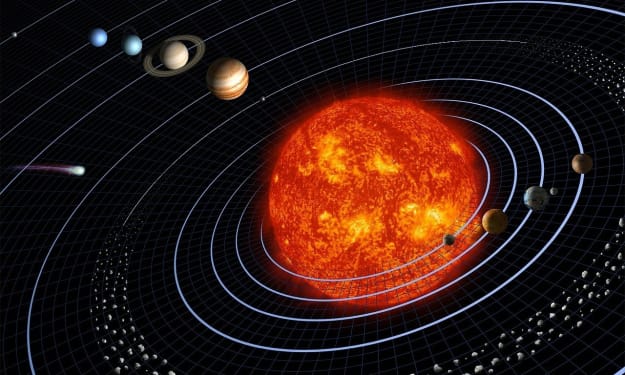
A "WALL" is found at the Edge of our Solar System
In the previous century, we've learned mind-boggling sums about our nearby planet group However, what do you think lies at the very edge of haziness—the entryway to another aspect? Perhaps when does our nearby planet group converge into different pieces of the universe unaffected by the Sun in the middle? Now, after quite a while of sending tests into space, we're at long last starting to find a few solutions We should discuss the design of our planetary group the inward piece of our nearby planet group, first of all, is genuinely and surely known because, well, our planet exists in it; there's the Sun at the middle, a planet that circles billions of space rocks and comets are held in gravity and masses of gas and residue twirl around near the Sun. Our four rough planets Mercury Venus Earth and Mars Past Mars is space for another planet and a material present that might have shaped into one if not for the monstrous gas monster Jupiter that comes next Following Jupiter comes Saturn another gas planet and afterward, pick more modest, colder gas planets Uranus in Neptune: Past Neptune, things are more scattered with a lower gravitational draw from the Sun; billions of clusters of rock and ice are in circles, never themselves framed into planets; the belt of comets farther than Neptune is known as the Kuiper belt; and the colossal air pocket of materials around the nearby planet group is known as the Oort cloud, now at the focal point of the nearby planet group around which all the other things circle. The Sun applies its impact to the furthest reaches with the two forces of gravity, and the particles produce these charged particles far out into space from the Sun every which way, making a circle around it called the heliosphere. This connects around eleven billion miles, where the distance is identical to multiple times the separation from the Sun to the Earth. The further these particles go, the less energy they have, and at the edge of the nearby planet group, the energy of uncharged hydrogen iotas in interstellar space stands up against those discharged by the Sun, and this limit is known as the hello limit. Leo Paz: It's accepted that here there is a development of hydrogen molecules from interstellar space, and this undetectable wall dissipates approaching bright lights. With the tremendous distances required, there have only been two spacecraft that have gone through the heliopause: Explorer 1 in 2012 and Void in 2018. It was from these space apparatus that we originally got confirmation that the edge of the nearby planet group existed where it was and regardless of whether it extends and contracts yet later tests have shown us much more about the new Skylines space apparatus which as of late directed a flyby past Pluto and the Kuiper belt utilized as Alice UV spectrometer to take readings of the heliosphere somewhere in the range of 2007 and 2017 it identified a bright sparkle on the limit where the sun oriented particles hit the hydrogen iotas past and this is known as the Lyman-alpha line this gleam can be seen across the whole planetary group yet it's more extraordinary at the edge of the planetary group did elsewhere anyway the hypothesis and understanding behind this peculiarity isn't seen at this point. So New Skylines will keep on gathering information two times per year as an excursions more profound into space in the long run it won't itself cross the limit conceivably in no less than 15 years and with the new innovation on board it can assist us with revealing more data about this secretive locale and as it is such a long ways out it appears to be a botched an open door to send a test to investigate the external edge without first visiting other neglected regions inside the planetary group the Explorer tests just arrived at an edge since they keep flying after the mission finished and New Skylines is just barely expected to stay functional when it arrives at it since the disclosure of the boundary there are currently requires a particular mechanical test to make the excursion on the off chance that the proposition is acknowledged it ought to have the option to arrive at the edge multiple times quicker than the explorers and could arrive at his objective in under decade heading out to a distance of 90 billion miles from the Sun. It will want to investigate the district and afterward send back the information to respond to probably the greatest inquiries that remain unanswered about the planetary group. Every time another test is conducted to investigate the planetary group, something different is found that provokes the curiosity of specialists considerably further. The puzzling limit between our sun's impact and interstellar space truly is as yet unclear, yet the new skylines and future stars will truly draw us a ton closer to a superior comprehension.
By Cyril Lord3 years ago in Earth
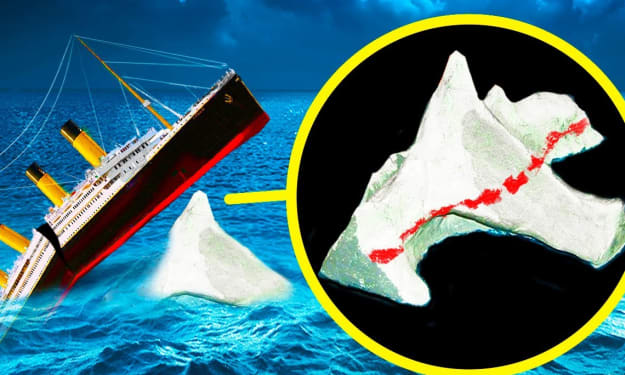
Biggest Secret of the Titanic Iceberg
A monstrous white shape is caught in the light beam as the faithful iceberg is about to rend the side of the legendary ship. The Titanic is silently making its way through the waves with its passengers asleep when suddenly a beam of electric light appears here in the darkness over the calm waters of the Atlantic Ocean.
By Henry Iroanyah3 years ago in Earth
5 Mind-Blowing Scientific Discoveries: Prepare to Be Amazed! 🚀
Hey there, fellow science enthusiasts! Have you ever wondered about the incredible world of scientific discoveries? Well, get ready for a fascinating journey as we explore five jaw-dropping revelations that will make your mind spin! 🤯 1. The Quantum Enigma 🌌 The realm of quantum physics has led us into a bizarre and mind-bending universe at the smallest scales imaginable. Imagine particles that can be in two places simultaneously or exist in multiple states at once! Wave-Particle Duality: Tiny particles like electrons can behave as both particles and waves, depending on how we observe them. It's like they have a secret life we can only glimpse. Quantum Entanglement: This phenomenon allows particles to instantaneously influence each other's properties, even if they're light-years apart. It's as if they're connected by an invisible thread. Quantum physics is like the wild west of science, challenging our understanding of reality and introducing us to a world where the rules we know don't always apply. 2. The Expanding Cosmos 🌠 Hold onto your cosmic hats because the universe is not only vast but also expanding! This discovery has revolutionized our perception of the cosmos. The Big Bang Theory: Scientists have uncovered evidence that the universe began as an incredibly hot and dense point and has been expanding ever since. It's like the ultimate cosmic fireworks show! Dark Energy and Dark Matter: Mysterious forces, known as dark energy and dark matter, make up about 95% of the universe's total mass-energy content. They're responsible for driving the universe's expansion. Imagine, most of the universe is made of things we can't even see! The universe is like an ever-inflating balloon, and we're riding along, trying to fathom the forces propelling its growth. 3. DNA: The Blueprint of Life 🧬 When it comes to scientific discoveries, the revelation of the DNA double helix structure is a monumental moment. It's the code of life itself! DNA's Structure: In 1953, James Watson and Francis Crick unlocked the structure of DNA, revealing how it carries genetic information. It's like the intricate recipe that defines each living creature. Genome Sequencing: Today, we can read and manipulate the DNA code, leading to a deeper understanding of diseases, evolution, and the essence of life. DNA is like the ancient manuscript of life, written in a language that scientists strive to decode and understand. 4. The Higgs Boson: The God Particle 🌟 Have you heard of the Higgs Boson? This scientific discovery has had a profound impact on particle physics. The Higgs Field: Scientists have found evidence of the Higgs field, a mysterious force responsible for giving particles mass. It's like the cosmic glue that holds the universe together. Large Hadron Collider: This colossal particle accelerator played a crucial role in detecting the Higgs Boson. It's akin to a real-life time machine, allowing us to explore the universe's early moments. The Higgs Boson is like the VIP of the particle world, providing insights into the fundamental forces that govern our existence. 5. Gravitational Waves: Ripples in the Cosmic Pond 🌊 Imagine the universe as a vast cosmic pond. When significant events occur, they send ripples through space-time. This is the essence of gravitational waves. Einstein's Prediction: Albert Einstein predicted these waves in 1915, and it wasn't until 2015 that scientists detected them. It's like eavesdropping on the universe's deepest secrets. LIGO and Virgo Collaborations: The Laser Interferometer Gravitational-Wave Observatory (LIGO) and the Virgo Collaboration act as cosmic microphones, listening for the faintest cosmic whispers. Gravitational waves are like cosmic echoes, revealing the most dramatic and powerful events in the universe. Conclusion: Keep Exploring 🚀 The world of scientific discoveries is an awe-inspiring adventure, uncovering concepts that challenge our understanding of reality. From the perplexities of quantum physics to the vastness of the expanding universe, each revelation adds another layer to our comprehension of the cosmos. So, fellow explorers of the unknown, keep your gaze fixed on the stars, your microscopes at the ready, and your inquisitiveness alive. Who knows what astounding discoveries await us on our cosmic journey? 🌌🔭🧬 Science is an ongoing treasure hunt, and every discovery is a nugget of gold, bringing us closer to unveiling the universe's greatest mysteries. So, embrace the curiosity, for the adventure has only just begun! 🌟🚀🔬
By Ismail errahili 3 years ago in Earth
Echoes of Endurance
In the quaint town of Harmonyville, nestled between rolling hills and babbling brooks, lived Sarah, a vibrant and spirited woman who had weathered the storm of the COVID-19 pandemic. Her journey, like many others, had taken an unexpected turn as she faced the mysterious and lingering effects of a virus that had upended lives worldwide.
By David Ojukwu3 years ago in Earth
The deadly sprint to the south pole!
Everyone in this picture died shortly after it was taken. These are British explorers standing at the South Pole in January 1912. The image marks the finish line of the race into the unknown. Two teams, one British and one Norwegian, trekked 900 miles into brutal territory and had to return to safety before winter arrived. And at first glance it looks like a British triumph. Except it's the Norwegian flag. And it only gets worse from here. Robert Falcon Scott was a meticulous planner. And his dream was to be the first person to reach the South Pole.
By Shubham Bajaj3 years ago in Earth
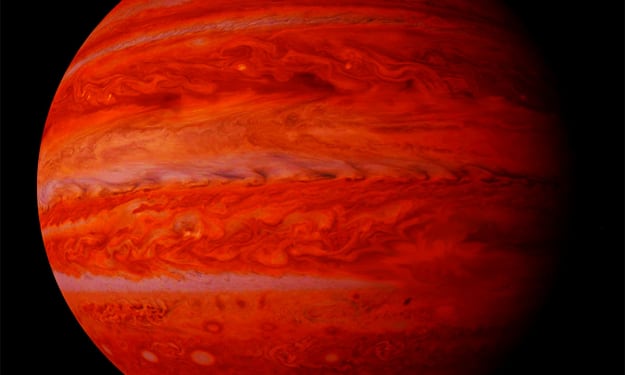
How Saturn, a Failed Star, Continues to Enchant Us with Its Dazzling Presence
This celestial body is frequently referred to as The Solar System's Gem, likely due to its mesmerizing beauty and captivatingly exotic appearance accentuated by its vibrant encircling rings. It's evident that the subject of discussion here is Saturn – the solar system's second-largest planet. The inquiry at hand revolves around whether Saturn could be categorized as an unsuccessful star. In the context of a failed star, its constitution comprises gaseous elements, yet it lacks the capacity to sustain the thermonuclear fusion reactions in its core, owing to its insufficient mass. This particular classification of a star often goes by the term "brown dwarf." These cosmic entities share a proximate size with Jupiter, the largest planet within our solar system. However, it's important to note that brown dwarfs possess notably greater mass.
By Janelle Daley3 years ago in Earth
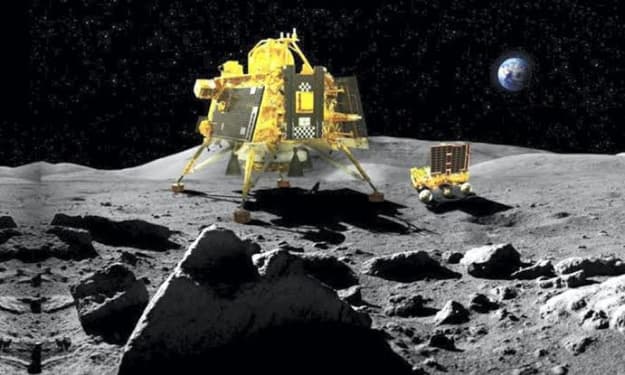
India makes history!
On October 22, 2008, India launched the Chandrayaan-1 mission. This spacecraft successfully reached the Moon and made a groundbreaking discovery. The discovery of water on the Moon made headlines worldwide. Chandrayaan-1 provided strong evidence for the presence of water, specifically in the South Pole area of the Moon. This news sparked a renewed interest in lunar exploration across the globe. The USA and China regularly send missions to the Moon, and Israel attempted a soft landing. Additionally, Japan, Europe, and Russia have planned numerous lunar missions. Currently, all eyes are on India's Chandrayaan-3 mission.
By Aisha soomro3 years ago in Earth