
India makes history!
Chandrayaan-3 soft landed on south pole of the moon.
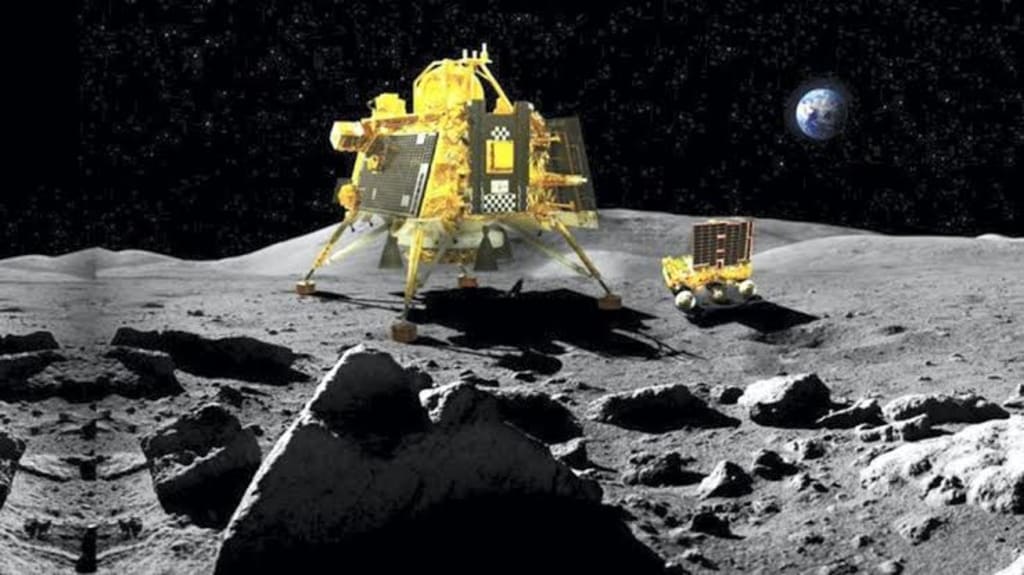
On October 22, 2008, India launched the Chandrayaan-1 mission. This spacecraft successfully reached the Moon and made a groundbreaking discovery. The discovery of water on the Moon made headlines worldwide. Chandrayaan-1 provided strong evidence for the presence of water, specifically in the South Pole area of the Moon. This news sparked a renewed interest in lunar exploration across the globe. The USA and China regularly send missions to the Moon, and Israel attempted a soft landing. Additionally, Japan, Europe, and Russia have planned numerous lunar missions. Currently, all eyes are on India's Chandrayaan-3 mission.
Chandrayaan-3 is expected to uncover a new discovery, while the Chandrayaan-2 mission encountered a failure. This video provides insights into India's journey towards the Moon and the upcoming Chandrayaan-3 spacecraft launch. India's focus is on exploring the uncharted South Pole of the Moon through the Chandrayaan-3 mission. Throughout history, various types of missions have been sent to the Moon, ranging from fly-by missions to more complex ones, as technology advances.
A flyby mission is a type of lunar mission in which a spacecraft passes by the Moon without entering orbit. The first successful flyby mission was launched by the Soviet Union in January 1959. The goal of flyby missions is to study the Moon from a distance.
An orbiter mission is a type of lunar mission in which a spacecraft orbits the Moon. The first successful orbiter mission was also launched by the Soviet Union in 1966. Orbiter missions allow for more detailed studies of the Moon's surface and atmosphere.
An impact mission is a type of lunar mission in which a spacecraft crashes into the Moon. The first successful impact mission was conducted by China in 2020. Impact missions can be used to study the Moon's surface at close range.
Today, flyby missions are only conducted when the Moon is on the way to another mission. Orbiter missions are the most common type of lunar mission. Impact missions are less common, but they can provide valuable data about the Moon's surface.
Impact missions are a type of lunar mission that involves sending a spacecraft to crash into the Moon. This can be used to study the Moon's surface at close range. The first successful impact mission was conducted by China in 2020.
The Chandrayaan-1 mission was an impact mission from India. It included a Moon Impact Probe that crashed into the Shackleton crater. The probe was equipped with an instrument called CHACE, which took readings every 4 seconds as it got closer to the surface. This helped scientists to learn that there is water in the atmosphere of the Moon.
The Chandrayaan-1 mission also had an orbiter that was carrying out its own orbiter mission. This orbiter was equipped with NASA's Moon Mineralogy Mapper M3 instrument. When the Moon Impact Probe crashed, some of the soil on the Moon's surface flew up. This instrument analyzed the lunar soil and confirmed that there is water in the Moon's soil.
The fourth category of lunar missions is lander missions. These involve sending a spacecraft to the Moon for a soft landing. This is much more challenging than an impact mission, but it allows scientists to collect more data from the lunar surface. The first successful lander mission was conducted by the Soviet Union in 1966.
Lander missions are becoming more common, and they are likely to play an important role in future lunar exploration. Scientists hope to use lander missions to learn more about the Moon's geology, history, and potential resources.
About the Creator
Enjoyed the story? Support the Creator.
Subscribe for free to receive all their stories in your feed.
Comments
There are no comments for this story
Be the first to respond and start the conversation.