Science
Verses of Change
In the tapestry of our world, where concrete jungles often drown out the whispers of nature, there lies an untold story—a story of trees reaching for the sky, rivers murmuring tales of their journey, and mountains standing as silent sentinels of time. It is a narrative eclipsed by the hum of technology and the clamor of progress. Yet, in the heart of this narrative, poetry emerges as an ethereal guide, weaving verses that echo the Earth's silent plea for salvation.
By Sub Freeman3 years ago in Earth
The tiniest entity in existence within the vast expanse of the cosmos.
We often discuss the largest things in the world, such as the tallest building or the largest animal. However, in this video, I would like to focus on something much smaller - the smallest thing. Not only is it the smallest thing in the world, but it may even be the smallest thing in the entire universe. As we delve into the core components of our mortal bodies, humans are now on a mission to unravel the fundamental building blocks that make up our universe.
By Sanjitha Shettigar3 years ago in Earth
New Research Reveals Alarming Acceleration of melting ice caps
Climate change refers to long-term changes in temperature, precipitation, and other atmospheric conditions on Earth. Human activities, primarily the burning of fossil fuels and deforestation, have significantly increased the concentration of greenhouse gases in the atmosphere. These gases, such as carbon dioxide and methane, trap heat and lead to a warming of the planet, commonly referred to as global warming.
By Shree Malai3 years ago in Earth
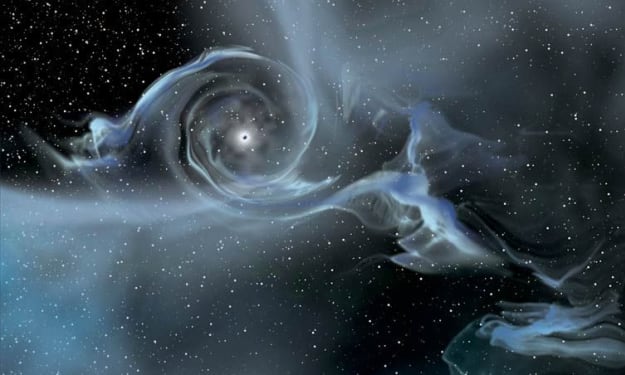
BLACKHOLE
THE LIFE OF A BLACK HOLE Black holes are captivating celestial entities, defined by their powerful gravitational pull, so intense that even light cannot escape. Their invisible nature makes them challenging to observe directly, but their presence is detected through the profound impact they have on nearby matter and light. Today, let's explore the basics of black holes: what they are, how they form, and how they ultimately meet their end. At the heart of a black hole lies the event horizon, the point of no return where gravity is so extreme that anything crossing it, including light, is trapped. This invisibility raises the question of how we identify them. The answer lies in their influence on surrounding matter and light. By observing the radiation emitted by superheated matter forming an accretion disc around a black hole, we can indirectly detect their existence. This radiation, often likened to the Eye of Sauron, offers a glimpse into the otherwise unseen realm of black holes. Central to our understanding of black holes is Einstein's theory of general relativity, revealing how these cosmic anomalies warp space and time. The extent of this warping is determined by the mass at the black hole's core, encapsulated by the Schwarzschild radius. Anything compressed within this radius becomes a black hole, whether it's a star, planet, or even an entire galaxy. While the term "black hole" may evoke images of a cosmic vacuum cleaner, indiscriminately swallowing everything in its path, the reality is more nuanced. For a celestial body to succumb to a black hole, it must venture within the Schwarzschild radius. This means that, even if our Sun were magically replaced by a black hole of equal mass, the orbits of planets in our solar system would remain unaffected. The cataclysmic change would be the sudden plunge into eternal darkness. When it comes to the formation of black holes, there are two primary categories: stellar-mass black holes and supermassive black holes. Stellar-mass black holes, ranging from three to dozens of solar masses, often originate from the explosive aftermath of a massive star going supernova. The remnants collapse into a core that slips below its Schwarzschild radius due to its overwhelming mass. On a grander scale, supermassive black holes, spanning from hundreds of thousands to billions of solar masses, inhabit the centers of galaxies, including our own Milky Way. The formation of these colossal entities remains a cosmic mystery, likely intertwined with the early stages of galaxy development. Recent discoveries have unveiled a new class of black holes—intermediate black holes—bridging the size gap between stellar and supermassive variants. There's also speculation about black holes existing on a minuscule, subatomic scale, potentially created through high-energy collisions within particle accelerators. However, direct evidence for these theories is yet to emerge. One common misconception dispelled by physics is that black holes, regardless of size, are not unstoppable forces engulfing everything in their path. Their threat is confined to the proximity of their Schwarzschild radius. Microscopic black holes, if they exist, would decay rapidly due to Hawking radiation, posing no danger. This radiation, theorized by physicist Stephen Hawking, emerges from the constant creation and annihilation of virtual particles near the event horizon, causing the black hole to shrink until it vanishes. In contrast, supermassive black holes, residing at the hearts of galaxies, boast a lifespan many orders of magnitude longer than the current age of the universe. Yet, the vastness of space ensures that encounters with these cosmic behemoths remain exceedingly rare, making them a captivating but distant aspect of our cosmic landscape. In conclusion, black holes, with their invisible allure, challenge our understanding of the cosmos. By grasping the fundamentals of their formation, sizes, and eventual decay, we can demystify these cosmic enigmas and appreciate the complexity of our universe.
By vivian kagwiria3 years ago in Earth
Unlocking the Mysteries of Time Travel: A Journey Through Physics and Speculation
Have you ever dreamt of traveling through time? I'm sure we all have. Maybe you want to go back to the past to witness historical events or change something, or perhaps you're curious about the future and want to see how it unfolds. Time travel has been a captivating concept in science fiction, with books and movies exploring the potential benefits and risks of such an ability. But is time travel more than just a fantastical idea?
By Hannah James3 years ago in Earth
Beyond the Stars: Unveiling the Mysteries of Our Universe
In the vast expanse of our universe, where stars are born and die, mysteries unfold, challenging our understanding of the cosmos. In this exploration, we delve into a myriad of celestial phenomena, from zombie stars surviving supernovae to the peculiarities of space and the enigmatic dark matter.
By Hannah James3 years ago in Earth
The Sun: A Vital Force In Our Solar System
Undoubtedly, the sun holds a pivotal position in our solar system, second only to Earth. Its gravitational influence keeps celestial bodies in orbit, while its electric currents generate a magnetic field that shapes our environment. The interconnected relationship between the Sun and Earth influences various aspects of our planet, from climate and seasons to ocean currents.
By Ayebazibwe Morris3 years ago in Earth