Science
Human Planet
The future of the human race is uncertain, with varying opinions on how long it will last, ranging from a few years to thousands of years. There are concerns about the impact of human civilization on the planet's climate and the potential consequences that may arise from it. The dangers of climate change have been known for six decades, starting in 1958 when air and water pollution were severe, even leading to rivers catching fire. As a result, activism and movements grew to address environmental issues. During President Obama's term, green energy initiatives received significant support, as he rolled out a trillion-dollar stimulus package, with nearly 100 billion allocated for green energy.
By Isaac Ekow Anyidoho2 years ago in Earth
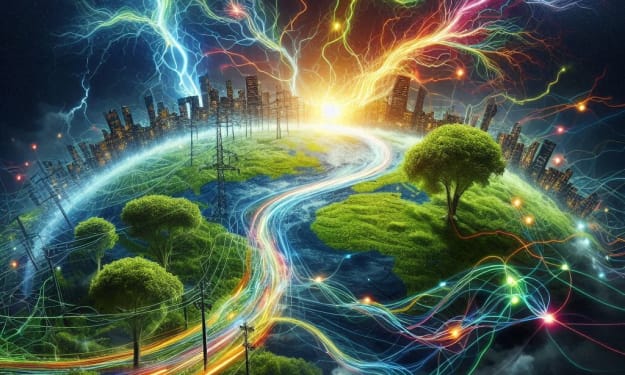
Whispers in the Wind: Can Climate Change Disrupt Earth's Electrical Symphony?. AI-Generated.
Crackling Secrets: How Climate Change Might Disrupt the Earth's Electrical Symphony Have you ever felt a tingle in the air before a thunderstorm? That's the Earth's electrical field at play! This invisible force, often overlooked, plays a crucial role in our planet's health. But recent research suggests a worrying connection – climate change might be disrupting the delicate balance of atmospheric electricity, with potential consequences for weather patterns and even human health. Let's embark on a journey to explore the fascinating world of atmospheric electricity and its surprising link to our changing climate.
By suren arju2 years ago in Earth
Liquid Wisdom
Title: Liquid wisdom; Exploring the Science and Mysteries of Water The Nature of Water Water, the essential element of life, holds within its liquid embrace the secrets of the universe. From the vast oceans that cover our planet to the smallest droplets that dance on a leaf, water embodies a complexity and mystery that transcends our understanding. In this chapter, we embark on a journey to explore the science and mysteries of water, delving into its unique properties, role in the natural world, and profound impact on life.
By Books Keeper2 years ago in Earth
Blue Mind
Title: Blue Mind: How Water Can Transform Your Health and Happiness The Healing Power of Water Water, in all its forms, has an inherent ability to soothe the human soul and uplift the spirit. From the gentle lapping of waves on a shore to the cascading rush of a waterfall, the presence of water has a transformative effect on our mental and physical well-being. In this chapter, we will explore the science behind the healing power of water and how it can impact our health and happiness.
By Books Keeper2 years ago in Earth
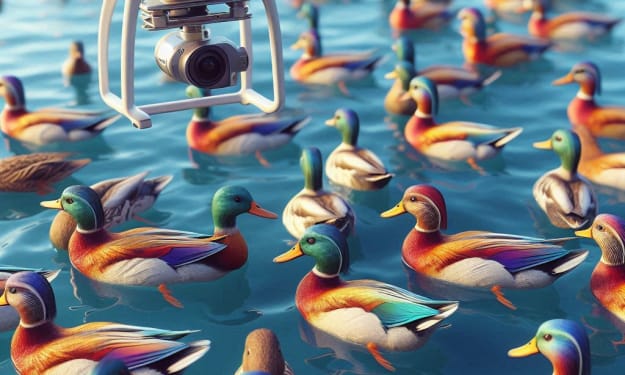
Duck Detectives: Unveiling the Feathered Faces from Above!. AI-Generated.
Unveiling the Feathered Secrets: A Duck Detective's Guide to Identification and Conservation Soar through the imagination, picturing a world of shimmering water and verdant landscapes from a bird's-eye view. This vantage point unveils a complex ballet of feathered friends, but identifying ducks specifically can be a challenge, even for seasoned birders. Their streamlined bodies and often cryptic markings create a puzzle to solve.
By suren arju2 years ago in Earth
Planet Evolution : What Will Earth Look Like in 1 Million Years?
Planet Development: What Will Earth Resemble in 1 Million Years? The fate of Earth has long captivated researchers, scholars, and visionaries the same. Foreseeing the specific condition of our planet a long time from now is loaded with vulnerability, however by looking at geographical, natural, and mechanical patterns, we can portray an image of potential situations. This article dives into the developmental directions that could shape Earth, investigating the interaction between normal cycles and human impact.
By robail shahzadi2 years ago in Earth
A Decade of Discovery: Unveiling the Mysteries of the Universe. AI-Generated.
### A Decade of Discovery: Unveiling the Mysteries of the Universe The last decade has been one of the richest periods of scientific discovery in history. Researchers across all disciplines have tested hypotheses, found proofs, and visited places that have reshaped our understanding of not only our own planet but of the entire universe. This was the decade when we began to confront one of humanity's greatest challenges and learned more than ever before about some of the most destructive objects in existence. Let’s delve into five of the most remarkable scientific discoveries of the 2010s. #### 1. Pluto's Dynamic Landscape Despite being reclassified from a planet to a dwarf planet in 2006, Pluto has remained a source of fascination. That same year, NASA launched the New Horizons spacecraft with the mission to explore this distant world. After a nine-year journey, New Horizons reached Pluto in July 2015, and the images and data sent back were astonishing. Far from being a dull, frozen rock, Pluto was revealed to have a surprisingly dynamic landscape. Scientists discovered moving glaciers, towering ice mountains, and a vast frozen sea composed of solid nitrogen. These ice formations are constantly shifting, albeit slowly, due to the warming pressure exerted from above, which causes the ice to rise and replenish the surface continually. This active geology was completely unexpected and provided new insights into the behavior of celestial bodies in the outer reaches of our solar system. #### 2. The Discovery of the Higgs Boson The discovery of the Higgs boson was a monumental achievement in physics, confirming a key component of the Standard Model. This elusive particle, also known as the "God particle," was first theorized in 1964 but remained unobserved for decades. It wasn't until the construction of the Large Hadron Collider (LHC) at CERN in Switzerland, the world's largest and most powerful particle accelerator, that the Higgs boson was finally detected in 2012. The Higgs boson is crucial because it explains why particles have mass. According to the Standard Model, the Higgs field gives mass to elementary particles through their interactions with the Higgs boson. This discovery not only validated the Standard Model but also opened new avenues for exploring the fundamental forces and particles that constitute the universe. #### 3. The Kepler Mission and Exoplanet Discovery For millennia, humans have gazed at the stars, wondering what lies beyond our solar system. The launch of the Kepler space telescope in 2009 marked a significant milestone in the search for exoplanets—planets orbiting stars outside our solar system. By measuring the minute dimming of stars as planets passed in front of them, Kepler was able to identify thousands of exoplanets. By the end of the decade, Kepler had discovered more than 4,055 exoplanets, including several that are potentially habitable. This unprecedented number of findings has revolutionized our understanding of the galaxy and suggested that planets are far more common than previously thought. This discovery hints at the possibility that our solar system is not unique and that potentially habitable worlds may be abundant throughout the universe. #### 4. Understanding Climate Change The Earth's climate has always been subject to change, but recent shifts are largely attributed to human activity. Over the past decade, the effects of climate change have become more apparent and alarming. In 2012 alone, Greenland lost 400 billion tons of ice, and Antarctica lost 252 billion tons annually throughout the decade. These losses are nearly six times greater than the ice loss experienced just 30 years earlier. This accelerated melting has dire consequences for global sea levels, which are projected to rise by three feet by 2100. Such an increase would directly affect at least 630 million people living in coastal areas. Beyond human displacement, climate change poses a threat to biodiversity, with 40% of amphibian species, over 33% of marine mammals, and 10% of insect species facing the risk of extinction. The last decade has brought the severity of climate change into sharp focus, underscoring the urgent need for solutions to mitigate its impacts. #### 5. Unraveling the Mysteries of Black Holes Black holes have long been some of the most enigmatic objects in the universe. Formed from the remnants of massive stars that have collapsed under their own gravity, black holes possess an intense gravitational pull that prevents even light from escaping. The last decade saw significant advances in our understanding of these cosmic phenomena. In 2016, the collision of two black holes was detected for the first time, confirming a prediction made by Einstein a century earlier. This collision produced gravitational waves—ripples in the fabric of spacetime. This groundbreaking discovery was followed in 2019 by the first-ever image of a black hole, captured by the Event Horizon Telescope. This massive black hole resides in the center of the Messier 87 galaxy, approximately 54 million light-years away, with a mass equivalent to 6.5 billion suns. These discoveries have provided invaluable insights into the nature of black holes and their role in the universe. It is now believed that supermassive black holes exist at the center of most galaxies, influencing the motion of stars and the structure of the cosmos. ### Looking Ahead The 2010s were an extraordinary decade for scientific discovery. From the dynamic surface of Pluto to the elusive Higgs boson, the detection of countless exoplanets, the stark realities of climate change, and the deep mysteries of black holes, we have learned much about our world and the universe. As we move forward, these discoveries not only expand our knowledge but also inspire us to continue exploring and understanding the cosmos. The next decade promises even more breakthroughs and insights, as humanity's quest for knowledge continues
By Mbeha maliwa 2 years ago in Earth
The Looming Thirst: A Deep Dive into the Global Water Crisis. AI-Generated.
The Looming Thirst: A Deep Dive into the Global Water Crisis Imagine a world where the simple act of turning on the tap becomes a gamble. A world where children spend hours collecting water instead of attending school. A world where water scarcity fuels conflict and jeopardizes entire communities. This, unfortunately, is not a dystopian future, but the harsh reality for billions of people today. The global water crisis is a complex and urgent issue demanding our immediate attention.
By suren arju2 years ago in Earth