Science
30+ Fantastic 'What If' Scenarios You Never Thought About
30+ Fabulous 'Consider the possibility that' Situations You Won't ever ponder In the domain of creative mind, 'consider the possibility that' situations fuel imagination, interest, and examination. They permit us to investigate elective real factors and contemplate the potential outcomes of various results. Here, we dive into more than 30 interesting 'imagine a scenario in which' situations that stretch the limits of our ordinary reasoning.
By robail shahzadi2 years ago in Earth
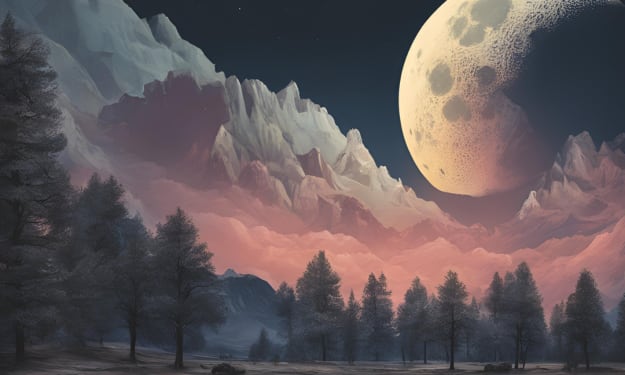
The Moon becomes a mine of gold... and other metals. AI-Generated.
Space exploration has long focused on reaching very distant destinations, but now there is a race to exploit new frontiers with the extraction of their minerals. Neil Armstrong's first walk on the Moon in 1969 was part of a strategy to beat the Soviets in the space race, a victory of imagination and innovation, not an attempt to mine precious metals. No one knew if there was water in that dusty celestial body. What a difference a generation makes... Mysterious and beautiful, the Moon has been a source of admiration and inspiration for humanity for millennia. It is now the center of a space race to extract minerals to power our future: smartphones, solar panels and possibly even a colony of earthlings. "We know there is water on the Moon, which changes the game for the Solar System. Water is rocket fuel. It is also fuel for life and agriculture. So exploring the Moon commercially is a first step to making it part of what that humanity sees as our world," says Bob Richards, CEO of Moon Express, one of 25 companies bidding to win the $30 million Google Lunar X prize. The Californian company is among the top three in the race. The others are Astrobiotic, from Pittsburgh, and Moon Team, from Barcelona. Google's first prize, of US$20 million, will be awarded to the first private company to put a robot on the Moon, successfully explore the surface by moving at least 500 meters and send high-definition video to Earth. The second prize, of US$5 million, goes to the second company to complete the same mission, with additional prizes for teams that travel more than 5 kilometers or find water. The deadline is 2015. But $30 million is a relatively small amount to fund a lunar mission. The competing companies have business models far beyond the Google prize, with the real prize being the potential treasure trove of valuable minerals. Does the Moon have an owner? "The most important thing about the Moon is probably what we haven't even discovered," Richards says. "But what we know is that there could be more platinum group metals on the surface of the Moon than in all the reserves on Earth." But can anyone own the Moon, and what happens if multiple companies and countries manage to get there? Under the 1967 outer space treaty, no nation can own the Moon, and most people believe that extends to individuals and companies. But would-be lunar miners may have something like property rights. And there is an advantage in arriving first and claiming rights. "The treaty does not allow appropriation, but open access exploitation is encouraged," notes space lawyer James Dunstan. "You can't own it, although you can use it, but how do we strike a balance?" China has plans to send a probe to the moon this year and astronauts in 2020. Because China's lunar plans are more ambitious than most, some fear it could gain too much control. Dunstan does not believe that China will flout international law to dominate space. "Trade sanctions would be very harsh if a country or corporation appropriated other people's assets." If Moon Express and others get it right, it is conceivable that in the future the lunar surface will host a colony of mining robots and astronauts who would use it as a base for further exploration of the solar system. Richards believes humans will discover ways to live permanently on the Moon. "We are becoming a multi-world species. The first traces of human beings on Mars will arrive in our era, in the next 10 to 20 years," he adds. "People will be transformed. They will merge with their technologies. And what we call human will be redefined as we seek to reprogram our bodies to live longer and find machines capable of working symbiotically with us to cure diseases." "So what we consider human today will continue to evolve." A space without pollution Moon Express, whose offices are at NASA's Ames Research Center, is financed by businessman Naveen Jain. Jain says the location is key, because it is in Silicon Valley, which he believes will become home to space pioneers. "We are those crazy people who think that every idea is crazy, until we make it concrete and then people say 'of course,'" he points out. So, if we will one day live on the Moon, shouldn't we be worried about contaminating it? Won't robot armies ruin our real estate future? Margarita Marinova, a planetary scientist at NASA, believes that we will not make the same mistakes in space as we did on Earth and that man cannot afford to explore space without taking advantage of local resources to survive. "For me it's hard, because I see these planets as beautiful and pristine as the Earth is no longer, so the idea of mining is a little difficult," she admits. The Moon's potential resources are vast. M. Darby Dyar, a professor of astronomy at Mount Holyoke College, Massachusetts, says ice reserves in the Moon's polar regions probably come from comets that collided with the Moon in the last 4 billion years, and that future miners Lunars could strike it rich with precious metals in ancient lunar rocks. But even if no company meets the 2015 deadline to win the Google award, Dyar says it has already borne fruit. "I lived through the excitement of the Apollo era, my father helped design thrusters on the lunar landing modules, and those remembered feelings of patriotism and wonder about the universe led me to lunar science in the first place." "When I give a girl a meteorite and tell her it's 4 billion years old, her entire frame of reference changes, and that's what science should do. Not everyone wants to be a scientist, but everyone is excited about learning to respect and understand their progress. "Competitions like this bring science to the public's eyes. Where better than on the Moon, which seems to be so close to us?"
By Isabela Stender 2 years ago in Earth
Why Cars Are Evil
Owning a car can make for a nice luxury. It’s private and more freeing than the alternatives, and to live in some cities, it’s all but a necessity that you have one to get around in. This article is not meant to criticize individuals for owning cars. It’s often the best decision for them. However, if one could design a city to be car-centric versus having well-developed public transportation, there’s no question that the latter is a much better aim than the former. By every conceivable metric, cars extract an unnecessary cost when compared to the alternative.
By Martin Vidal2 years ago in Earth
The last tree
The village of Verde lay nestled in a valley that once boasted lush forests and flowing rivers. But those days were long gone. Deforestation and climate change had turned the land into a dry, barren place, with only one tree remaining—a towering oak that stood as a lone sentinel against the relentless march of time and environmental decay. Twelve-year-old asha had grown up hearing stories from her grandmother about the forest that used to thrive around Verde. The oak tree, known as the Guardian, was the last of its kind, a relic from a bygone era when nature and humanity coexisted in harmony. Every day after school, Asha would visit the Guardian. She felt a deep connection to the tree, often sitting beneath its sprawling branches to read or simply to think. It was her sanctuary, a place where she could escape the harsh reality of a world plagued by environmental degradation. One particularly dry summer, Asha noticed the Guardian's leaves were turning yellow and brittle. Panic gripped her heart. She rushed home to her grandmother, the village's unofficial historian and storyteller. "Grandma, the Guardian is dying," Asha said, her voice trembling. Her grandmother's face grew somber. She had feared this day would come. "The land is thirsty, child. The climate is changing, and the rains are not coming as they used to. The Guardian is struggling to survive." Asha refused to accept this fate. "There must be something we can do," she insisted. Her grandmother thought for a moment, then nodded. "There might be a way. The tree needs water, and not just any water, but the purest we can find. We must create a system to bring water from the distant mountains where streams still flow." Asha's eyes sparkled with determination. "I'll do it, Grandma. I'll save the Guardian." With the help of her grandmother and some villagers who still remembered the old ways, Asha began constructing a simple irrigation system. They used bamboo and clay pipes to channel water from the mountains to the village. It was hard work, and the scorching sun made the task even more challenging, but Asha's determination never wavered. The village was initially skeptical. "It's just a tree," some said. "What difference can one tree make?" But as they saw Asha's unwavering dedication, more villagers joined the effort, bringing their skills and labor to the project. Finally, after weeks of relentless work, the system was complete. Water trickled down from the mountains, flowing through the pipes and into a makeshift reservoir near the Guardian. Asha carefully watered the tree, her heart filled with hope. The change was not immediate, but slowly, the Guardian began to show signs of recovery. New leaves sprouted, green and vibrant. The tree seemed to stand taller, its branches spreading wide as if embracing the sky. The villagers, inspired by the tree's resilience and Asha's determination, started planting new trees around the Guardian, using the irrigation system to nurture them. As the years passed, the once-barren valley began to transform. New trees took root and flourished, and the air grew cooler and cleaner. Wildlife returned, drawn by the renewed habitat. The Guardian stood at the center of it all, a symbol of hope and a testament to what could be achieved through collective effort and a deep respect for nature. Asha, now a young woman, often sat beneath the Guardian with her own children, telling them the story of how the last tree had almost died and how the village had saved it. The tree had given them more than just shade and fruit; it had given them a reason to believe in the future. In the end, the Guardian was not just the last tree—it was the first of many in a reborn forest, a living reminder of the power of hope, community, and the enduring bond between humanity and the environment.ha
By Anthony mutafela 2 years ago in Earth
The Ultimate Guide to Effective Meditation: Achieve Wisdom, Calm, and High Awareness
In our fast-paced modern world, finding moments of peace and clarity can be challenging. However, meditation offers a pathway to achieving a state of calm, wisdom, and heightened awareness. This guide will walk you through the essentials of effective meditation, ensuring you can practice with confidence and reap its many benefits.
By Gaming Lupa2 years ago in Earth