Science
Why Solar Eclipses Are Such a Big Deal!
The sun is much larger than anything else in the solar system. Earth is lucky because our moon is 400 times smaller than the sun, but it's conveniently 400 times closer to us. This makes the sun and the moon look almost the same size in the sky to us on earth. Occasionally, the moon crosses in front of the sun and blocks its light, creating a solar eclipse. On April 8th, there will be a total solar eclipse passing over where I'll be standing. This is a rare event, as the US won't see another total solar eclipse for 20 years. So, it's a once in a lifetime opportunity to witness this incredible cosmic event. I'll provide all the information you need to fully enjoy the eclipse and learn from it, whether you're a scientist or just curious about the universe. Let's talk about choosing the best spot, what to bring, what to expect before, during, and after the eclipse, and the fascinating things we can learn from such a spectacle.
By Mariam Fathalrahman2 years ago in Earth
Telescope Made for Sea
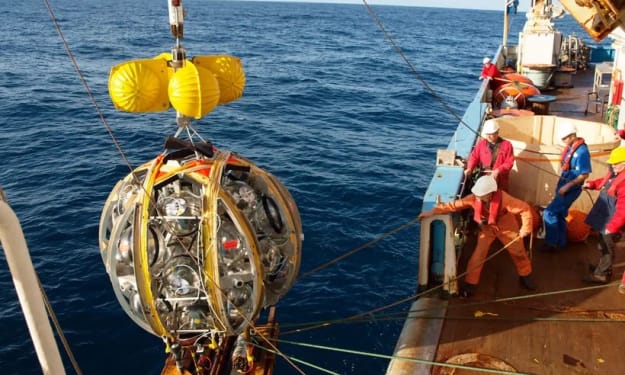
Telescopes Built At Bottom Of The Sea Across the world, telescopes are the best way for us to see what's out there in space. But did you know that there's actually one being built with a completely different purpose? It's a telescope at the bottom of the sea. [Music] The KM3NeT is a next-generation deep-sea research facility that's being built between 1.5 and 3 miles deep in the waters of the Mediterranean Sea. This research infrastructure will house telescopes that aren't designed to look at light, like the ones we're more familiar with, but instead will be looking through the water at neutrinos. There will be two telescopes: one known as ARCA, which will allow scientists to search for neutrinos that have been produced by distant astrophysical sources, such as gamma-ray bursts, colliding stars, and supernovae; and the other telescope, called ORCA, which is focused on learning more about the properties of neutrinos that have been formed in the Earth's atmosphere.
By Richchik Bardhan2 years ago in Earth
The Ground Over Yellowstone is Rising - Is It Going to Erupt?. AI-Generated.
It is likely that you are aware that Yellowstone National Park is situated atop a massive supervolcano, which accounts for the region's impressive geysers and hot springs. However, this also indicates the presence of a substantial magma chamber beneath Yellowstone. In 2015, researchers from the University of Utah discovered that this chamber was significantly larger than previously estimated. They also identified an additional reservoir of magma located beneath the primary chamber. Notably, the larger the chambers, the greater the volume of magma they can hold. Collectively, these two reservoirs contain a quantity of magma sufficient to fill the Grand Canyon eleven times over.
By Brian Dickerson2 years ago in Earth
The Multiverse: A Journey Through Parallel Realities. Content Warning. AI-Generated.
The concept of the multiverse has captured the imagination of scientists, philosophers, and storytellers alike. It is a tantalizing idea, suggesting that our universe—vast and incomprehensible as it already is—might be just one of countless others, each with its own distinct laws of physics, constants, and even versions of reality. The multiverse, once the realm of science fiction, is increasingly finding a place in serious scientific discussions. But what exactly is the multiverse, and why does it matter ?
By Krishna Yadav2 years ago in Earth
The Cracks Beneath the City
In the sprawling metropolis of Altagaz, a city perched on the eastern coast of Turkey, the skyline had changed dramatically over the past few decades. What was once a sleepy coastal town had transformed into a bustling urban hub, its silhouette dominated by towering skyscrapers and densely packed apartment blocks. The city’s rapid growth was fueled by an influx of people from rural areas, all seeking better opportunities, a brighter future, and a piece of the city's promise.
By Aminu Muhammad2 years ago in Earth
Could Covering the Sahara Desert with Solar Panels Solve Our Energy Problems?
The Sahara Desert, spanning roughly nine million square kilometers, bakes under temperatures that can reach up to 80°C daily. It receives about 22 million terawatt hours of energy from the Sun annually—more than 100 times the amount of energy humanity consumes each year. Given these statistics, one might wonder: could covering the Sahara with solar panels resolve our energy challenges permanently?
By Avnit Mangat2 years ago in Earth
EXPLORING THE OCEAN
**Exploring the Ocean: Unraveling the Mysteries** In the boundless expanse of the ocean, where the sun casts a shimmering blue veil and weightlessness allows one to float effortlessly, lies a world that has fascinated humankind for centuries. The ocean is a realm of both beauty and danger, home to creatures of extraordinary variety and mystery, many of which remain enigmatic even today. To delve into this hidden world, an extraordinary team embarks on a journey across the globe.
By Kelvin Sena Datsa2 years ago in Earth
Embracing Green Innovation
The direness to handle environmental change and advance manageability has never been more prominent. Green innovation, with its commitment of decreasing ecological effect and supporting proficiency, remains at the very front of this development. This article will investigate the meaning of green innovation, its key parts, applications, benefits, and the difficulties it faces. By understanding these components, you can see the value in how imperative green innovation is in this day and age and consider your job in adding to a manageable future.
By AUTHER Naila2 years ago in Earth
Health and Hope. AI-Generated.
John Bradley sat in the small, dimly lit room of his modest apartment, the hum of the old refrigerator the only sound breaking the silence. At seventy-two, his body felt every bit its age, and his recent diagnosis of cancer weighed heavily on his spirit. He had lived a simple life, working as a machinist for over forty years until retirement. His wife, Mary, had passed away a decade ago, leaving him alone with memories of their shared life and dreams.
By God'spower2 years ago in Earth
Are We Alone In The Galaxy?
are we alone in the universe this question has been in the minds of scientists for centuries capturing the imagination of people everywhere and driving countless other questions of the unknown many scientists believe that Earth isn't the only place in the UN Universe to host life but considering just how big the universe is with an estimated 2 trillion galaxies perhaps then a better question is are we alone in the Milky Way according to a new study published in the astrophysical journal researchers from the University of Nottingham suggest that the Milky Way galaxy is home to 36 communicating intelligent alien civilizations but how did they arrive at this very specific number they say the estimate is actually conservative and it's based on the assumption that intelligent alien life forms on other planets in a similar way to how it does on Earth the scientists assume that Earth is not special if we imagine a planet much like ours orbiting a star like our sun hosting a civilization that develops technologically in a similar way to humans and under the assumption that it takes 5 billion years for intelligence life to form then there would be at least 36 earthlike civilizations in our galaxy previous calculations of alien life have been based on the Drake equation which includes seven factors needed to find the number of intelligent civilizations but the estimates have been extremely broad ranging from zero to a few billion civilizations with this new method the researchers refined the equation using new data and assumptions they found that there are ly between 4 and 21 civilizations with 36 the most likely number however finding these civilizations is another issue entirely scientists said they would be thousands of light years away but let's begin by exploring Proxima centor B the nearest exoplanet that may potentially Harbor alien life this intriguing World orbits within the habitable zone of Proxima centor the habitable zone or the goldilock zone is the region around a star where the conditions are just right for liquid water to exist on a planet's surface in this Zone the temperature is ideal neither too hot which would cause water to evaporate if the planet were too close to its star nor too cold which would cause water to freeze if the planet were too far away this temperature range offers the potential for Life as we know it to thrive Proxima centor B is very similar in size to Earth with a mass of of approximately 1.17 Earth masses this suggests it's only about 10% larger in diameter than our world the planet is likely tidily locked meaning one side of the planet always faces the star receiving constant daylight while the other side is In Perpetual Darkness there could be three distinct climate zones due to Tidal locking a hot sun-facing side a cold dark side and a potentially habitable Twilight Zone in between if alien life exists on Proxima centor B the unique conditions of being tidily locked could lead to extraordinary adaptations on the perpetually lit side life forms might have evolved to withstand continuous exposure to the Stars radiation possibly developing protective mechanisms or using the constant light to their advantage perhaps through photosynthesis like processes On the Dark Side organisms could have adapted to the extreme cold and constant Darkness possibly relying on geothermal energy or other forms of heat different from Starlight to survive now if intelligent alien life exists on Proxima centor B the implications would be astonishing first it would suggest that intelligent life is likely common throughout the Galaxy considering the Milky Way hosts an estimated 400 billion stars the odds that the only two planets with intelligent life happen to be neighbors would be astronomically low second the discovery could provide clues into the nature of space travel among extraterrestrial civilizations if these neighboring beings have not yet made contact it could indicate that even for a more advanced alien Society Interstellar travel is an even bigger challenge than we thought or it might also suggest that they are technologically less advanced than we are positioning Humanity as the potential first Interstellar visitors in this scenario we would be the aliens arriving on their planet however before we get ahead of ourselves it's crucial to remember that these ideas remain purely speculative the existence of extraterrestrial life let alone intelligent life beyond Earth has yet to be confirmed another intriguing candidate for hosting alien life is Kepler 62e a superar located about 1200 light years away and here's why this exoplanet stands out it's approximately 1.6 times the size of Earth which suggests it might have similar mass and gravity it orbits within the habitable zone of its star which is smaller and cooler than the sun creating potentially ideal conditions for liquid water there's a strong hypothesis that Kepler 62e could be a water world covered mostly or completely by oceans this could mean a variety of of Aquatic Life forms might exist there if Kepler 62e has an atmosphere it's thought to be very cloudy warm and humid extending to the polar regions if it truly is a water world this could make the development of civilization as we know it more challenging yet it does not eliminate the possibility of advanced marine organisms the concept of Life on Kepler 62e is still speculative but it's a top candidate in the search for alien in life due to these promising characteristics however its great distance from Earth means that our current technology doesn't allow us to study it in detail to confirm these possibilities Glee 667cc is another Super Earth with the potential to host alien life the planet has a radius 1.7 times that of Earth and is about 23 light years away Glee 667 cc is part of a triple star system which could mean that if you were standing on the planet you might see three suns in the sky its host star is a red dwarf with about a third as much mass as the sun as a result stars like Glee 667 C can live up to 150 billion years or 15 times longer than the sun's lifespan even if alien life does not currently exist on Glee 667cc the system's potential lifespan of one 150 billion years offers an extended window for life to emerge and evolve this prolonged period of stability far exceeds that of our own Sun providing more than enough time for complex life forms to develop at a later stage in the planet's history G 667 cc is among five other planets that orbit the red dwarf star three of which are within the habitable zone this makes this system a prime candidate for the potential of alien life however whether life actually exists there remains a mystery as we currently lack the technology to detect life at such a distance directly the study of exoplanets like Glee 667 CC helps astronomers understand the conditions under which life might arise and how common habitable worlds might be in our galaxy Kepler 22b is another fascinating alien world categorized as a super Earth and is about 2.4 times Earth's radius the planet's composition is still a matter of debate it could be covered in a vast Ocean or it might even be gaseous but if it is an ocean world it's possible that life could exist in such an environment as suggested by some scientists involved in the Kepler project the idea of an ocean world is particularly interesting because it opens the possibility of Aquatic Life forms however with a staggering distance of about 640 light years separating us from Kepler 22b it's currently beyond our reach for direct exploration using today's technology now picture an advanced alien civilization on Kepler 22b peering through sophisticated telescopes aimed at Earth what they'd be observing is our planet as it was back in the year 1384 they would see Earth's Medieval Era this delay is due to to light the fastest thing in the universe taking 640 years to travel from our world to theirs yet even as vast as 640 light years may seem it represents less than 1% of our Milky Way staggering bread of 100,000 light years so far our exploration of exoplanets has barely touched a tiny fraction of the potentially habitable worlds that might exist out there drawing on data from the kep Space Telescope estimates suggest there could be up to 300 million potentially habitable planets within our galaxy alone considering this estimating only 36 potential alien civilizations in the Milky Way seems extraordinarily conservative now let's imagine for a moment that each Galaxy hosts just one single civilization if true with the estimated 2 trillion galaxies in the observable universe there would be a minimum of 2 trillion civiliz izations out there faced with these numbers it's humbling to realize that our civilization might just be a tiny Speck as viewed from the broad Cosmic perspective as we gaze out into the Stars we must ask ourselves what Legacy will We Leave Behind in this Cosmic sea of possibilities
By Michael Jackstha2 years ago in Earth