
The Multiverse: A Journey Through Parallel Realities
Universe to multiverae

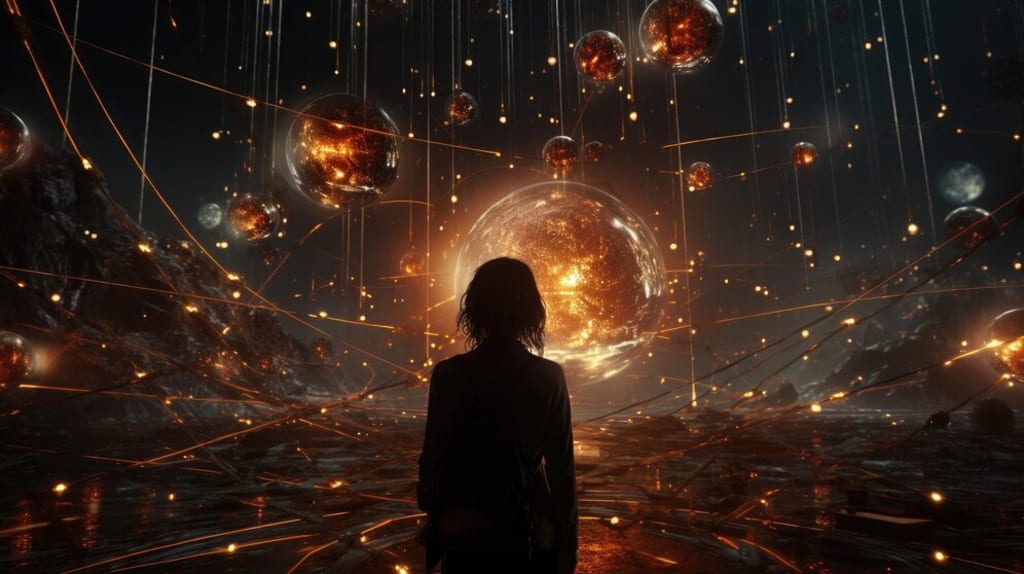
The concept of the multiverse has captured the imagination of scientists, philosophers, and storytellers alike. It is a tantalizing idea, suggesting that our universe—vast and incomprehensible as it already is—might be just one of countless others, each with its own distinct laws of physics, constants, and even versions of reality. The multiverse, once the realm of science fiction, is increasingly finding a place in serious scientific discussions. But what exactly is the multiverse, and why does it matter ?
What is the Multiverse?
The multiverse theory posits that there are multiple, perhaps infinite, universes existing parallel to our own. These universes are often referred to as "parallel worlds" or "alternate realities." While the idea can be traced back to ancient philosophical musings, it has gained traction in modern times thanks to advancements in cosmology, quantum mechanics, and string theory.
Different Models of the Multiverse
There isn't just one concept of the multiverse; several models propose different ways these alternate realities might exist.
1. The Bubble Universes (or Inflationary Multiverse):According to the inflationary model of the universe, our universe underwent rapid expansion just after the Big Bang. Some theories suggest that this process could happen multiple times, creating "bubble" universes that are constantly forming and detaching from each other. Each bubble would be a separate universe, with its own distinct properties.
2. The Many-Worlds Interpretation:In quantum mechanics, the many-worlds interpretation suggests that every time a quantum event has multiple possible outcomes, the universe splits into different branches, with each possible outcome occurring in a separate branch. This means that there could be countless versions of ourselves, living out every possible outcome of every decision we’ve ever made.
3. The Brane Multiverse: In string theory, which posits that the fundamental particles of the universe are not points but rather tiny strings, there is the idea of "branes"—multidimensional objects that could exist in higher-dimensional space. Our universe could be a brane, and there could be other branes floating in this higher-dimensional space, each corresponding to a different universe.
4. The Mathematical Multiverse:This concept, proposed by physicist Max Tegmark, suggests that all mathematical structures exist physically. According to this theory, every consistent mathematical structure corresponds to a different universe. This is the most abstract of the multiverse theories and is more philosophical in nature.
The Implications of the Multiverse
If the multiverse exists, it has profound implications for our understanding of reality and our place in it. For one, it challenges the notion that our universe is the only one with the right conditions for life. The so-called "fine-tuning" problem—where the constants of our universe seem precisely calibrated to allow life—could be explained if there are countless other universes where these constants are different, and life is impossible.
The multiverse also raises questions about the nature of existence and identity. If there are infinite versions of ourselves in different universes, what does that say about our decisions, our identity, and our sense of self? Are we just one of many iterations of the same person?
Moreover, the multiverse theory touches on the limits of scientific knowledge. If these other universes are truly separate from ours, it might be impossible to ever observe or interact with them. This raises the question of whether the multiverse is a scientific theory or a philosophical one. Can something that is, by definition, unobservable be considered part of science?
The Multiverse in Popular Culture
The multiverse concept has deeply influenced popular culture, particularly in science fiction. From television shows like *Doctor Who* and *Rick and Morty* to blockbuster movies like *Spider-Man: Into the Spider-Verse* and *Everything Everywhere All at Once*, the multiverse offers a rich playground for exploring alternate realities, moral dilemmas, and the nature of existence. These stories often use the multiverse as a metaphor for human experience, reflecting on how small choices can lead to vastly different outcomes.
Conclusion
The multiverse is a compelling and complex idea that straddles the boundary between science and philosophy. While there is no definitive proof that the multiverse exists, the theories that suggest it offer fascinating insights into the nature of reality. Whether or not we ever find evidence of these parallel worlds, the concept of the multiverse challenges us to think more deeply about the universe we inhabit and the countless possibilities beyond it.
About the Creator
Enjoyed the story? Support the Creator.
Subscribe for free to receive all their stories in your feed.
Comments
There are no comments for this story
Be the first to respond and start the conversation.