Science
Global Price Increases: Recognizing the Global Cost Increase.
Millions of households and businesses have been impacted by an unprecedented rise in prices across a variety of industries over the past few years. From basic necessities like food and fuel to services and housing, inflation has tightened its grip on global economies, sparking concerns and debates about its causes and long-term consequences.
By Naeem Ahmedabout a year ago in Earth
The Benefits of Birdwatching: 4 Reasons It’s More Than a Hobby
When mentioning birdwatching, people often think of crazy fanatics who keep hundreds of sightings journals and travel the world for the rarest of species. But what if I told you it's not just simply an obsession? There's a grey area where the casual and hardcore bird enthusiasts have more in common than meets the eye. Whether it's forging new meaningful relationships or expanding our own knowledge about life itself, nature provides many benefits to the human experience. Here's the top four biggest reasons why birdwatching isn't only a hobby, but potentially a life-changing opportunity to improve mental health. It’s sure to get you into a flap!
By The Observant Maskabout a year ago in Earth
Shocking Spherules on Mars:. Content Warning. AI-Generated.
In a fascinating new development in the ongoing Martian exploration, NASA's Perseverance rover has found an odd rock formation that is both exciting and perplexing scientists. Scientists have now dubbed the rover's discovery "shocking spherules," which are tiny, spherical mineral formations that have never been seen before and are lodged in a Martian rock.
By Afnan Khan Turasabout a year ago in Earth
"The Pulse of Tomorrow"
The Earth was a living entity, its pulse a rhythmic hum, much like a beating heart. For eons, it had breathed in silence, with only the occasional roar of nature’s storms and the rustle of leaves in the wind to mark its presence. Then came a different kind of hum—an artificial hum that was made by man rather than by the soil. It was the beginning of a relationship that would forever change both the planet and its inhabitants.
By Mridul Mahmud about a year ago in Earth
How Climate Change Could Exacerbate Arsenic Contamination in Rice: A Looming Global Health Crisis. Content Warning.
Rice, the staple food for over half of the world’s population, faces a dual threat from climate change: not only could yields decline in key growing regions, but the grain may also accumulate dangerous levels of arsenic, a toxic carcinogen. Recent research highlights how rising temperatures, shifting precipitation patterns, and elevated atmospheric carbon dioxide (CO₂) levels are altering soil chemistry and plant physiology in ways that amplify arsenic uptake in rice crops. This convergence of environmental and health risks poses unprecedented challenges for food security and public health, particularly in Asia, where rice accounts for up to 70% of daily caloric intake in countries like Bangladesh and Cambodia.
By Tech Horizonsabout a year ago in Earth
"Resurrecting Legends: The Genetic Revival of the Dire Wolf"
On April 7, a biotechnology company in Texas, U.S., named Colossal Biosciences announced that they had resurrected a dire wolf, a large dangerous predator that went extinct more than 10,000 years ago. In a paper uploaded by the company on April 11, Colossal Biosciences claimed that the genomes of the gray wolf and the dire wolf are 99.94% identical, implying that 2.445 billion of the 2.447 billion base pairs were in the same places in the two genomes.Scientists extracted DNA from ancient dire wolf fossils, including a 13,000-year-old tooth and a 72,000-year-old ear bone.They sequenced the dire wolf genome and identified 20 key genetic differences between dire wolves and their closest living relative, the gray wolf.It takes surprisingly few genetic changes to spell the difference between a living species and an extinct one. Like other canids, a wolf has about 19,000 genes. Creating the dire wolves called for making just 20 edits in 14 genes in the common gray wolf, but those tweaks gave rise to a host of differences.The dire wolf genome analyzed to determine what those changes were was extracted from two ancient samples—one a 13,000-year-old tooth, the other a 72,000-year-old ear bone.
By San Rafael . Aabout a year ago in Earth
The Last Normal Year: A Storm Named Superintelligence Is Coming. AI-Generated.
2025 might just be the last normal year of your life. Our civilization was once transformed by electricity. Then came the internet- it reshaped everything: our society, economy, politics and communication.
By Shamim Hasanabout a year ago in Earth
A Major Wind Project Stalls in New York, Raising Concerns for U.S. Renewable Energy Goals. AI-Generated.
New York, NY — Developers attempted to secure crucial financial adjustments from the state, but were unsuccessful, putting a high-profile offshore wind project in New York in jeopardy. The impasse has far-reaching consequences, not only for New York's clean energy goals but also for the entire offshore wind industry in the United States, which is already experiencing difficulties with financing, supply chain delays, and rising costs. Experts warn that if policymakers and developers can’t find a solution, the setback could slow America’s transition to renewable energy, jeopardizing state and federal climate goals.
By Gaming Sayemabout a year ago in Earth
Earth’s Deepest Abyss
The Mariana Trench represents the deepest section known to exist in every ocean worldwide by settling in the western Pacific Ocean. At its deepest section the underwater trench extends deeper than Mount Everest could reach with its maximum height while reaching 36,000 feet below sea level (10,984 meters). This ocean trench stretches more than 1,500 miles at 2,550 kilometers while forming a curved scar across the ocean's floor so it received its name after the Mariana Islands.
By Arefin Foysalabout a year ago in Earth
Most recent earthquake. . AI-Generated.
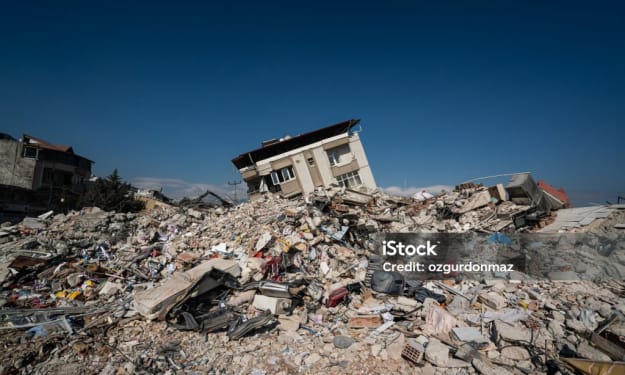
http htternat Recent Earthquake in Myanmar: A Catastrophic Event Myanmar experienced a disastrous earthquake of 7.7 to 7.9 on March 28, 2025. The epicenter was near Mandalay in Sagaing Region, making it the strongest earthquake that hit Myanmar since 1912. The effects of the quake were felt in neighboring countries like Thailand, China, and Vietnam.
By Farjana Akterabout a year ago in Earth
The Importance of the Moon for US policy. AI-Generated.
The Moon and the Arctic: Parallels in Policy and Governance As humanity prepares for a new era of lunar exploration and potential settlement, the Moon’s harsh and enigmatic environment has drawn comparisons to Earth’s polar regions—especially the Arctic. Both are extreme frontiers marked by unique scientific value, environmental vulnerability, and complex governance challenges. Given these similarities, there is a compelling case for adapting the successful policy frameworks and international cooperation models developed for the Arctic to guide our approach to the Moon.
By Amor Zella Goldabout a year ago in Earth