Science
Next week, a rare planetary alignment will create a "smiley face" in the sky. Verify the Specifics
From Earth's perspective, a triple conjunction is an astronomical event in which three celestial bodies, such as planets, the Moon, or stars, appear to align closely in the sky. Because of their respective positions and motions along the ecliptic, the objects appear to be close to one another, creating a striking configuration in which they appear to converge within a small portion of the celestial sphere. Astronomy enthusiasts worldwide are poised to witness a captivating celestial display as a rare triple planetary conjunction graces the night sky on Friday, April 25. According to Live Science, this extraordinary astronomical alignment will have a striking visual composition that includes Venus, Saturn, and a slender crescent Moon. Although it will only last for a short period of time, it will be globally observable. With Venus and Saturn acting as the bright "eyes" and the gently curved crescent Moon acting as the "smile," this unusual arrangement will give the impression of a "smiley face" suspended in space. The phenomenon is a remarkable combination of perspective and orbital mechanics that provides a brief but delightful spectacle for observers all over the planet. A significant celestial event known as a triple conjunction occurs when three astronomical bodies, typically the Moon or planets, are visible from Earth in close angular proximity in the sky. Although it is the result of line-of-sight perspective rather than actual spatial convergence, this optical alignment provides a compelling visual display. As Venus, Saturn, and a slender crescent Moon get closer to one another in the early hours of April 25, they will form a triangular arrangement that looks like a smiling face. This is a rare and beautiful sight. Live Science claims that in the early morning twilight, this alignment will be visible to observers with an unobstructed view of the eastern horizon, providing a brief but captivating spectacle. What exactly is a triple junction? From Earth's perspective, an astronomical phenomenon known as a conjunction occurs when two or more celestial bodies, such as planets, the Moon, or bright stars, appear to be in close alignment. The alignment of their orbital paths along the ecliptic plane results in this apparent proximity. A triple conjunction occurs when three of these bodies meet in this manner. Even though they are far apart in space, their alignment from Earth's perspective gives the impression of close proximity, resulting in a unique and striking arrangement in the celestial sphere.
By Muhammad Mehebub Alamabout a year ago in Earth
Innovative Green Technologies and Technology:
Introduction Sustainable technology and green innovations have emerged as the need of the hour and the foundation of future progress in an era when environmental and climate change issues dominate the news. Industries all over the world are reorienting to adopt greener practices, ranging from environmentally friendly manufacturing to breakthroughs in renewable energy. This change is not only beneficial to the environment but also smart business.
By Dipak Chakrabortyabout a year ago in Earth
Google is in more danger than ever of being broken upGoogle will fight to keep its Chrome browser in a search antitrust trial starting Monday, after losing an ad-tech suit.
Google Faces Unprecedented Pressure Amid Antitrust Trials Google, one of the most powerful tech companies in the world, is facing perhaps its greatest legal challenge yet. As the company prepares to defend itself in a major antitrust trial over its Chrome browser and search dominance, it does so under the looming shadow of another recent setback—losing an important case tied to its advertising technology business. These legal battles, taken together, mark a turning point for the tech giant and could alter its business model significantly or even cause it to dissolve. A Legacy of Disputes in Court Antitrust authorities around the world have long targeted Google. In the European Union, the company has already faced billions in fines over its Android operating system, search practices, and online shopping services. However, the current wave of U.S.-based litigation is different—more direct, more aggressive, and potentially more damaging.
By GLOBAL NEWSabout a year ago in Earth
How the 1946 Alaska Earthquake Is Still Shaping Earth's Mantle Today 80 Years Later
How the 1946 Alaska Earthquake Is Still Shaping Earth's Mantle Today 80 Years Later Scientists Reveal How a Forgotten Megaquake Continues to Reshape the Planet Beneath Our Feet
By Adnan Rasheedabout a year ago in Earth
Satellite Captures Mysterious Symbols in Desert Ancient Civilization or Alien Code?
Satellite Captures Mysterious Symbols in Desert Ancient Civilization or Alien Code? High resolution satellite images reveal strange desert markings sparking global debate on ancient cultures secret messages and possible extraterrestrial origins
By Adnan Rasheedabout a year ago in Earth
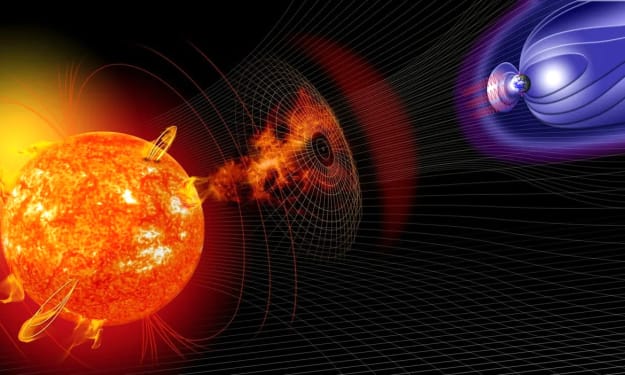
2025 Solar Storm: A Cosmic Power Surge Headed Our Way!. AI-Generated.
**The Solar Storm of 2025: Understanding the Phenomenon and Its Potential Impact** In 2025, the Earth is expected to experience one of the most significant solar storms in recent history. While solar storms are not new—having been documented for centuries—the intensity and potential consequences of this event are drawing heightened attention from scientists, governments, and industries alike. This article delves into the nature of solar storms, why the 2025 event is particularly concerning, and what the implications might be for modern technology and society.
By Faizan Afrazabout a year ago in Earth
Modern World
A Landscape of Transformation and Tension The modern world stands as a complex tapestry woven with rapid technological progress, shifting social norms, economic disparities, environmental uncertainty, and geopolitical recalibrations. In the 21st century, global society traverses a paradoxical terrain marked by unprecedented innovation and persistent injustices, connectedness and conflict, opportunity and risk. From digital revolutions to climate change, modern humanity faces the dual challenge of managing transformation while preserving fundamental values and social stability. Innovation in Technology and Digital Transformation Technology defines the modern era. The proliferation of smartphones, high-speed internet, artificial intelligence (AI), and automation has reshaped how people live, work, learn, and interact. People can now form communities across cultures and continents thanks to instantaneous and borderless communication. Social media platforms influence political discourse, cultural trends, and economic decisions at a scale once unimaginable. Tools in the healthcare industry, including personal assistants and diagnostic systems, are now powered by artificial intelligence. In fields like finance, logistics, and cybersecurity, AI models manage vast amounts of data with increasing precision. Robotics and automation are altering the labor market, replacing repetitive tasks while demanding new skillsets. Biotechnology and quantum computing both offer breakthroughs that have the potential to reshape the fields of materials science, energy, medicine, and the environment. However, the digital age also brings challenges. Data privacy, surveillance, cybercrime, and misinformation raise ethical and legal dilemmas. AI bias, algorithmic control, and the concentration of tech power in a handful of corporations create concerns over equity and democratic accountability. While innovation accelerates, many regions struggle with limited access to digital infrastructure, deepening the global digital divide. Globalization and Economic Inequality The modern world is economically interconnected. Global trade networks span continents, multinational corporations operate across jurisdictions, and financial markets respond in real-time to political events. Globalization has expanded access to goods, services, and knowledge, lifting millions out of poverty and fueling growth in emerging economies. Globalization, however, also reveals systemic imbalances. While wages for the working and middle classes remain stagnant in many nations, elite wealth is becoming increasingly concentrated. Outsourcing and automation have hollowed out traditional industries in developed nations, contributing to unemployment and social dislocation. Economic inequality persists both within and between countries, fueling resentment and political polarization. Modern economies must grapple with inflation, debt, and fragile supply chains. The COVID-19 pandemic, for instance, revealed vulnerabilities in global systems—highlighting how interdependence, while efficient, can also be brittle. As governments confront new fiscal and labor realities, debates over taxation, regulation, and the role of the state continue to intensify. Stress in the Environment and Climate Change Climate change represents one of the most urgent challenges of the modern era. Rising temperatures, extreme weather events, melting polar ice, and sea-level rise threaten ecosystems, economies, and human settlements. Deforestation, pollution, and the loss of biodiversity put additional strain on natural systems already under pressure from consumption and industrialization. Governments and organizations have committed to reducing carbon emissions and transitioning to renewable energy. Wind, solar, hydroelectric, and emerging technologies like green hydrogen hold promise. However, progress is still uneven. Fossil fuels still dominate energy production, and developing nations often lack resources to shift rapidly toward sustainability.
By Nabir Mondolabout a year ago in Earth