Nature
Unleash Your Inner Forager: Exploring the Delectable World of the forest “Guide to Wild Foods”. AI-Generated.
In a world saturated with processed foods and artificial flavors, there’s a growing movement towards rediscovering the untamed abundance of nature’s pantry. If you’ve ever felt the primal urge to reconnect with the land and savor its bountiful offerings, then “Guide to Wild Foods” is your compass to embark on a flavorful adventure like no other.
By Cameron Depew2 years ago in Earth
Life on an Oxygen-Rich Planet. AI-Generated.
Living on a high-oxygen planet would be exciting and invigorating. Breathing in deeply would instantly energize you, similar to drinking espresso. The sky would be a vibrant blue, and the trees would be huge, lush, and growing quickly.
By Asen Djidjev2 years ago in Earth
The Marvel of Earth: The Extraordinary Blue Planet
Earth, the beautiful blue planet we call home, stands out in the vastness of space as the only known place that sustains life. It is a marvel of scientific phenomena and sheer chance. This small speck in the universe holds the keys to our past, present, and future.
By Nurudeen Jimoh2 years ago in Earth
Sustainable Aviation Fuels. AI-Generated.
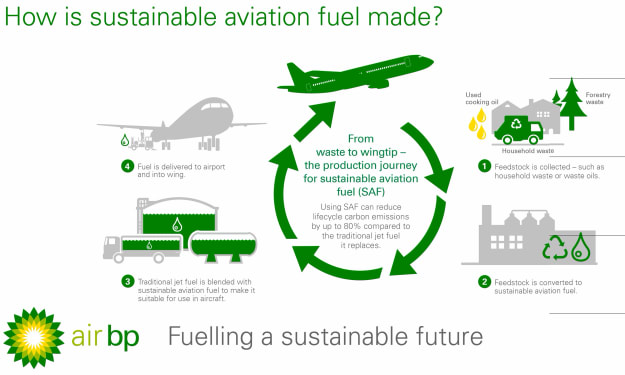
What is SAF? Sustainable aviation fuel (SAF) is a non-conventional fuel that is used in the aviation industry. It is the preferred term used by IATA to describe this type of fuel. Other terms used to refer to SAF include sustainable alternative fuel, sustainable alternative jet fuel, renewable jet fuel, or bio-jet fuel. These terms are generally used to convey the same meaning. It is important to note that biofuels refer to fuels produced from biological resources such as plant or animal material, but current technology allows fuel to be produced from other alternative sources. The chemical and physical properties of SAF are almost identical to those of conventional jet fuel, and they can be safely mixed with the latter to varying degrees. SAF is a drop-in fuel, which means it can be easily incorporated into existing airport fueling systems and does not require the adaptation of aircraft or engines. To be considered “sustainable,” SAF must meet sustainability criteria such as lifecycle carbon emissions reduction, limited fresh water requirements, no competition with needed food production, and no deforestation.
By Bhangs Corporation2 years ago in Earth