Nature
Savoring Wine on Warm Summer Nights. AI-Generated.
As the sun sets on a warm summer day, there's a unique magic that fills the air. The heat gives way to a gentle breeze, and the world seems to slow down, inviting us to unwind and savor the moment. For many, this is the perfect time to enjoy a glass of wine, letting its flavors and aromas complement the enchanting ambiance of a summer night.
By Nikolaos Smith2 years ago in Earth
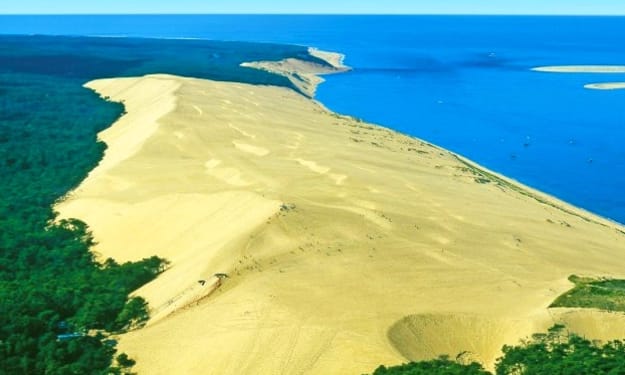
Dune de Pilat: Nature's Majestic Masterpiece
Nestled along the pristine coastline of Pyla-sur-Mer lies a natural marvel that captivates the hearts of all who behold it – the colossal sand dune known as Dune de Pilat. Standing as a testament to the raw power and beauty of nature, this magnificent dune beckons adventurers and nature enthusiasts alike to explore its towering heights and breathtaking vistas. Join us on an immersive journey as we uncover the allure and wonder of Europe's largest sand dune.
By Radoslav Marinov2 years ago in Earth
Top Tourist Cities in Dubai 2024
Dubai, known for its futuristic architecture, luxurious lifestyle, and vibrant culture, continues to be a top destination for travelers in 2024. With its blend of modernity and tradition, this emirate offers a plethora of attractions that cater to diverse interests. Here are some of the best tourist areas in Dubai that you should explore this year.
By Mahmoud Hamed2 years ago in Earth
The Mariana Trench and Its Extreme Life Forms. AI-Generated.
The deep sea is a world of extremes, where life has adapted to the cold, dark depths in remarkable ways. In this series, we’ve explored the ecosystems of this unforgiving realm and seen how communities of life cling to any available energy source, from vents of superheated water to the carrion of sunken whales. Now, it's time to dive even deeper and discover a place where life is pushed to its absolute limits: the Mariana Trench.
By Dilesmeyyy<32 years ago in Earth
"Wonders of Grand Canyon"
The Grand Canyon, a magnificent natural wonder carved by the powerful Colorado River, has been championed by President Theodore Roosevelt for its unparalleled beauty. This majestic canyon not only boasts breathtaking views but also influences its weather patterns, creating a unique environment that supports a diverse range of wildlife, including the majestic California condors. These condors form lifelong partnerships, contributing to the preservation and future of their species within the park. Since its designation as a national park in 1919, the cliffs of the Grand Canyon have been protected, providing a haven for condor families and other wildlife. The park offers a variety of habitats, from towering rock faces to the Kaibab Plateau, which is home to unique animals like the Kaibab squirrel. However, the newborn wildlife in national parks face numerous challenges in their struggle for survival. For instance, elk calves are particularly vulnerable to predators and rely on the protection of their herd. Similarly, condor chicks face their own set of challenges as they grow up in high-rise nurseries, navigating the treacherous cliffs and learning to fly. Javelinas and mule deer also encounter difficulties in finding water within the vast expanse of the Grand Canyon National Park. Javelinas, also known as 'Skunk pigs,' rely on their keen sense of smell to strengthen family bonds and mark their territory. Living in close-knit groups, they face the risk of dehydration during the scorching summer months. On the other hand, a mule deer and her young offspring brave a perilous descent into the canyon in search of water. Fortunately, the Grand Canyon National Park offers natural water sources such as seeps and springs, providing a lifeline for the park's inhabitants. Predators within the park have developed their survival tactics. The Gila monster, for example, feasts on quail eggs to store fat for digestion in her burrow. Meanwhile, the mountain lion strategically hides her prey to avoid scavengers and adapts to the challenges posed by summer storms. Fires, although destructive, can also stimulate new life in forests. By thinning the canopy, more sunlight reaches the forest floor, allowing new grasses and flowers to flourish. These protected lands also serve as a sanctuary for iconic birds like the condor, ensuring their continued existence. In Yosemite National Park, winter brings its own set of challenges. Coyotes rely on their exceptional hearing to hunt for food beneath the snow-covered landscape. The unique geography and natural water supply of Yosemite make it an oasis in a state that is experiencing.
By Isaac Ekow Anyidoho2 years ago in Earth
Unraveling Earth's Cycles
The Earth's climate is influenced by a variety of intricate cycles. Factors such as Milankovitch cycles, atmospheric wind patterns, solar and lunar influences, and movements within the Earth's core all contribute to shaping our weather patterns. The Earth's tilt causes seasonal changes, with different parts of the world experiencing summer and winter based on their position relative to the Sun. The orbit and tilt of the Earth impact temperature fluctuations, affecting how sunlight reaches the surface and leading to variations in temperature - the equator, for example, experiences less change. Over a span of 100,000 years, the changing shape of the Earth's orbit alters our distance from the Sun, resulting in temperature changes throughout the year. The Earth's tilt and rotation also play a role in the occurrence of ice ages. The tilt of the Earth fluctuates between 22.1 and 24.5 degrees over a period of 41,000 years, influencing seasonal variations. A decrease in tilt could potentially cause ice sheets to spread due to the reflection of sunlight by icy surfaces. Various Earth cycles, including Milankovitch cycles and El Niño Southern Oscillation, have an impact on global temperatures and climate. Long-term trends lasting 100,000 years and shorter cycles occurring every 41,000 years leave their mark on fossil records. Fluctuations in CO2 and methane levels drive changes in global temperatures, affecting the formation and melting of ice as well as the reflection of sunlight. Shifts in the Pacific Jet Stream have far-reaching effects on global weather patterns. A southward shift in the Pacific Jet Stream affects regions such as the US, Canada, the Gulf Coast, Coastal South America, Peru, and Ecuador. El Niño events can trigger weather anomalies worldwide, leading to severe consequences like floods in Peru and famines in India. Conversely, La Niña alters Earth's cycles with distinct regional impacts, bringing warmer waters to Asia and causing the upwelling of cold, nutrient-rich water near the Americas.
By Isaac Ekow Anyidoho2 years ago in Earth
The Planetary Wellbeing Diet: An Outline for Life span and Ecological Sustainability
In a period where worldwide wellbeing and natural maintainability are progressively entwined, the Planetary Wellbeing Diet arises as a progressive way to deal with eating that vows to address both general well-being and environmental emergencies. This eating regimen, figured out by the EAT-Lancet Commission, is intended to advance human well-being while at the same time protecting the planet. It underlines a dominatingly plant-based diet, with moderate measures of creature items and economically obtained food varieties. Logical exploration has connected the Planetary Wellbeing Diet not exclusively to a lower hazard of unexpected passing but additionally to critical decreases in ecological effect.
By afrin jahan2 years ago in Earth