Nature
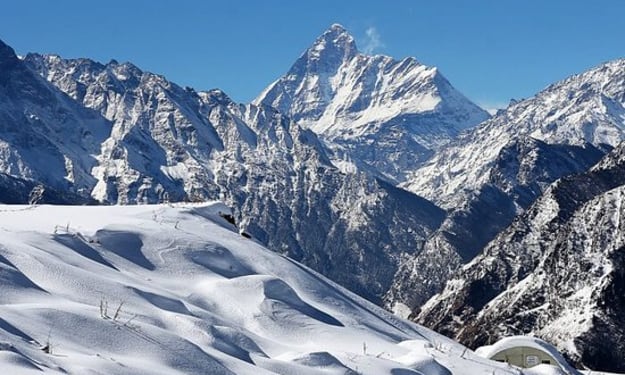
Everest Expedition: Conquering the World's Highest Peak
The Everest Expedition is the ultimate adventure, drawing climbers from around the globe to attempt the summit of Mount Everest (8,848.86 meters / 29,031.7 feet), the highest mountain on Earth. This challenging expedition is a test of endurance, skill, and determination, offering an unparalleled experience of the majestic Himalayas.
By Oliver Backman2 years ago in Earth
NASA’s Europa Clipper Uses Mars to Go the Distance.
NASA’s Europa Clipper Uses Mars to Go the Distance. NASA’s Europa Clipper is set to embark on a historic journey to explore Jupiter’s moon Europa one of the most intriguing celestial bodies in the solar system. This mission designed to determine whether Europa has conditions suitable for life relies on a strategic interplanetary route that includes multiple gravity assists. On March 1, 2025 the spacecraft will execute a critical maneuver by using Mars’ gravity to adjust its trajectory and fine tune its path toward the outer solar system. This technique a staple in NASA’s space exploration playbook allows the spacecraft to conserve fuel and optimize its travel time. Europa Clipper’s encounter with Mars is a planned gravity assist a maneuver where the spacecraft flies close to a planet to alter its trajectory using the planet’s gravitational pull. The upcoming flyby will bring the probe just 550 miles 884 kilometers above the Martian surface taking advantage of the Red Planet’s gravitational force to reshape its solar orbit. This interaction will slow down the spacecraft slightly refining its path in preparation for the next major assist a slingshot around Earth in December 2026. As Europa Clipper approaches Mars it will be moving at an impressive velocity of 15.2 miles per second 24.5 kilometers per second relative to the Sun. The planet’s gravity will act as a cosmic steering wheel bending the spacecraft’s path and adjusting its speed. After the flyby Europa Clipper will continue its voyage at a slightly reduced speed of 14 miles per second 22.5 kilometers per second positioning it for the next leg of its interplanetary journey.
By Adnan Rasheed2 years ago in Earth
Quick Himalayan Escapes: Best Weekend Treks from Delhi & Dehradun
Introduction When city life gets overwhelming, a quick Himalayan escape is the perfect way to recharge. Fortunately, there are several incredible weekend treks near Delhi and Dehradun that offer a refreshing break without requiring extensive planning. From lush meadows to snow-capped peaks, these treks are a dream come true for adventure seekers.
By Tenzingkungalothar2 years ago in Earth
The Hidden Health Gem That’s Changing Lives . AI-Generated.
Introduction to the Plant In the pursuit of enhanced well-being, many individuals are increasingly turning to natural remedies. Among these, moringa is emerging as a standout due to its remarkable health benefits. Often referred to as the "miracle tree," moringa is native to regions of Africa and Asia and has been utilized for centuries in traditional medicinal practices. Its global popularity is on the rise, and it's easy to see why.
By Joel Brown2 years ago in Earth
Love Those Creatures of the Night
Nocturnal animals are among the most intriguing because you know they are out there but you won't see them out and about during the daytime. These animals have keen senses that work for them in the dark at night. Usually their eyes are huge so that more light can get in them and they can see better at night. These night creatures have a special reflective layer in their eyes (tapedum lucidum) which bounces back light through the retina giving the animals super night vision.
By Rasma Raisters2 years ago in Earth
NASA installs 'bulletproof' sunshade on powerful Nancy Grace Roman Space Telescope.
NASA installs bulletproof sunshade on powerful Nancy Grace Roman Space Telescope. NASA's Nancy Grace Roman Space Telescope has achieved a significant milestone with the successful installation of its deployable sunshade a critical component designed to enhance the observatory's ability to capture faint infrared signals from the cosmos. This advancement brings the mission closer to its anticipated launch in 2027 promising to expand our understanding of the universe. The sunshade officially known as the Deployable Aperture Cover functions akin to a pair of blackout curtains effectively blocking unwanted light that could compromise the telescope's sensitive observations. Constructed from two layers of reinforced thermal blankets the design ensures that stray light is minimized thereby increasing the telescope's sensitivity to distant celestial objects. One of these layers is fortified with Kevlar the same material used in bulletproof vests providing robust protection against potential micrometeoroid impacts. This meticulous engineering ensures that even if one layer is perforated the staggered design reduces the likelihood of light penetrating both layers simultaneously maintaining the integrity of observations.
By Adnan Rasheed2 years ago in Earth
The Global Sneeze: How Pandemics Spread
Picture a world where every continent is just a hop, skip, and a jump away—a dazzling global network where modern jet travel can whisk you (and any unwelcome microscopic hitchhiker) from one side of the globe to the other in the blink of an eye. Today, a single sneeze in a crowded subway station can ignite a chain reaction that transforms local germs into a worldwide spectacle. Welcome to the age of instant connectivity, where every handshake and every boarding pass carries the hidden potential to spark a health crisis.
By Eyo Otoabasi2 years ago in Earth
Disconnect to Reconnect: Why an Iquitos Lodge is the Perfect Digital Detox
In today’s hyper-connected world, where notifications buzz non-stop and screens dominate our attention, the idea of unplugging seems almost impossible. But what if you could escape to a place where Wi-Fi is non-existent, your only playlist is the sound of nature, and your biggest concern is spotting a pink river dolphin or listening to the distant calls of a howler monkey?
By BRISA TROPICAL LODGE2 years ago in Earth
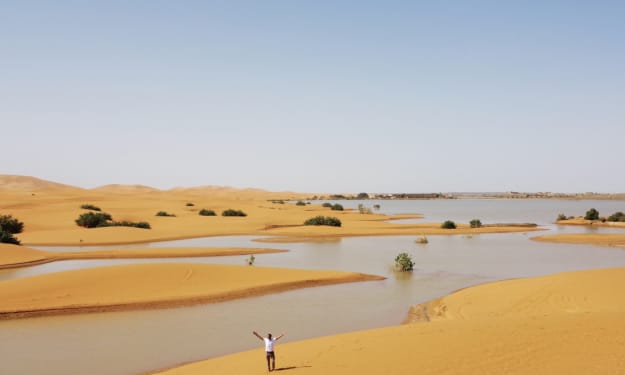
HOW SAHARA IS CHANGING
The Sahara is often seen as a barren wasteland. However, recent satellite images reveal surprising sights—lakes and rivers in Morocco and Algeria. This change followed heavy rains in early September 2024. These are not oases; they mark the Sahara returning to a wetter state. Long ago, the Sahara was a lush paradise with rich vegetation.
By Rafsan monir Kousol2 years ago in Earth
The End of the Earth: How Humans Are Destroying Their Own Planet
The End of the Earth: How Humans Are Destroying Their Own Planet The Earth, our home, is in grave danger. This crisis is not due to natural disasters or an asteroid collision, but rather because of human actions. Our carelessness, excessive consumption, and exploitation of nature have pushed the planet to the brink of destruction. Let’s explore how different countries around the world are contributing to this crisis.
By Nikita Angel2 years ago in Earth