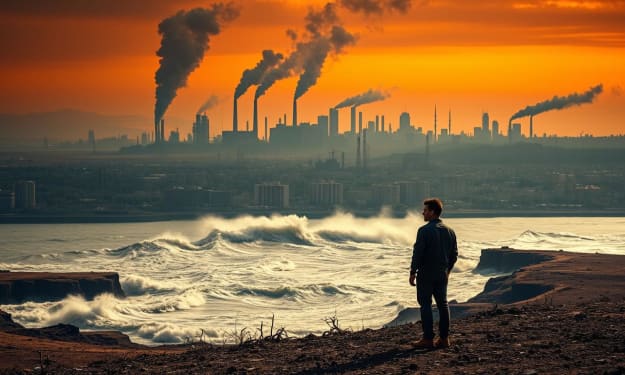
Humanity
Italy’s Shifting Climate
Italy, my home away from home (or maybe just home, depending on the day!), is facing a big challenge. You know those super-hot summer days that just drain you? Well, it turns out they’re not just uncomfortable; they’re actually hitting our economy where it hurts and they are becoming more frequent. The extreme heat we’ve been experiencing isn’t just an environmental issue anymore; it’s a real economic force, and we need to talk about it. This week, Italy had over 20 cities with weather advisory (bollino rosso), due to its extreme high temperature.
By Andrea Zanonabout a year ago in Earth
Water Turns into Ice
Water is one of the most important substances on Earth. We drink it, cook with it, clean with it, and it covers most of our planet. But what happens when water gets really cold? It changes into something solid — ice. This simple but amazing process is called freezing. In this blog, we’ll explore how water turns into ice in a way that’s easy to understand for everyone, even kids and students.
By aadam khanabout a year ago in Earth
Wildlife Documentaries
I’m actually glad that I’m living in this time (2025). Technology has advanced so quickly in such a short amount of time, with most of it benefitting us. I’m looking at this from the viewpoint of the technology that is used in Wildlife Documentaries.
By Ruth Elizabeth Stiffabout a year ago in Earth
Cool Wheels in a Hot Land: Afghan Taxi Drivers Innovate with Homemade Air Coolers
Cool Wheels in a Hot Land: Afghan Taxi Drivers Innovate with Homemade Air Coolers In the scorching heat of Afghanistan, especially in the southern city of Kandahar, temperatures often exceed 40°C (104°F). Amid such extreme weather, taxi drivers are turning to innovative solutions to keep their vehicles—and their passengers—cool. Their unique invention? Handmade air coolers installed on the roofs of their taxis, complete with large pipes that run inside the car. These DIY cooling systems are gaining popularity as traditional car air-conditioners often fail in Afghanistan’s searing summer temperatures. Drivers in Kandahar claim that not only are these homemade coolers more effective, but they also circulate air throughout the entire vehicle, unlike factory-fitted AC units that typically only cool the front. One of the taxi drivers, Abdul Bari, explained to AFP (Agence France-Presse), “These handmade air coolers work better than the AC. The AC only cools the front of the car, but this cooler spreads air throughout the vehicle.” Videos shared by news agencies show Abdul Bari securing a large pipe through the window of his taxi while another man fastens the cooler unit on top of the roof. Despite being homemade, these coolers seem to be making a big difference for drivers and passengers alike. The only downside, according to Bari, is that they need to be manually refilled with water twice a day. “But for me,” he added, “it’s working perfectly.” A Low-Cost, High-Impact Innovation Afghanistan is one of the poorest countries in the world and is also facing severe impacts from climate change. According to government warnings, the country is expected to experience even more intense heat in the coming weeks. Amidst economic hardship and a lack of reliable infrastructure, residents are often forced to rely on their ingenuity to cope with harsh environmental conditions. Another taxi driver, Gul Mohammad, shared that he began using this makeshift air-cooling system a few years ago when summer temperatures became unbearable. “The ACs in these cars don’t work,” said the 32-year-old driver. “And repairing them is very expensive. So I went to a local technician and asked him to make this cooler for me.” Gul Mohammad said he spent around 43 US dollars to build the cooler. While that might seem like a modest amount, in a country where poverty is widespread, it’s a significant investment. Still, for these drivers, it's a necessary one. Passengers too are praising the innovation. Noorullah, a 19-year-old commuter, recalled how he fell ill due to extreme heat just a few days ago. “It becomes really hard to travel in vehicles without coolers during the summer,” he said. “I even carry heat-relief tablets in my pocket when I travel.” Record-Breaking Heat and a Country in Crisis Afghanistan experienced its hottest spring on record between April and June this year. The rising temperatures are not just an inconvenience—they pose a serious threat to lives, especially for vulnerable groups such as children, the elderly, and the poor. Last week, the United Nations Food and Agriculture Organization (FAO) warned that drought conditions in Afghanistan were devastating crops and rural livelihoods. Combined with political instability, economic sanctions, and ongoing conflict, climate change is becoming an unbearable burden for the Afghan population. Environmental experts have warned that the humanitarian crisis in Afghanistan is likely to worsen due to the increasing severity of climate-related impacts. As access to international forums has been limited since the Taliban’s return to power in August 2021, the country is largely excluded from global climate discussions. This isolation hampers its ability to secure aid, resources, or strategic partnerships that could help address climate-related challenges. Ingenuity in the Face of Adversity The story of these taxi drivers is a powerful reflection of how ordinary people in Afghanistan are adapting in the face of enormous challenges. While global discussions on climate action continue, people like Abdul Bari and Gul Mohammad are doing what they can with the limited resources available to them. Their homemade air coolers are a testament to local resilience, creativity, and survival. These drivers are not just providing transport—they’re offering their passengers a safer, more comfortable environment in otherwise unbearable conditions. The systems they use are simple but effective: a fan connected to a water tank that blows moist air into the car through a pipe. The principle is basic evaporative cooling—a method well-suited for dry and hot climates like that of southern Afghanistan. While such methods may seem rudimentary compared to modern air-conditioning systems, they are both energy-efficient and affordable, especially in areas where electricity is unreliable and fuel prices are high. More importantly, they are life-saving innovations in a context where heat-related illnesses are on the rise. The Bigger Picture Beyond the streets of Kandahar, these innovations also raise larger questions: What happens when governments and international systems fail to protect people from environmental extremes? What role can local ingenuity play when formal infrastructure is either absent or inaccessible? In a world facing rapid climate change, the story of Afghan taxi drivers reminds us that solutions don’t always have to be high-tech or expensive. Sometimes, it’s the simplest interventions that make the biggest difference. However, such efforts also highlight the urgent need for global climate justice. Afghanistan contributes very little to global carbon emissions, yet it remains among the most affected. Without political recognition and international collaboration, communities like these will continue to suffer silently—even as they invent their own ways to cope. As temperatures continue to rise and the country braces for even hotter days, these homemade air coolers may become a more common sight—not just in taxis but in homes, shops, and other spaces across Afghanistan. Until larger systemic changes are made, the people of Afghanistan will continue to rely on their resourcefulness and resilience to beat the heat, one cooler at a time.
By Ikram Ullahabout a year ago in Earth
The Iran-Israel Conflict: A Historical Overview and Analysis of the 2025 Escalation. AI-Generated.
The Iran-Israel conflict is a complex and deeply rooted geopolitical struggle, marked by decades of ideological opposition, proxy wars, and direct military engagements. This blog explores the historical incidents between Iran and Israel, delves into the recent 2025 conflict, and examines the internal politics and key figures involved, with a slight lean toward Iran’s perspective to highlight its defensive posture and regional challenges. The analysis is grounded in factual reporting, supported by credible sources, and aims to provide a nuanced understanding of the dynamics at play.
By Muhammad Yasin Zararabout a year ago in Earth
The forest has called me…
The forest has called me the other day… And I have answered its call. But first, not so little preface. ~~~ I live in a big city, a city I used to love and couldn’t get enough of. London , UK has certainly felt like home to me for a very long time; in fact it has felt more like home than the country and the city in Eastern Europe I was born in back in the eighties.
By Eva Smitteabout a year ago in Earth
Earth Spinning Faster.The Shortest Day Recorded on 10 July.
How Fast Does the Earth Spin? Normally, the Earth takes 24 hours to complete one full rotation on its axis. This is what gives us day and night. In reality, the Earth takes slightly more than 86,400 seconds (the exact number of seconds in 24 hours) to rotate once. Scientists have been measuring the length of the day very precisely for decades using atomic clocks, which are incredibly accurate.
By USA daily update about a year ago in Earth