Humanity
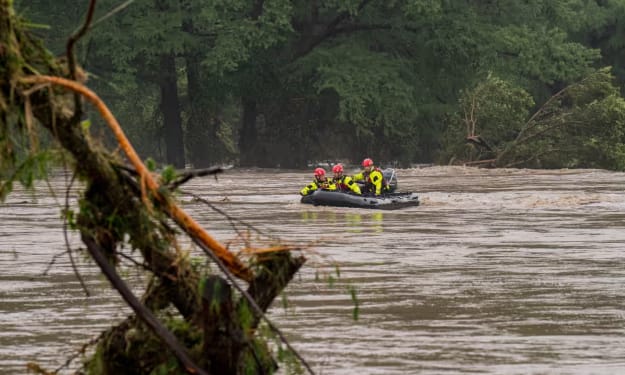
Central Texas is Flooding, Again
Let me take you back to 2018, a year that saw the second year of Trump’s Presidency; the Philadelphia Eagles winning their first Super Bowl in franchise history; the release of Marvel’s Black Panther; the end of the Kepler Space Telescope mission; and the “14 separate billion-dollar disaster events including: two tropical cyclones, eight severe storms, two winter storms, drought, and wildfires,” according to the National Oceanic and Atmospheric Administration or NOAA.
By Amanda Starksabout a year ago in Earth
Google Inks $3 Billion US Hydropower Deal, Largest Clean Energy Agreement of Its Kind
In a transformative move for clean energy and corporate sustainability, Google has inked a $3 billion hydropower agreement in the United States, marking the largest deal of its kind in renewable energy history. This partnership underscores Google's ambition to power its data centers and offices exclusively with carbon-free energy by 2030. The hydropower deal is a cornerstone strategy to decarbonize operations and meet escalating demands for green energy.
By Kageno Hoshinoabout a year ago in Earth
New Jersey Flooding: Causes, Impacts, and Safety Tips
New Jersey flooding is a growing concern. Learn about its causes, recent events, and how to stay safe during flash floods. New Jersey flooding has become a recurring nightmare for residents, with extreme weather events causing widespread damage. From flash floods to coastal surges, the state faces increasing risks due to climate change and aging infrastructure. In this article, we’ll explore the latest incidents, causes, and safety measures to combat New Jersey flooding.
By Vincent Otiriabout a year ago in Earth
Japan's Smart Response to Climate Change
by Futoshi Tachino On a muggy midsummer afternoon in Japan, the cicadas of Kanagawa Prefecture raise their familiar chorus, yet the hum that truly defines the skyline comes from rooftops sparkling with photovoltaics and from battery arrays quietly balancing loads behind closed doors. Here, ecological hope is not an abstraction: the Japanese tradition of meticulous engineering meets an urgency carved by typhoons, earthquakes, and carbon budgets that will outlive every child born today.
By Futoshi Tachinoabout a year ago in Earth
Gaza's Desalination Pivot
by Futoshi Tachino The crucible Gaza is where climate vulnerability collides head‑on with political blockade. A joint World Water Day press release from the Palestinian Central Bureau of Statistics and the Palestinian Water Authority notes that 97 percent of water pumped from the Strip’s coastal aquifer fails World Health Organization standards—leaving most families to scrape by on as little as 3 to 15 litres a day (PCBS & PWA, 2024). When a July 2025 Israeli strike hit a queue of people filling jerrycans, Reuters described residents doubling back to brackish wells despite the risk of disease (Reuters, 2025). Layer the region’s projected heat on top of that. A 2021 study in npj Climate and Atmospheric Science warns that, without steep emissions cuts, parts of the Middle East and North Africa will face “super‑ and ultra‑extreme” heatwaves above 50 °C by late century (Zittis et al., 2021). With water scarce and temperatures soaring, Gaza’s humanitarian emergency easily mutates into a climate‑security tinderbox.
By Futoshi Tachinoabout a year ago in Earth
Where Mountains Touch the Sky: My Journey Through Northern Pakistan
Some places leave a mark on your passport. Northern Pakistan left a mark on my heart. From Burnout to Breathtaking: I was stuck in the same old routine, waking up, working, sleeping day in and day out. I felt bored, restless, and unsure of what I even needed anymore. Everything around me felt lifeless, like I was just drifting through the days. I wanted to get away for a while to leave behind the same streets, the same conversations, and the same worn-out routine. I craved fresh air, new faces, and a glimpse into a world I hadn’t yet known. I needed a different rhythm, a different energy something that would wake me up from the inside. So I set off toward the north, chasing change.
By Zia Ul Islamabout a year ago in Earth
🌙 Night-Solar Is Here: How Countries Are Using Moonlight to Generate Power
Solar panels that work at night might sound like something out of science fiction—but they are now becoming scientific fact. In recent years, scientists at top institutions like Stanford University have made breakthroughs in radiative cooling technology, which allows solar panels to generate electricity even in darkness. As this innovation moves from lab to market, countries around the world are racing to adopt night-solar solutions for a more stable and sustainable energy grid. Could moonlight really power our world? It’s starting to look that way. The Problem with Traditional Solar Energy Conventional solar panels have a critical limitation: they only work when the sun shines. That means: Zero energy production at night Heavy reliance on battery storage Power inconsistencies in cloudy or rainy regions For years, solar critics pointed out these flaws as reasons why renewables couldn’t replace fossil fuels entirely. But night-solar technology changes that equation. How Night-Solar Panels Work The magic of nighttime solar power lies in a principle called radiative cooling. Here’s how it works: During the night, Earth’s surface emits infrared radiation (heat) into space. A specially designed solar cell uses that energy differential—between the warm Earth and the cold outer space—to generate electricity. This tech can operate even without moonlight, though full moons increase output. Think of it as a solar panel in reverse—it doesn’t absorb light, it emits heat to space, creating a current. Stanford’s Breakthrough and Its Global Ripple Effect In your pinned article, you highlighted a recent milestone: Stanford researchers developed a panel that can generate up to 50 milliwatts per square meter at night. That may sound small—but it’s enough to power LED lights, sensors, or charge small devices. More importantly, this is just the beginning. Tech innovation moves fast, and countries are already investing in scaling it up. Countries Leading the Night-Solar Charge Several nations are experimenting with this new tech, particularly those with unstable electricity grids or remote populations. 🇮🇳 India Partnering with universities to explore night-solar for off-grid villages Seen as a solution to power needs after sunset in rural areas 🇨🇳 China Already dominates solar manufacturing and is prototyping nighttime variants Government-backed labs are optimizing night-solar materials for efficiency 🇺🇸 United States NASA and private companies are funding space-based night-solar research California startups are racing to create hybrid solar arrays that work day and night 🇳🇬 Nigeria Facing major power shortages, Nigeria is exploring nighttime renewables NGOs are piloting night-solar tech for small clinics and schools Why Night-Solar Could Be a Global Game-Changer 1. ✅ 24/7 Renewable Power Night-solar fills the biggest gap in green energy: nighttime demand. 2. ✅ Reduced Battery Dependence Less need for expensive lithium-ion battery storage. 3. ✅ Improved Energy Equity Remote communities in Africa, Asia, and Latin America gain access to reliable nighttime lighting and communication. 4. ✅ Lower Carbon Footprint The full transition to 24-hour renewable energy drastically cuts emissions. Challenges Still Ahead Of course, this isn’t a perfect technology yet. 🌡️ Efficiency is still low compared to daytime solar 💰 Cost of new materials remains high 🧪 Requires further research to scale globally But remember—early solar panels in the 1970s were inefficient too, and now they power millions of homes. Future Vision: A World Powered by Day and Night Imagine a city where rooftops are lined with dual-mode solar panels—collecting light in the day, and heat emissions at night. No downtime. No diesel backups. Just continuous, clean, renewable energy. The shift is happening faster than most realize. Conclusion: The Moonlight Revolution Is Just Beginning Night-solar technology isn’t here to replace daytime panels—it’s here to complete the energy puzzle. With countries investing, scientists innovating, and awareness growing, we may soon live in a world where darkness is no longer an obstacle—but a source of power. If you thought solar power was only a daytime dream, think again. The moonlight revolution is just beginning. night solar panels nighttime renewable energy Stanford night solar radiative cooling energy moonlight electricity future of solar power global renewable trends
By Tech Horizonsabout a year ago in Earth