Climate
Our dear planet
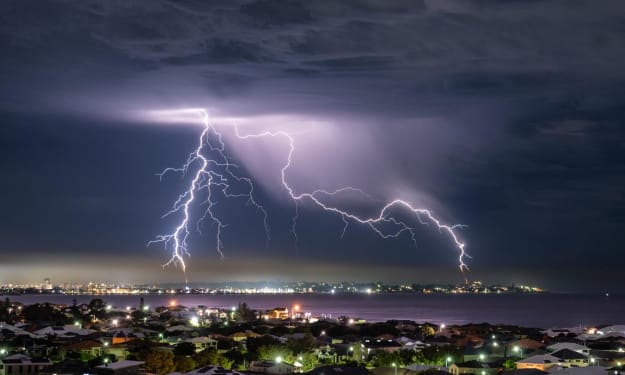
The beauty and mesmerization of the northern lights, home to the Scandinavian countries have sparked engrossment in our hearts, as they appear luminous and simply beautiful. They're called Auroras, and sadly are not prevalent in the equator, but only countries located in the northern and southern hemisphere can get a glimpse of those eye candy sights.
By Mars Frederick3 years ago in Earth
Climate change and Environment
In a small coastal village named Luminar, nestled between lush green mountains and the sparkling ocean, lived a young girl named Amina. Luminar was a place of unparalleled beauty, where the harmony between nature and humanity seemed unbreakable.
By Jamiu Khadeejat3 years ago in Earth
The urgency of taking action to address climate change
In the heart of a small coastal village, where the sunsets once painted the sky in hues of gold and crimson, a sense of unease hadbegun to settle. The winds were warmer, the sea more restless, and the once-thriving fishing industry had dwindled to a mere shadow of its former self. The villagers could no longer deny the truth—the world around them was changing, and the urgency to take action had never been more critical.
By Benard Patrick3 years ago in Earth
Loss of Natural Beauty
Amelia had always found solace in the heart of the forest. The rustling leaves, the gentle babbling of the brook, and the melodious chirping of birds created a symphony of serenity that she could lose herself in for hours. Growing up, she had explored every hidden trail, every secret glade, and every tranquil clearing, building an intimate bond with nature that was stronger than any other.
By Segawa Arafat3 years ago in Earth
Unraveling the Mystery of Missing Ocean Plastic: Where Does It Go?
The vast expanse of the world's oceans holds a hidden secret: the accumulation of plastic waste. With significant attention on the Great Pacific Garbage Patch, a vast area between Hawaii and California, scientists have sought to understand where our ocean's plastic ends up. Despite the discovery of multiple garbage patches around the globe, recent studies reveal that the visible plastic at the ocean's surface only accounts for a small fraction of the total plastic pollution, leaving scientists to grapple with a perplexing question: where does the rest of the plastic go?
By Vivian Yao3 years ago in Earth
Harmony's Haven
In the heart of a quaint village nestled between gentle, rolling hills, there lived a young woman named Elara. From an early age, she had been captivated by the beauty and wonder of nature. Every sunrise painted the world in hues of gold, and every raindrop's touch was a blessing from the heavens. Elara's heart ached for the Earth and its well-being, and she dreamt of creating a garden that would not only dazzle the eyes but also nurture the land it rested upon.
By Yakubu Abubakar3 years ago in Earth
How we can all contribute to, the fight against climate change from our immediate environment....Article 2
Harnessing Energy Efficiency to Mitigate Climate Change: A Sustainable Path Forward Introduction Climate change is an unprecedented global challenge that poses significant threats to our planet's atmosphere and environment. The accumulation of greenhouse gases, primarily carbon dioxide (CO2) and methane, in the atmosphere has led to a warming trend, resulting in various adverse impacts such as rising sea levels, extreme weather events, and disruptions to ecosystems. Addressing climate change requires a comprehensive approach, and one of the key strategies in the fight against it is energy efficiency. In this article, we will explore the concept of climate change, its impact on the atmosphere and environment, and delve into the ways energy efficiency measures can play a crucial role in combating it.
By Nwafulume Uchenna3 years ago in Earth
A Journey of Hope Amidst the Storm
Once upon a time in a quaint village nestled between rolling hills, lived a young woman named Eliza. She had always dreamt of embarking on a grand adventure beyond the village, to explore the vast world that lay outside. With determination shining in her eyes, she set out on a long journey, her heart brimming with excitement and curiosity.
By Bala Tahir Yunusa 3 years ago in Earth
What are Hurricanes?
Have you heard the news of Hurricane named Idalia is moving towards the Florida and it is categorized as category 3 strength Hurricane? If you have heard the news then do you know how Hurricanes forms and how are they classified? If you don't know then let's get to know. When a cluster of thunderstorm develop over warm tropical Ocean and moves towards low pressure area it starts rotating when these clusters grow in size they known as tropical cyclones. The word cyclone is derived from the Greek word Cyclos meaning the coils of a snake and it was coined by Henry Piddington. Cyclones are the most violent storms on Earth. People call these storms by other names, such as typhoons or cyclones Tropical cyclones that form over the Atlantic Ocean or eastern Pacific Ocean are called Hurricanes. Hurricanes are large storms which can produce wind of upto 120km/hr. Winds of Hurricane can damage buildings and trees and can also cause flooding in affected areas. There are 6 factors that can be held responsible for the formation of the cyclone: 1. Warm temperature at the surface of the sea. 2. Instability in atmosphere. 3. Coriolis force: Coriolis force is an apparent force caused by the earth's rotation. The Coriolis force is responsible for deflecting winds towards the right in the northern hemisphere and towards the left in the southern hemisphere. 4. High level of humidity in lower part of troposphere. 5. Low pressure area 6. Low vertical wind shear: Wind shear is a change in wind speed and/or direction over a short distance. There are five categories of hurricanes. The categories are based on wind speed. 1. Category 1: wind speed 119 to 153 km/hr. 2. Category 2: wind speed 154 to 177 km/hr. 3. Category 3: wind speed 178 to 208 km/hr. 4. Category 4: wind speed 209 to 251 km/hr. 5. Category 5: wind speed more than 252 km/hr. There are three main parts of Hurricane. Eye: The eye is the "hole" at the center of the storm. Eye wall: The eye wall is a ring of thunderstorms. The wall is where winds are strongest and rain is heaviest. Rain bands: Bands of clouds and rain go far out from a hurricane's eye wall. These bands stretch for hundreds of miles. How are Hurricanes Named? There can be more than one hurricane at a time. This is one reason hurricanes are named. Names make it easier to keep track of and talk about storms. Each year, tropical storms are named in alphabetical order. The names come from a list of names for that year. There are six lists of names. Lists are reused every six years. If a storm does a lot of damage, its name is sometimes taken off the list. It is then replaced by a new name that starts with the same letter. Some most devastating Hurricanes: 1. Hurricane Katrina: It is Category 5 Hurricane forme in Atlantic Ocean on 23rd August 2005. It takes the lives of 1836 people and damage the property of around $145 billion. 2. Hurricane Maria: This category 5 Hurricane hits the Puerto Rico in September 2017 and accounted for almost 3000 deaths. 3. Hurricane Sandy: It was extremely destructive Hurricane of Octavia 2012. It was largest Atlanic Hurricane. 4. Hurricane Sandra: It was one of the major hurricanes in the north-east Pacific region. 5. Hurricane Camille: Hurricane Camille impacted the southeast Mississippi and southwest Alabama Hurricane Camille made landfall along the Mississippi Gulf Coast. Camille ranks as the 2nd most intense hurricane to strike the continental US, Camille ranks just below the 1935 Labor Day Hurricane. 6. Labor Day Hurricane: The 1935 Labor Day Hurricane, which struck the Florida on September 2, still holds the record for the lowest pressure ever recorded for any tropical cyclone or hurricane in the Western Hemisphere.
By Nikhil Jadhav3 years ago in Earth
The Role of Human, Technology in Disaster Relief
In recent years, technological advancements have revolutionized disaster relief efforts, particularly in the aftermath of catastrophic events like hurricanes. Drones and Artificial Intelligence (AI) have emerged as indispensable tools, playing a crucial role in expediting response, enhancing situational awareness, and aiding in the recovery process. Their ability to navigate challenging environments, gather data, and assist in decision-making has transformed the way relief organizations approach hurricane recovery.
By OKAFOR OGECHUKWU3 years ago in Earth