Advocacy
Tensions Rise: USA, Israel, and Iran — What We Know”
Tensions Rise: USA, Israel, and Iran — What We Know” In the last few days, world attention turned to a high-profile meeting between U.S. President Donald Trump and Israeli Prime Minister Benjamin Netanyahu at Trump’s Mar-a-Lago residence in Florida. The leaders met to discuss a range of issues, but a major focus was Iran — its ballistic missile program and its nuclear developments.
By Wings of Time 9 months ago in Earth
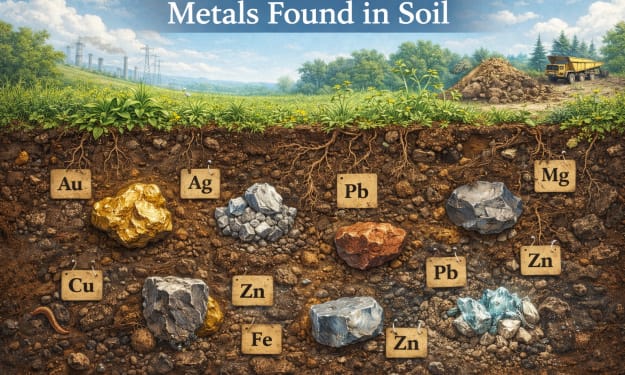
Metals Found in Soil Hidden Elements Beneath the Earth’s Surface. AI-Generated.
How Metals Enter the Soil Metals enter soil through both natural and human-made processes. Natural Sources Weathering of rocks releases metals into the soil over millions of years Volcanic activity adds metal-rich ash River deposits spread metal particles across land Human Activities Mining and smelting Industrial waste disposal Use of fertilizers and pesticides Vehicle emissions and urban pollution Over time, these processes increase the concentration of metals in soil. Common Metals Found in Soil 1. Iron (Fe) Iron is one of the most abundant metals in soil. It gives soil its red or brown color. Importance: Essential for plant growth Helps in chlorophyll formation Improves soil structure Iron-rich soils are commonly found in tropical and subtropical regions. 2. Aluminum (Al) Aluminum is naturally present in most soils. Characteristics: Not essential for plants Can become toxic in acidic soils Affects root growth High aluminum levels can reduce crop productivity. 3. Calcium (Ca) Calcium is a beneficial metal found in soil. Role: Improves soil fertility Helps plant cell wall development Reduces soil acidity Lime is often added to soil to increase calcium content. 4. Magnesium (Mg) Magnesium is an essential nutrient. Importance: Part of chlorophyll molecule Helps enzyme activity in plants Improves photosynthesis Magnesium-deficient soils lead to poor plant growth. 5. Potassium (K) Potassium is widely found in soil minerals. Uses: Enhances plant resistance to disease Improves crop yield Regulates water balance in plants It is commonly added through fertilizers. Trace Metals in Soil Trace metals are present in very small amounts but are extremely important. 6. Zinc (Zn) Essential for plant enzymes Helps seed development Deficiency causes stunted growth 7. Copper (Cu) Required for photosynthesis Supports plant respiration Excess copper can be toxic 8. Manganese (Mn) Aids plant metabolism Helps nitrogen use High levels cause leaf damage 9. Nickel (Ni) Needed in very small quantities Supports enzyme activity Toxic at higher concentrations Heavy Metals in Soil Heavy metals are a serious concern because they can be toxic. 10. Lead (Pb) Comes from industrial waste and old paints Affects human nervous system Dangerous for children 11. Cadmium (Cd) Found near mining areas Accumulates in crops Causes kidney and bone damage 12. Mercury (Hg) Released from coal burning and industries Highly toxic Can enter food chains Benefits of Metals in Soil Not all metals are harmful. Many are essential for life. Positive roles include: Supporting plant nutrition Improving crop yield Maintaining soil structure Supporting microorganisms Healthy soil contains a balanced mix of metals. Negative Effects of Excess Metals Excessive metal concentration can cause: Reduced plant growth Soil pollution Contaminated groundwater Health risks to humans and animals Crops grown in contaminated soil may absorb toxic metals. Metal Absorption by Plants Plants absorb metals through their roots. Some plants, called hyperaccumulators, can absorb large amounts of metals. These plants are used in phytoremediation, a method to clean polluted soils naturally. Managing Metal Levels in Soil To maintain healthy soil: Test soil regularly Use fertilizers carefully Add organic matter Avoid industrial waste dumping Practice crop rotation These methods help control metal concentration. Importance for Human Life Metals in soil indirectly affect human health through food. Balanced metal levels ensure: Nutritious crops Safe drinking water Healthy ecosystems Soil management is crucial for sustainable agriculture.
By Say the truth 9 months ago in Earth
The AI That Can Predict Your Next Move—And Why Everyone Is Talking About It
Imagine this: You’re scrolling through your favorite app, and suddenly it recommends something before you even knew you wanted it. A movie, a song, an article—it’s eerily precise. Some people call it coincidence. Others call it magic. But the truth? It’s artificial intelligence. And the kind of AI that’s being developed today isn’t just smart—it’s predictive, almost like it can read your mind.
By Yasir khan9 months ago in Earth
The Water Crisis That Could Spark Global Tensions
The Water Crisis That Could Spark Global Tensions Water—something we often take for granted—is becoming one of the world’s most precious resources. Across the globe, rivers are drying up, lakes are shrinking, and underground water supplies are disappearing faster than they can naturally refill. What was once a local problem is now a growing international concern, and countries are beginning to clash over access to freshwater.
By Wings of Time 9 months ago in Earth
The Hidden Magic of Ordinary Days
We tend to wait for life to deliver something extraordinary. A huge adventure. A moment that changes everything. A story worth telling. But the truth is, magic doesn’t always arrive with fanfare. Most of it is subtle, tucked into ordinary days, waiting for someone curious enough to notice.
By Yasir khan9 months ago in Earth
Whistler 2025: More Than a Destination, A Journey Into Peace and Purpose
Whistler is not just a destination; it is an experience that quietly changes the way you see the world. Located in the Coast Mountains of British Columbia, Canada, Whistler is widely known as one of the most beautiful mountain resorts on Earth.
By Daily Motivation9 months ago in Earth