Latest Stories
Most recently published stories in Earth.
Digital Burnout Is Real: Why Logging Off Might Save Your Sanity. AI-Generated.
The Age of Endless Pings We wake up to buzzing phones, scroll through notifications before our feet hit the floor, and dive headfirst into a sea of emails, posts, and messages. Our days are shaped by screens and punctuated by pings. In a world more connected than ever, the irony is hard to ignore: we’re drowning in digital noise, and it’s costing us our peace. Welcome to the age of digital burnout—where your brain feels like a browser with 47 tabs open, most of them frozen. --- What Exactly Is Digital Burnout? Digital burnout isn’t just about being tired. It’s a deep, psychological fatigue caused by the overuse of digital devices and platforms. It creeps up on you slowly: you can’t focus for more than a few minutes, your sleep is fractured, and your creativity feels suffocated. Everything feels urgent, and nothing feels fulfilling. We often confuse productivity with purpose. But if every moment is spent responding to others—emails, DMs, Slack messages—when do we respond to ourselves? --- Why Are We So Hooked? Technology is designed to be addictive. Infinite scrolling, dopamine-triggering likes, and autoplay features aren’t bugs—they’re features, deliberately engineered to hijack our attention. Social media apps reward us intermittently, much like slot machines. You don’t know what you’ll get, but maybe this time you’ll feel seen, loved, or validated. This variable reward system is part of what keeps us checking our phones hundreds of times per day—often without realizing it. We tell ourselves we’re "just checking something real quick." But real quick turns into 30 minutes lost in a digital haze. The minutes add up, but so does the mental clutter. --- The Myth of Being "Always Available" One of the most damaging ideas of our era is that we must always be reachable. That responding immediately is a sign of respect or efficiency. But this expectation erodes our boundaries, leaving little space for reflection, creativity, or even boredom (which, ironically, is a gateway to new ideas). We weren't built to process thousands of inputs a day. Yet, many of us move through life like human routers—receiving, sending, buffering, crashing. --- The Impact on Mental Health There’s mounting research on how constant digital exposure affects mental well-being: Increased anxiety from comparison and information overload Reduced attention spans due to constant switching between apps and tasks Sleep disruption from blue light exposure and late-night scrolling Isolation masked as connection—interactions online replacing meaningful offline relationships The kicker? Even when we know this, we often feel powerless to stop. --- The Power of Logging Off (and How to Actually Do It) You don’t need to quit the internet or toss your phone in a river. You just need to be intentional about how and when you use it. Here are some realistic ways to reclaim your time and mental clarity: 1. Schedule Screen-Free Hours Try unplugging for the first and last hour of your day. Mornings set your tone; nights set your rest. Give yourself real space to think, stretch, and exist without external noise. 2. Use “Do Not Disturb” Like a Gatekeeper You are not obligated to be on-call for the world. Set your phone to Do Not Disturb during meals, focused work, or rest. People will adjust—trust me. 3. Delete One App (Even Temporarily) Which app drains you the most? Delete it for a weekend. Watch how your brain reacts. The discomfort is revealing—and eventually freeing. 4. Relearn Boredom Let yourself be bored in line, in traffic, or waiting at a café. Boredom breeds insight. It allows your brain to process, reflect, and generate ideas instead of being constantly distracted. 5. Practice “Digital Minimalism” Coined by author Cal Newport, this concept encourages using tech with intention. Instead of saying yes to every platform, ask: “Does this genuinely serve me?” If not, let it go. --- Reclaiming Attention as a Radical Act Attention is the currency of the digital age. Every scroll, click, and watch is monetized. Reclaiming your attention is more than self-care—it’s resistance. It’s refusing to be a passive consumer and choosing instead to be a conscious participant in your own life. We often chase productivity hacks, but the real hack is slowing down. Resting. Thinking. Creating. Being. --- A Personal Experiment Earlier this year, I did a 7-day digital detox. No social media, no unnecessary phone time, no Netflix binges. I journaled, took long walks, cooked without watching YouTube videos, and even rediscovered how much I love drawing (badly, but joyfully). The result? I slept better. I laughed more. I had ideas I hadn’t had space to hear in months. Logging off didn’t disconnect me—it reconnected me to the parts of myself I’d been too busy to notice. --- Final Thoughts: Your Life Is Not a Feed Your life isn’t meant to be lived in highlights or hashtags. It’s not supposed to feel like a stream of updates or performance metrics. It’s supposed to feel lived. Messy, boring, beautiful, and real. You don’t need to earn rest. You don’t need permission to slow down. Digital burnout is a wake-up call—not just to unplug, but to reengage with what truly matters. So the next time you feel overwhelmed, anxious, or scattered, try this radical move: log off. Your soul will thank you.
By GoldenToneabout a year ago in Earth
Earth Spinning Faster.The Shortest Day Recorded on 10 July.
How Fast Does the Earth Spin? Normally, the Earth takes 24 hours to complete one full rotation on its axis. This is what gives us day and night. In reality, the Earth takes slightly more than 86,400 seconds (the exact number of seconds in 24 hours) to rotate once. Scientists have been measuring the length of the day very precisely for decades using atomic clocks, which are incredibly accurate.
By USA daily update about a year ago in Earth
Challenging Peak Trails in Marin for Avid Hikers. Content Warning.
By Sam Bennett For experienced hikers seeking a challenge, Marin County delivers steep ascents and rugged trails that promise a serious workout and even greater views. These peak hikes will test your endurance and reward you with panoramic vistas and a lasting sense of accomplishment.
By Bay Area Back Roadsabout a year ago in Earth
Plastics in Electronics
Plastics are everywhere in electronics, from smartphone casings to circuit board insulation. But choosing the right polymer is about much more than just convenience. It requires a careful balance between performance, safety, cost, and environmental responsibility. The Enviropass article, “Plastics in Electronics: A Guide for Engineers,” explores how different plastics shape the design and sustainability of electronic products.
By Mahgol Nikpayamabout a year ago in Earth
"Earth Speaks: The Untold Story Beneath Our Feet"
We walk on it, build on it, and live because of it — yet we rarely listen to it. Earth, our only home, isn’t silent. It speaks in tremors, whispers through winds, sighs with the melting of glaciers, and groans under the weight of human industry. If we pay close attention, Earth tells a story — ancient, urgent, and unfolding in real time beneath our feet. The Living Planet Earth is not just a rock floating in space; it’s a dynamic, living system. The concept of Gaia Theory, introduced by scientist James Lovelock, suggests Earth functions like a self-regulating organism. Its oceans, forests, atmosphere, and even the soil interact like organs in a body, working together to sustain life. Soil alone is more alive than most people imagine. Just one tablespoon contains more microorganisms than there are people on Earth — fungi, bacteria, and other tiny creatures that make life above ground possible. They decompose organic matter, fix nitrogen, and help grow the food we eat. Yet much of this underground world remains a mystery, a silent story still being uncovered. Earthquakes and Fire: The Planet’s Pulse Sometimes, Earth speaks more forcefully. Every day, there are thousands of small earthquakes around the globe. Most go unnoticed, but they are signs of the planet’s internal motion. These tremors happen as tectonic plates — massive slabs of Earth’s crust — shift and grind against each other. This process has shaped continents, created mountains, and caused devastating events. Volcanoes are another voice of Earth — sometimes violent, sometimes subtle. While eruptions can destroy, they also give life. Volcanic soil is among the most fertile on the planet, and eruptions have played a key role in shaping our atmosphere and ocean chemistry over millions of years. The Climate Conversation In more recent decades, Earth has been speaking louder and more urgently. Temperatures are rising, glaciers are retreating, oceans are warming, and extreme weather is becoming more common. These are not random occurrences — they’re symptoms. Imagine Earth with a fever. Carbon dioxide and methane — greenhouse gases from burning fossil fuels, deforestation, and agriculture — act like a blanket, trapping heat in the atmosphere. The more we burn, the thicker the blanket becomes. Earth is responding. In the Arctic, sea ice once as old as ancient civilizations is melting at record speeds. Coral reefs, often called the “rainforests of the sea,” are bleaching and dying as ocean temperatures rise. Droughts, floods, and wildfires are becoming part of a new normal. The Hidden Layers: What Lies Beneath Beneath the crust lies a realm of heat and pressure that powers the engine of plate tectonics. Deeper still is the Earth’s core — a swirling sea of molten metal that generates our magnetic field, shielding life from deadly solar radiation. These deep systems may seem distant, but they affect our daily lives. Without the magnetic field, GPS satellites wouldn’t work, power grids would be vulnerable, and our atmosphere could be stripped away by solar winds. Even deeper, scientists are now exploring the possibility of a “deep biosphere” — a hidden world of microbial life miles beneath the surface. Some of these microbes live in environments so extreme they challenge what we thought life needed to survive. What we learn from them may help us understand life on other planets, and our own origins. Are We Listening? The truth is, Earth has always spoken. But have we been listening? Indigenous cultures have long viewed the planet as a living entity, something to respect and live in balance with. Modern science is now catching up to this wisdom, revealing how interconnected everything is — from the roots of a forest to the clouds in the sky. We are part of this system. Our actions ripple through Earth’s systems in ways both visible and hidden. But here’s the good news: we also have the power to heal. Regenerating soil, restoring forests, reducing emissions, and shifting how we interact with nature can all help rewrite the next chapter. The Next Chapter Earth’s story is still being written — and we’re not just readers; we’re authors. The question is, what kind of story do we want to tell? One of collapse and silence, or one of listening, healing, and coexisting? If we pay attention to the signs — the language of wind, water, stone, and soil — perhaps we’ll hear not just warnings, but guidance. Earth is speaking. And the time to listen is now.
By Muhammad Saad about a year ago in Earth
"Where the Earth Speaks in Steam: A Walk Through Sulfur Realms"
Where the Earth Speaks in Steam: A Walk Through Sulfur Realms Tracing the Breath of the Planet in a World of Mist, Minerals, and Fire --- There are places on this Earth that feel less like parts of our world and more like whispers from another realm—untouched, untamed, and almost mythical. Sulfur lakes belong to that realm. Veiled in swirling steam, colored with unnatural hues, and perfumed with the acrid breath of the underworld, they stand as raw, living proof that the Earth is not a static rock but a breathing, pulsing organism. To walk through these sulfur realms is not merely a geological experience—it is a spiritual, sensory, and psychological journey. This is the story of what it feels like to stand at the edge of creation, in places where the planet exhales. --- 🌋 What Are Sulfur Lakes? Sulfur lakes, also called acidic crater lakes, form in areas of intense volcanic activity. These lakes are often born inside volcanic craters or calderas and are rich in dissolved sulfur, producing an eerie, iridescent appearance—ranging from milky turquoise to neon yellow or even a ghostly grey. The water in these lakes is extremely acidic, sometimes with a pH near zero, making it as corrosive as battery acid. They are often heated from below by magma chambers, resulting in the continuous release of steam, sulfur dioxide, and other volcanic gases. Famous examples include: Kawah Ijen, Indonesia — home to electric blue flames at night. Dallol, Ethiopia — one of the hottest, lowest, and most acidic environments on Earth. Yellowstone’s Grand Prismatic Spring, USA — known for its vivid rainbow colors caused by microbial life. Poás Volcano, Costa Rica — with its roiling, acid-green lake shrouded in toxic mist. --- 🥾 My Journey Into the Sulfur Realm The path wasn’t paved. It wasn’t marked clearly either. The air grew thicker as I ascended a rocky trail, and with each step, I felt the terrain becoming more alive beneath my feet—warm, trembling, and unpredictable. The breeze carried the distinct, almost metallic smell of sulfur—like a thousand burnt matchsticks crushed into dust. Approaching the crater’s edge felt like arriving on another planet. The lake before me wasn’t just water. It was color, steam, and sound. The surface boiled gently, hissing and spitting occasionally as if irritated by our presence. Gases escaped in sudden bursts from vents along the shore, and thick plumes of steam curled around jagged volcanic rocks like fingers grasping at the sky. My guide wore a gas mask. I didn’t. Not at first. Within minutes, the sharp, stinging air began to bite my lungs, and my eyes watered uncontrollably. Breathing became difficult. The sulfur stung in ways I never imagined. It was both terrifying and intoxicating. --- 🌫️ The Science Behind the Steam What gives these lakes their character is the combination of volcanic heat, gas emissions, and mineral content. The high sulfur concentration interacts with groundwater and rainwater, creating sulfuric acid. When this acid dissolves minerals in the surrounding rocks, it contributes to the unique coloration and chemical makeup of the lake. In places like Kawah Ijen, miners harvest solidified sulfur at great personal risk. The glowing blue fire that tourists come to witness is caused by ignited sulfuric gases, which burn only at night, creating a supernatural effect. In Yellowstone, the vibrant colors aren’t from minerals alone—but from thermophilic bacteria that thrive in extreme temperatures and pH levels. Each ring of color corresponds to a different microbial colony, adapted to very specific living conditions. --- 💀 Danger and Beauty Intertwined Despite their mesmerizing beauty, sulfur lakes are deadly. The acidity can dissolve flesh and bone. The surrounding area may collapse without warning due to underground activity. The gases—especially hydrogen sulfide and sulfur dioxide—can be lethal in high concentrations. In 2013, two tourists died near a crater lake in Indonesia due to toxic gas exposure. Even experienced geologists tread carefully, often wearing full respirators and monitoring air quality at all times. Yet, this danger only adds to the allure. Much like the edge of a storm, there’s a magnetic pull to these places. They remind us that nature is not just a passive backdrop to human life—it’s powerful, dynamic, and very much alive. --- 🌍 Cultural and Mythical Significance Many ancient cultures considered sulfur-rich areas as entrances to the underworld. In Greek mythology, volcanic sulfur springs were linked to Hades. In some Indigenous traditions, these steaming, bubbling waters are sacred, seen as the breath of gods or spirits that reside within the Earth. The smell of sulfur has long been associated with omens, purging, and transformation. Alchemists in the Middle Ages believed sulfur represented the soul or the divine essence of change. It’s no surprise then that walking through these realms often feels less like tourism and more like a pilgrimage. --- 🧠 A Psychological Experience There is something deeply humbling about standing in front of a sulfur lake. The chaos and power of the Earth become palpable. You feel small—insignificant—but not in a disempowering way. It’s a reminder of your place in the cosmos, a kind of ego-shattering encounter that forces you to listen. The constant hiss of steam is not white noise. It’s like the Earth is breathing, speaking in a language older than words. I stood in silence for a long time, listening to that breath. --- 📸 Photography and Preservation Sulfur lakes are some of the most photogenic but challenging places to photograph. The intense light reflections off the acidic water, the fast-moving steam, and the need to protect camera gear from corrosive air make it a test for even seasoned photographers. Preservation is also a major concern. With increasing tourism, these fragile ecosystems are at risk. Many regions now require permits or guided tours to reduce human impact. The best way to honor these places is with respectful observation—leave no trace, take only memories (and photos). --- 🌐 Why You Should Go (Cautiously) If you ever have the chance to visit a sulfur lake—go. But go with reverence, preparation, and an open heart. Bring protective gear. Learn about the local geology. Hire a guide if it’s remote. And most importantly, take time to feel. These lakes aren’t just about sightseeing; they’re about connection. They are a mirror held up to the raw power of the planet—and to ourselves. To walk through sulfur realms is to feel the pulse of something ancient and eternal. --- Final Thoughts In a world of curated experiences and polished perfection, sulfur lakes stand out as wild, untamed truths. They are not beautiful in a traditional sense. Their beauty is violent, volatile, and honest. They show us that beneath our cities, our comforts, and our illusions of control, the Earth is still alive—and it speaks. Sometimes in fire. Sometimes in steam. And sometimes, if you’re quiet enough, you can hear it breathe.
By Hasbanullahabout a year ago in Earth
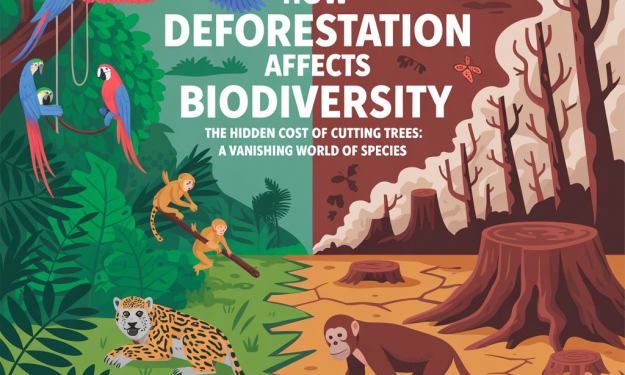
How Deforestation Affects Biodiversity
Introduction Forests are often called the lungs of the Earth, not just because they absorb carbon dioxide and release oxygen, but because they support an extraordinary range of life. From the tropical rainforests of the Amazon to the temperate woodlands of North America, forests are home to more than 80% of terrestrial animals, plants, fungi, and microorganisms. However, this rich biodiversity is under serious threat due to deforestation—a large-scale removal of forested areas, often driven by human activities. As forests disappear, so do the many species that depend on them. Deforestation is not just an environmental issue—it is a biodiversity crisis with far-reaching consequences for ecosystems, climate, and human well-being.
By JAWAD HUSSAINabout a year ago in Earth