Latest Stories
Most recently published stories in Earth.
''Whispers of the Wild''
The forest had always been a place of secrets. To the villagers of Elmswood, it was simply known as the Greenwood. Towering oaks, ash, and birch stood like sentinels over winding paths lost to time. Few dared to venture far beyond the edge. Strange sounds—low murmurs, soft rustles that didn’t belong to wind or wildlife—kept them away.
By farooq shahabout a year ago in Earth
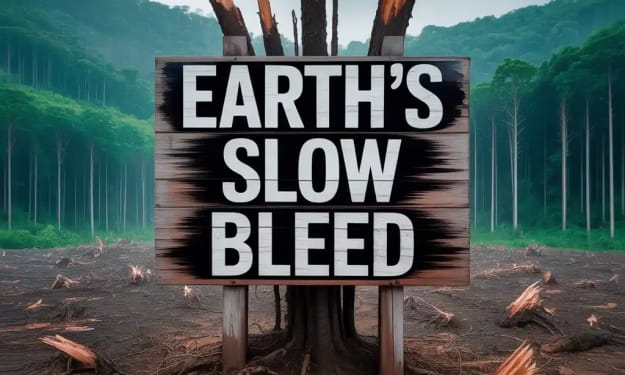
Deforestation: Earth’s Slow Bleed
I was ten years old when my grandfather first took me to the forest behind our village. It wasn’t big or famous, but it was beautiful. Birds chirped from branches high above. Sunlight broke through the thick canopy in golden beams. The ground smelled of damp earth and wildflowers.
By Muhammad Aizazabout a year ago in Earth
The Scary Ocean: Mysteries, Dangers, and Fascination Beneath the Waves
The ocean has always been a source of awe and wonder for humans. Covering more than 70% of the Earth’s surface, it is vast, deep, and largely unexplored. Despite its beauty and importance, the ocean can also be terrifying. From dark, crushing depths to strange creatures and unpredictable weather, the ocean holds many mysteries and dangers that have scared sailors, explorers, and scientists for centuries. This article explores why the ocean is scary, what dangers lurk beneath its surface, and why we continue to be fascinated by it.
By JAWAD HUSSAINabout a year ago in Earth
The Dazzling Dance of Light on Water
**The Dazzling Dance of Light on Water: Science or Just Pure Magic?** Okay, let’s be real—if you’ve ever just stared at sunlight skipping across a pond or watched waves glitter like someone spilled a bag of diamonds, you know it’s pretty dang hypnotic. There’s something about that combo—light doing gymnastics on water—that just sucks you in. And yeah, there’s a whole lot going on beneath the surface (no pun intended), from straight-up physics to wild artistic inspiration. So, let’s pull back the curtain a bit, shall we? Spoiler: it’s not just magic, but honestly, science comes pretty close.
By Shahzaib ahmed khalilabout a year ago in Earth
"The Golden Connection: Honeybee and the Marigold Flower"
In the vast tapestry of nature, some of the most profound stories are not spoken in words, but in silent exchanges—like that between a honeybee and a marigold. It's a relationship as ancient as time, yet still as fresh as the morning dew. One blooms in vibrant shades of orange and gold; the other flutters tirelessly in search of nectar. Together, they form a delicate yet powerful bond that reflects the balance and beauty of the natural world.
By Daily Motivationabout a year ago in Earth
The Hidden Town Where No One Ages
The Hidden Town Where No One Ages A Twilight Zone-style Mystery by ChatGPT I first heard of Everspring from a traveler at a dusty roadside diner in northern Oregon. He was old, grizzled, and talked in riddles like he belonged in an old folktale. As I sat nursing a coffee, he leaned over and muttered, “If you ever get lost on Route 9, and take the wrong turn at the burnt elm tree, don’t be surprised if you end up in Everspring. People say no one ever grows old there. They say time forgets them.”
By Huzaifa Dzineabout a year ago in Earth
A Scene Underwater. AI-Generated.
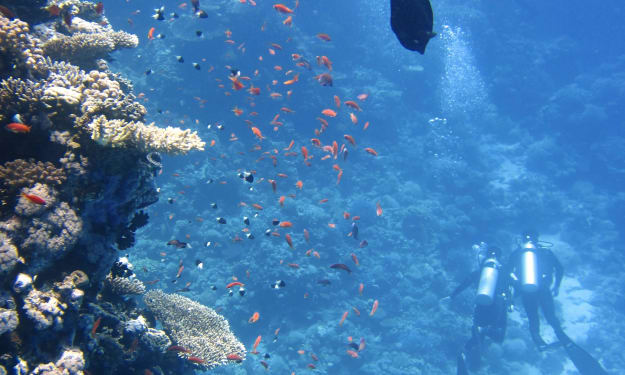
Please Don't Forget Like and Subscribe ! Under the surface of the water, there is a secret world full of amazing life. Many people think of the ocean or rivers as just water, but below the waves, there is a colorful and busy place. One of the most beautiful sights in this underwater world is when a giant fish swims among many tiny fish. It is a scene that shows the beauty of nature and how different creatures live together.
By Bilal Mohammadiabout a year ago in Earth
Feather Islands :Architectural character, sea and picturesque nature
What impresses many tourists is the special style that is unique to the island, especially the features of nature, terrain, vast green spaces, and the density of trees in all parts of the island. It is also characterized by the presence of mountainous areas with a stunning view that you can see in the winter periods, as these mountains become completely covered with snow. This is what attracts winter tourism lovers and winter atmosphere lovers from all over the world.
By Tariq Toussiabout a year ago in Earth
F-Gas Compliance
When we think of climate change, carbon dioxide (CO₂) is usually the first culprit that comes to mind. However, it is far from the only greenhouse gas contributing to global warming. One category of particularly potent gases is fluorinated gases, or F-gases—a group of synthetic compounds commonly used in industrial and commercial equipment. Although less talked about, F-gases have a global warming potential (GWP) that can be thousands of times greater than CO₂. Because of their significant environmental impact, F-gases are now heavily regulated, especially in the European Union (EU). Businesses that manufacture, import, or distribute products containing F-gases need to stay informed and compliant—or risk facing penalties and damaging their brand reputation.
By Mahgol Nikpayamabout a year ago in Earth
Full Moon Tonight: The Magical Buck Moon of July
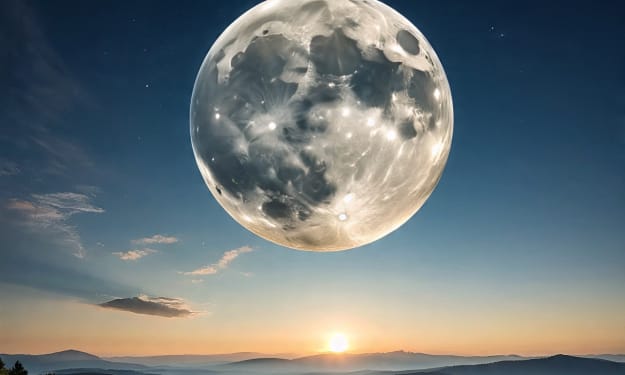
Have you looked up and wondered, “Is tonight a full moon?” If so, you’re not alone. There’s something about a big, bright moon hanging in the sky that captures our imagination. And if you’re asking “Is there a full moon tonight?” — this month, you’re in for a treat. July’s full moon is called the Buck Moon, and it’s one of the most beautiful and meaningful moons of the year. Whether you’re a casual stargazer or someone who loves all things lunar, let’s explore the moon tonight, why the July full moon is called the Buck Moon (and sometimes the Thunder Moon), why it might even look orange tonight, and how you can best enjoy tonight’s moon. What Is the Buck Moon?
By Najeeb khanabout a year ago in Earth
Beneath the Surface: The Hidden Systems That Shape Our World
Every morning, as the sun stretches over the skyline and the city hums to life, Maya steps outside with her coffee in hand, barely thinking about the world beneath her feet. To her, the day begins with traffic lights, notification sounds, and digital calendars. But unbeknownst to her—and most people—the real machinery of modern life operates beneath the surface. Maya is a systems analyst for a tech firm, someone who understands digital frameworks and backend processes. Yet one morning, while stuck in a subway delay, she began to wonder: What else am I missing? That moment sparked a journey of curiosity. What are the invisible forces that make our world function? Her first stop was her own domain: the digital world. Behind every online purchase, GPS ping, or video stream lies an intricate ballet of signals bouncing between cell towers, data centers, and undersea cables. For instance, when Maya texts her sister in another country, the message doesn’t float magically through the air—it’s routed through thousands of miles of fiber-optic cables on the ocean floor. These global data highways, invisible to the naked eye, form the backbone of the internet. “People think the cloud is this mysterious place in the sky,” one network engineer told her. “But really, it’s warehouses full of blinking servers powered by electricity, cooled by complex HVAC systems, and monitored 24/7.” Even electricity itself is a hidden marvel. Power grids stretch like nervous systems across continents. Electricity travels from wind turbines and power plants to substations and transformers, eventually lighting up Maya’s apartment with a simple flick of a switch. She realized how rarely she thought about these grids—until they went down. But not all invisible systems are man-made. Nature, too, operates vast hidden networks. Intrigued, Maya visited an environmental research center, where a biologist introduced her to the “wood wide web.” Beneath forests, tree roots are linked by vast fungal networks—mycorrhizae—that transport nutrients, share chemical signals, and even warn neighboring trees of danger. “In a way,” the biologist said, “trees talk to each other underground. An old tree might share sugars with a sapling. A diseased tree might be quarantined by the network. It’s cooperation, not just competition.” Maya was fascinated. Beneath the soil she walked on every day, entire communication systems were silently at work—natural versions of the internet, formed long before humans built their own. Even urban life rests on unseen natural processes. Storm drains and aquifers redirect rainwater. Pollinators like bees, largely unnoticed, enable a third of the global food supply. Microbes in the human gut—trillions of them—help digest food, fight disease, and even influence mood and behavior. The more Maya learned, the more she realized: The world isn’t just built above ground or on screens—it’s powered by ecosystems, machines, and networks we rarely see or appreciate. One day, Maya took a walk through a local park. As she sat on a bench, she watched people scroll their phones, jog past trees, and chat on benches. She began to reflect on society’s hidden systems—those built not of metal or mycelium, but of behavior, trust, and connection. Take language, for example. It’s an invisible code humans use to pass knowledge, express emotion, and preserve culture. Or consider the financial system—money moves between banks in digital pulses, governed by trust, agreements, and regulations. Even democracy itself is a system: reliant on participation, belief in fairness, and shared values. Perhaps the most powerful hidden system is human connection. Every time a neighbor helps another, when people vote, when communities organize or when ideas are shared—it’s part of a vast social network. Much like the forest, societies thrive when connected, and falter when those connections break down. By the end of her exploration, Maya’s view of the world had changed. She now saw the layers that lay beneath the surface—technological, biological, and social. She began to ask more questions. What systems do we depend on without realizing it? How do these systems adapt—or collapse—under pressure? She realized that progress didn’t just mean faster phones or taller buildings. True progress meant understanding the systems that sustain us, and ensuring they remain strong, equitable, and resilient. That night, as she looked out her window at the glowing skyline, she felt awe. Not just at the beauty of the city lights, but at everything that made them possible—from the silent currents of electricity, to the fungi in the soil, to the people who keep things running, often unseen and unthanked. Because beneath the surface, the real world is always at work. And to truly understand our future, we must learn to see what’s hidden.
By Muhammad Saad about a year ago in Earth