
The Manuscript Beneath the Clock
Concerning a dwelling, seven names, and an absent conclusion

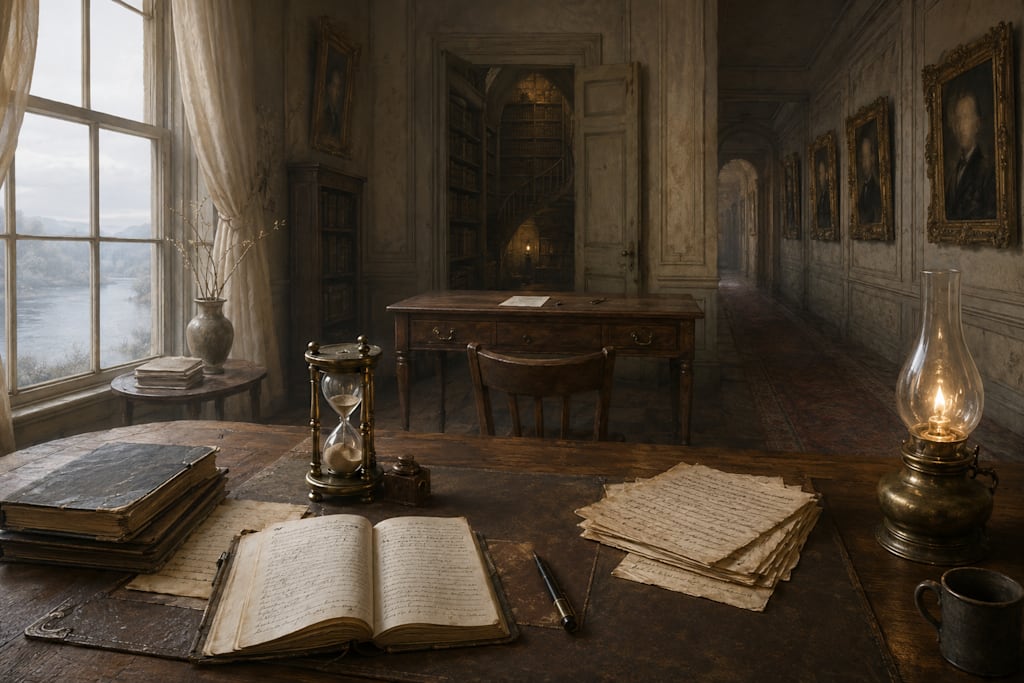
For seventeen years I have kept a packet of pages within a narrow drawer beneath an ancient clock whose pendulum marks each passing hour with solemn authority. The packet bears no title. Its first page carries a date crossed out so many times that the numerals resemble wounds cut into paper, while its final page ends in the middle of a sentence.
That sentence has waited for completion longer than some marriages endure.
Many failures have visited my desk over the years. Most earned oblivion. A few received fire. This one survived. I cannot say whether survival proves merit or merely stubbornness. Perhaps both. Perhaps neither.
I shall present the fragment here, together with the account of its affliction, for the tale itself and the defect within it have become inseparable.
The fragment begins thus.
A man named Vale inherited a dwelling from an uncle whose existence had remained almost mythical throughout childhood. The inheritance contained little wealth. It offered instead a sprawling structure upon a barren rise overlooking a river whose current moved with uncanny slowness.
Vale entered at dusk. No servant greeted him, and no relative lingered to welcome him. The place seemed abandoned for years, though no dust lay upon the furnishings. Every chamber appeared prepared for company that had departed moments earlier.
A long corridor extended through the central portion of the dwelling. Portraits occupied both sides, and their subjects shared one disturbing trait. Every face appeared arrested at the instant before speech, as though each sitter had perceived some revelation and then remained forever suspended in anticipation of uttering it.
Vale attempted laughter at the coincidence.
The effort failed.
He spent his first evening exploring room after room. During that exploration he discovered a locked chamber near the northern extremity of the building. The key hung nearby, suspended from a nail. Such convenience struck him as strange.
Upon opening the door, he found a desk and a chair. Nothing more occupied the room. Yet the chamber possessed an influence difficult to describe. Many locations inspire dread through darkness, decay, or visible signs of suffering. This one displayed none of those qualities. Instead it conveyed expectation.
Someone had intended an act there. Some decisive act.
Upon the desk rested a single sheet bearing seven names.
The final name belonged to Vale.
At this point, years ago, I believed myself in possession of a splendid mystery. I imagined revelations concealed within those names. I imagined secret genealogies, forgotten crimes, ancient vows, perhaps even a doom stretching across generations.
Such confidence belongs largely to youth.
The fragment continues.
Vale removed the sheet and examined it beneath lamplight. Six names had been crossed out. His remained untouched.
Beneath the list appeared a sentence.
“Completion requires the seventh.”
No signature followed. No explanation accompanied the message.
Sleep evaded him. Shortly after midnight he descended toward the lower levels of the dwelling, where he discovered a passage leading beneath the structure into a series of ancient chambers.
The chambers contained journals, hundreds of them, arranged upon shelves that vanished into darkness. Their authorship varied, and the dates inscribed upon their covers spanned more than a century. Vale selected one volume at random and discovered an account of recurring dreams involving a man seated before a desk in a barren room. Every dream concluded before any decisive action could occur.
Curious and increasingly unsettled, he opened a second journal and found the same vision described in different language. A third account followed. Then a fourth. As dawn approached, a dreadful conclusion settled upon him. Every journal, regardless of author or era, described the same room, the same desk, the same chair, and the same unfinished event.
Here my younger self became delighted. I recall pacing through my lodging and speaking aloud to invisible audiences. I believed atmosphere alone could sustain momentum forever. Every mystery seemed profound merely because explanation remained distant.
Yet explanation eventually demands entrance. A tale may survive uncertainty. It seldom survives endless postponement.
Several weeks passed. Vale examined every journal. Though phrasing differed from one account to another, each writer expressed the same conviction. The room awaited an occupant destined to perform an act capable of concluding a process initiated long ago.
No writer identified that act. No writer explained the process.
Several investigators died during their pursuit of answers, while others vanished under circumstances their journals never clarified. One descended into madness and filled page after page with obsessive drawings of clocks. Another devoted years to a sequence of mathematical calculations whose purpose remained hopelessly obscure.
Vale gathered these fragments and searched tirelessly for some connection among them, yet no pattern emerged. Even so, he persisted.
One evening he returned to the chamber containing the desk. There he discovered a new sheet of paper resting before the chair. No sound had announced its appearance. No visitor had entered. Upon the page appeared seven words.
“You already know more than you believe.”
At that instant, according to my fragment, Vale perceived something dreadful.
Here the manuscript fractures.
The next pages contain revisions layered upon revisions. Entire paragraphs suffer obliteration beneath dark strokes of ink. Margins carry frantic notes. Arrows point nowhere. Sentences begin and terminate abruptly.
One abandoned version declares that Vale recognized every journal as his own work. Through some impossible distortion of time, he had authored each account across a century of repetition.
I pursued that notion for twenty pages.
Then I discarded it.
The solution explained too much. Mystery collapsed beneath explanation.
Another version proposed that the dwelling functioned as a machine designed to manufacture prophecy. Every occupant interpreted random events as signs until obsession consumed reason.
I abandoned that version as well.
It possessed logic. It possessed coherence. It possessed no terror.
A third version carried Vale into hidden chambers beneath the river. There he discovered seven graves bearing the names from the list.
Even while writing those chapters, I knew they belonged to another story.
Each answer solved the puzzle. Each answer diminished it.
The deeper difficulty emerged slowly. I had mistaken questions for structure. The list of names, the journals, the chamber, and the messages all promised revelation. Yet I had created them before understanding what they revealed.
Several pages later appears a note written entirely in capital letters.
WHAT DOES VALE LEARN?
Beneath it appears another.
IF I CANNOT ANSWER THIS, NOTHING ABOVE MATTERS.
Months later another note appears in different ink.
STILL NO ANSWER.
Years later comes a final observation.
THE ATMOSPHERE WORKS. THE ENDING DOES NOT.
Those remarks disturb me more than anything within the story itself.
From that point forward, the manuscript begins to fail in earnest. I do not mean that the prose deteriorates. I mean that the foundation beneath the narrative fractures.
For nearly two hundred pages I led Vale toward revelation. Every scene implied hidden design. Every clue suggested coherence waiting beyond reach. Yet when revelation approached, I discovered a disastrous truth.
I had built the corridor. I had adorned it with portraits. I had filled underground chambers with journals and covered paper with ominous messages.
Yet I possessed no chamber at the corridor's end.
No secret existed.
Only the promise of one.
Many writers confront this difficulty. They mistake intrigue for architecture. A locked door feels meaningful. A list of names feels meaningful. A warning scrawled across paper feels meaningful.
Meaning, however, requires construction.
Atmosphere can lure a reader forward. Atmosphere alone cannot reward pursuit.
For months I struggled. I drafted explanations involving ancestral guilt. Then occult societies. Then elaborate deceptions extending across generations. Each solution diminished the terror rather than deepening it.
The true source of unease lay elsewhere.
The manuscript understood something its author had failed to recognize. The unfinished event within the story mirrored the unfinished idea behind the story. Both awaited completion. Neither received it.
Even now I can recite the abandoned passages. Vale discovers hidden compartments. Vale deciphers coded entries. Vale traces bloodlines. Vale uncovers conspiracies. Each version reads competently. None feels inevitable.
That word, inevitable, became my torment.
Great mysteries generate surprise followed by recognition. The reader thinks, of course. The answer appears startling and unavoidable simultaneously.
Every answer I produced felt imported from another tale.
So, I ceased writing.
Years passed. The packet remained beneath the clock.
From time to time I returned. I reread the fragment. The opening retained power. The corridor still unsettled me. The journals still suggested vast design. Yet the central question remained untouched.
What had Vale perceived?
I attempted solutions during periods of grief, joy, prosperity, illness, travel, loneliness, companionship, success, and disappointment. None endured.
Then, several winters ago, a disturbing possibility occurred.
Perhaps Vale perceived the same truth that halted his creator.
Perhaps the dwelling concealed no secret.
Perhaps the process described by every journal consisted of a search for meaning among disconnected fragments.
Perhaps generation after generation had mistaken coincidence for destiny.
Perhaps the chamber existed solely to lure occupants toward interpretation.
This idea interested me deeply.
It also ruined the story.
The manuscript had trained readers to expect revelation. Offering absence in place of revelation felt less like tragedy and more like betrayal.
Once again I stopped.
Thus the fragment survives in suspension. Vale remains seated before the desk. The seventh name remains uncrossed. The sentence remains unfinished.
When I examine the pages now, I perceive their flaw with greater clarity than ever before.
Structure holds them back.
The narrative establishes a question whose answer must exceed expectation. Each chapter increases pressure upon the eventual disclosure. By the midpoint, no realistic solution can satisfy the promise accumulated earlier. The tale becomes victim to its own momentum.
Yet another obstacle exists, harder to define.
I no longer believe the story concerns haunted dwellings, ancestral mysteries, or cryptic journals. Those elements serve as disguises. The true subject involves humanity's hunger for patterns.
We encounter fragments and arrange them into destiny. We encounter coincidence and elevate it into design. We discover seven names upon a page and assume a hidden intelligence arranged them.
The manuscript reaches toward that idea. Then it retreats. Then it reaches again.
Such hesitation infects every chapter.
A story can survive uncertainty within characters. It struggles when uncertainty governs the author.
So, the work remains unfinished.
The packet beneath the clock contains three hundred and twelve pages. Two hundred and ninety-six belong to the story. Sixteen belong to arguments with myself.
During recent years I have discovered that I return more often to those sixteen pages than to all the rest. They document every failed attempt to bridge the distance between promise and revelation. In their own strange fashion, they form a second narrative running alongside the first.
Perhaps completion still awaits. Perhaps some future year will reveal the missing connection. Perhaps Vale will rise from that chair, cross out the final name, and illuminate every shadow cast throughout the narrative.
Or perhaps the fragment has already become what it was destined to become.
A record of pursuit.
A monument to an unanswered question.
The final page rests before me now as I write these words. Its last sentence extends across half a line.
“Vale lowered his gaze toward the paper and understood that the author of every journal, the architect of the dwelling, and the prisoner sought through a century of searching were…”
There the ink ceases.
There the story abandons its course.
There the gap remains.
And perhaps that gap, more than any conclusion I could supply, explains why the manuscript still endures beneath the clock, waiting through one passing year after another, preserving forever the instant before revelation.
About the Creator
Tim Carmichael
Let your becoming be louder than your fear, and your smallest steps become the road you once thought impossible to walk. An Appalachian poet and cookbook author my book Beautiful and Brutal Things is on Amazon, Link 👇
Enjoyed the story? Support the Creator.
Subscribe for free to receive all their stories in your feed. You could also become a paid subscriber, letting them know you appreciate their work.
Comments
There are no comments for this story
Be the first to respond and start the conversation.