
The 17-Year Unlearning
A quiet story about the longest, most expensive illusion in client work—and the one metric that actually counts.
Last month I met a man in New York. He wouldn't let me use his real name. I call him Old Charlie. Charlie got into the industry in 2007, a full cycle ahead of most family office practitioners in America. He was twenty-six that year, working as a relationship manager in the Americas division of an old British private bank. One day his boss called him into the office and said, we're going to test something domestically, called a family office — would you like to come on board. Charlie said yes.
In 2024, Charlie left the platform where he had spent seventeen years. He wasn't laid off, and he didn't fall out with his boss. He had simply figured something out on his own, and then realized that of almost everything he had done over those seventeen years, if he had to do it all over again, he would only do one thing. And that one thing was something he didn't do at all in the first ten years.
Charlie and I sat for an hour and a half in the lobby café of a hotel in Midtown Manhattan. All around us people with rolling luggage were checking in and checking out. The two of us sat in a corner, voices kept low. Several times he stopped mid-sentence, watching whoever walked through the entrance, making sure it wasn't someone he knew, before he went on. I am writing down here the part he was willing to share. Not because his story is extraordinary, but because the thing that happened to him is happening right now, in different versions, to almost everyone in this industry.
The first ten years, in Charlie's own words, he was busting his ass to bring in clients. Pitching a family office on American soil from that platform in 2007 was like selling raincoats in the desert — nobody really knew what you were peddling. Charlie said that in the first three years he met close to four hundred potential clients, sifting through the private bank's existing client roster, crashing charity galas at country clubs, working his way into any golf tournament he could get a badge for. Most people asked him, what's the actual difference between you and a trust company, what's the difference between you and one of those fee-based financial advisors. Charlie said he delivered that same pitch four hundred times over those three years, until he could reel it off without engaging his brain, almost believing it himself.
Slowly, starting around 2010, the wind shifted. The ultra-high-net-worth crowd began to genuinely care about legacy, not because their thinking had suddenly evolved, but because their age had caught up with them. The postwar baby-boomer entrepreneurs were crossing sixty around 2010, and the second generation was moving into their thirties. Succession went from being a concept in a law firm memo to a real agenda item no one could dodge at the family dinner table. Charlie caught that wave. From 2010 to 2017, his platform grew from serving fewer than ten families to nearly a hundred and twenty. At his peak, Charlie personally handled thirty-six families, with restructuring and asset-ringfencing deals ranging from tens of millions to several hundred million dollars a year.
Those seven years, Charlie said, were the years that felt most like combat. He flew to three or four cities a month, saw the Denver airport at two in the morning, choked down cold sandwiches on the factory floor of a client's plant in Ohio. He knew which boarding school in London a particular family's younger son attended, knew the time of year a certain founder's wife flew to Switzerland for her annual checkup, knew which offshore structure contained a landmine left behind thirteen years ago from a rushed IPO. He said during those years he thought he was pretty good. The platform was growing, and he was growing with it. The client count was rising, his title was rising, his annual pay was rising. At industry conferences, people were starting to recognize his name on the badge. In 2017, he was made partner. He was thirty-six.
The inflection point came in 2023. It wasn't one specific event. It was a lot of small details piling up until one afternoon, sitting in his office, he suddenly saw something clearly. He put it to me like this. He said, have you ever stopped to ask yourself, out of the thirty-six clients on your list, how many are there because of you. Charlie held his coffee cup still for maybe five seconds when he said that, then he smiled first and said, I was a lot more miserable when I figured out the answer than I am right now.
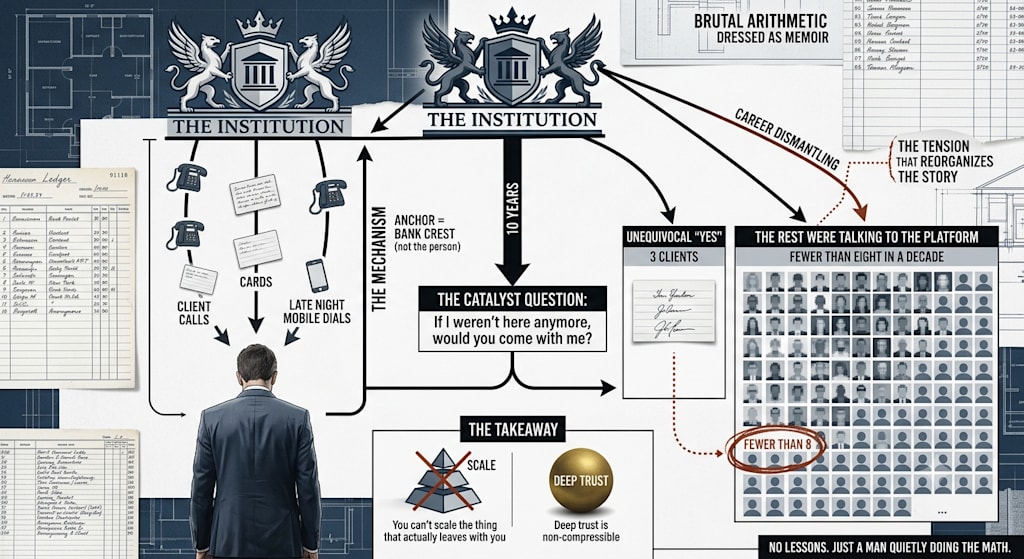
Thirty-six clients. He did the math carefully. The number who would entrust their entire wealth to him purely out of trust in him as a person: fewer than four. The rest were there because of the platform's century-old brand, because of its licensed compliance architecture, because of its track record across multiple jurisdictions, because it could connect them to the top-tier investment banks and law firms they needed. Charlie was the person who delivered the platform's value, but he was not the value itself.
This distinction was impossible to see clearly while he was still inside the platform. Because when clients met him, they called him "Charlie." They sent handwritten cards at Thanksgiving. They dialled his personal mobile late at night when a trust structure hit a dead end, their voice carrying the kind of urgency reserved for an old friend. All these signals pointed to a reassuring conclusion: this client and I have a good relationship. But in 2023, when Charlie began seriously considering leaving, he did something he should have done ten years earlier. He had a quiet word with a few of his longest-standing clients, in completely informal settings, and asked them one question. He said, I may be considering some changes. If I weren't at Baxter anymore sometime down the road, would you consider letting me continue to serve you.
When he described the outcome to me, his tone was very calm, like he was reading an autopsy report on someone else. But I asked him, how did you actually feel. He said, how do you think it feels to spend ten years building up your confidence, and then tear it down in a single afternoon. Out of the thirty-six clients, three said unequivocally that they would go with him. A few others said, depends on the situation, depends on what you can independently provide after you leave that we can't do without. Charlie said that afternoon he sat in his office, shut the door, and stayed there for a long time. Outside the window, the traffic on Park Avenue was its usual gridlocked string of silent taillights, and he realized for the first time that a very large portion of the "Charlie, we couldn't have done this without you" he had heard over the past decade had actually been spoken to the bank crest pinned to his chest.
He figured something out, something that if he had understood ten years earlier, would have left him in a completely different place today. Put in a single sentence: everything you accumulate inside a platform — the clients' trust, the industry reputation, the case studies, the network — the moment you walk out, half of it stays with you, and the other half stays where it was. And the part that stays where it was — that was the biggest chunk of your first ten years.
Charlie laid out the numbers for me. In his first decade, he met roughly six hundred ultra-high-net-worth individuals, served about a hundred and twenty families in depth, and the number with whom he built a trust that could survive without the platform underneath it, he said, was fewer than eight. That conversion rate, from what I know of the industry, is not low. What's low is the number of people willing to do the math. Eight, spread across ten years. Fewer than one a year. And the bulk of his time in that first decade — the energy, the flights, the cold sandwiches and the accumulated frequent-flyer miles — was spent on relationships that would not leave with him. It wasn't that those relationships were fake. It was that the anchor of those relationships was not lodged in him. It was lodged in the platform. He was an extension of the platform, not the other way around. You can't see the difference in normal times. It reveals itself in a single stroke the moment you try to leave.
Charlie said that looking back, if he had understood this ten years ago, he would have made an entirely different choice. From day one, he would not have chased the length of his client list. From day one, he would have chosen just two or three families and gone as deep as it is possible to go. Not doing deals. Doing relationship. Not executing transactions. Being present in moments of vulnerability. So that when the people in those two or three families woke up in the middle of the night in a cold sweat, the first number they thought to dial was not the bank's 24-hour concierge line. It was Old Charlie's private mobile. Change the platform and you still can't replace Old Charlie — that's what real would have looked like. But the Charlie of those first ten years would not have chosen that. Because the Charlie of those years, like the vast majority of people in this industry right now, was living inside a deep-seated illusion. The illusion that more clients is always better, that a larger AUM is always better, that the more often your name gets dropped at industry events, the better. The more you're known in the industry, the higher your market value.
Charlie said this illusion isn't entirely false. It's half true, half false. The first half checks out — more clients bring resources, more scale brings bargaining power. But the second half is wrong, and fatally so. Recognition and depth of trust are two different things. Between a client knowing your name and a client being willing to sign their family name on a blank contract without the bank's compliance department standing behind it — the distance between those two things is the entire Atlantic Ocean. You cannot cross that ocean in your first ten years, because inside a platform, you never need to. You just hand over the century of institutional credibility, and the client psychologically equates you with it. Until you're no longer there.
I asked Charlie how the past year or so had been since he left. He said, harder than he imagined, but more worth it than he imagined. He's now independent, unaffiliated with any platform, renting a small office himself. Outside the window there's no Park Avenue view, just an air shaft. The number of families he serves on a stable basis: five. He expects that within two years it will reach eight to ten, and then he'll stop. He said the way he works now is completely different from his first ten years. Before, he tried to take on as much as possible; once a family's structure was in place, he'd hurry off to find the next opportunity. Now, putting a trust structure in place is only the beginning. He needs to walk through at least two full market cycles together with that family, to go through the violent tremors of one generational handover with them, before he dares to say quietly to himself, this relationship is set. He said, if you ask me now what I should have done most in those first ten years, I'd tell you: from day one, find a family willing to build long-term, unconditional trust with you, and then deepen that trust until it becomes irreplaceable. Everything else is noise. The one thing that cannot be changed is this: someday, deep in the night, when a next-gen member of a family is backed into a corner by the board, their first instinct is to dial your number, not to open a browser and search for which advisory firm is still open. This thing — if you don't start doing it in your first ten years, you can start in the eleventh. But between the person who starts in the eleventh year and the person who starts on day one, there is a gap made of one substance. That substance is time. Trust is something you cannot compress time with. You can only spend time on it.
That's Charlie's story. The thing I want to say is this: something is happening right now in this industry. It happened to Charlie once, and over the next five years it's going to happen, in different forms, to at least half the people currently working in this field. The thing is this: the dividend phase of the platform and the dividend phase of the individual are not the same thing. When the platform is rising, you are not necessarily rising. When the platform is accumulating institutional credibility, you are not necessarily accumulating any. When the platform's name is being added to more family office league tables, you are not necessarily being trusted any more deeply. The misalignment between these two things is the most expensive illusion of those first ten years. Charlie is someone who took seventeen years to dismantle it.
How long are you going to take? Have you ever, on the quiet, done the math — if you left your current platform tomorrow, how many of the clients who call you by your first name would actually leave with you? Don't rush to answer. Do the calculation, then come back. This verification comes at a very high cost. But if you never verify it, you will never know where, in all those years of clinking glasses and warm handshakes, you were actually standing.
About the Creator
Jin
Writer of reamstories
https://reamstories.com/jin
Enjoyed the story? Support the Creator.
Subscribe for free to receive all their stories in your feed. You could also become a paid subscriber, letting them know you appreciate their work.
Comments
There are no comments for this story
Be the first to respond and start the conversation.