Outline
Mental Health Tips for Digital Creators (From Someone Who Knows the Burnout)
Mental Health Tips for Digital Creators (From Someone Who Knows the Burnout) It sounds like the ideal job to be a digital creator. You get to work from anywhere, be your own boss, and turn your ideas into content people actually care about.
By Farida Kabir9 months ago in Critique
When Is a Move Final?
The Commitment Problem in Modern Chess Modern chess operates under a fractured commitment model that no longer aligns with how players think, how turns function in most games, or how chess itself is actually played across physical and digital formats. At the heart of the problem is that chess treats physical contact with a piece as binding commitment while simultaneously relying on a separate explicit action to end a player’s turn. This creates a logical contradiction: a move becomes final before the turn is over. In most turn-based games, interaction with game components is provisional until the player explicitly signals the end of their turn. Chess is an anomaly in this respect, and the inconsistency becomes increasingly visible in modern play.
By Peter Thwing - Host of the FST Podcast9 months ago in Critique
A Tale of Two Cities. Runner-Up in The Most Overrated Challenge.
A Tale of Two Cities by Charles Dickens It was the best of books, it was the worst of… Nope can’t do it. Get out of here with those bad puns production team! Not today! No sir. I say again. Not. Today.
By Matthew J. Fromm9 months ago in Critique
The Lost City of Z
The Lost City of Z by David Grann Growing up I thought I wanted to be an archaeologist. Now that I’m a ripe 32, I realize what I really wanted to be was an adventurer–someone who dug deep into the dark and emerged with treasures unseen for millennia.
By Matthew J. Fromm10 months ago in Critique
Words of Radiance
Words of Radiance by Brandon Sanderson And so we come to the yearly ovation for Mr. Sanderson. The man is a genius, his lecture series is one of the most important resources ever developed for writers, and I’m yet to pick up a Sando that’s scored below a 70. I have critiques that we’ll come to, but suffice to say I am a big supporter of Sanderson.
By Matthew J. Fromm10 months ago in Critique
Judge Temporarily Blocks Deployment of National Guard in Washington
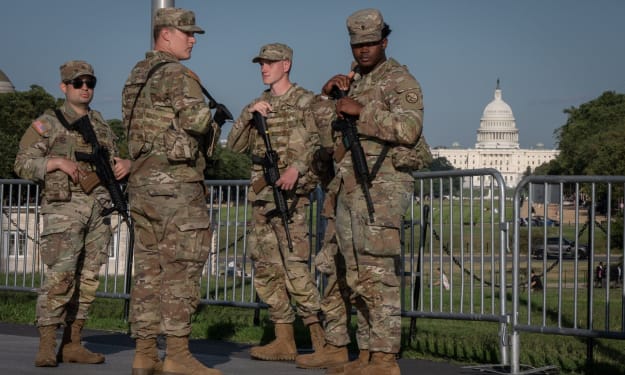
A federal judge in Washington temporarily blocked the Trump administration on Thursday from maintaining more than 2,000 members of the National Guard deployed to the city’s streets, finding the city was likely to succeed in arguing the deployment was illegal. Judge Jia M. Cobb of Federal District Court, a Biden appointee, wrote in a 61-page opinion that the deployment, which began in August, appeared to be illegal for a variety of reasons, including limits on the president’s authority to assert total control over the local D.C. National Guard, as well as concerns over the city’s rights to self-governance. Those concerns were compounded, she wrote, by the fact that more than 1,000 members of the force deployed to Washington are from other states, and that the Trump administration had taken steps to establish a semi-permanent command structure, with an eye to keeping troops in the city well into next year. She paused her ruling for three weeks, to allow time for the administration to remove the troops, as well as to appeal her decision. “At its core, Congress has given the District rights to govern itself,” Judge Cobb wrote. “Those rights are infringed upon when defendants approve, in excess of their statutory authority, the deployment of National Guard troops to the District.” President Trump announced the deployment in Washington as part of an aggressive drive to ratchet up law enforcement in the city, directing heavily armed National Guardsmen to deploy to the city while integrating federal agents with local police officers to conduct sometimes routine police work. The troops have also played a role as armed backup for sharply stepped-up immigration and deportation operations around the city in what experts have described as a trial run in joint immigration operations. Since the summer, small groups of armed National Guardsmen have been ubiquitous around the city, patrolling subway stops, tourist areas and nightlife districts. They have also been subject to mockery online after being observed guarding national monuments and relatively vacant areas or doing “beautification” work such as removing trash or sweeping plant debris. Judge Cobb’s ruling followed several others around the country in which federal judges found that Mr. Trump’s deployment of troops to Chicago, Memphis and Portland, Ore., also most likely violated the law. The Supreme Court is currently considering whether the president can deploy hundreds of National Guard troops to the Chicago area over the objections of state and local leaders. Whatever the justices decide in the Illinois case will most likely set the ground rules for Mr. Trump’s efforts to use state-based troops in other American cities as part of his aggressive immigration crackdown. But it’s not clear if the court’s decision will have a similar impact in Washington, because of the unusual status of the District of Columbia, where federal authorities including the president have expanded powers. Mr. Trump has used that authority to bring in a force of National Guard troops contributed by at least 9 Republican states to serve as a semipermanent patrol in the city, and has announced plans to keep the force in place until at least the end of February. “There is also the risk that this incursion may become permanent, or at least enduring, given the creation of a D.C.N.G. unit specifically established to conduct law enforcement in the District,” Judge Cobb wrote, referring to the D.C. National Guard. She noted that under the Home Rule Act, the federal law granting the city limited self-government, Congress delegated considerable control over the city’s law enforcement to its local leaders. She described the president’s actions as “major intrusions into local governance.” She wrote that the Trump administration “exceeded the bounds of their authority” with the deployment, and “acted contrary to law” by sending in the Guard to carry out “nonmilitary, crime-deterrence missions in the absence of a request from the city’s civil authorities.” A White House spokeswoman said in an email that Mr. Trump enjoyed broad power to assume control over and command the members of the D.C. National Guard. “This lawsuit is nothing more than another attempt — at the detriment of D.C. residents — to undermine the president’s highly successful operations to stop violent crime in D.C.,” said the spokeswoman, Abigail Jackson. While Muriel E. Bowser, the city’s mayor, initially opposed the Trump administration’s efforts to wrest law enforcement control from her office, she has since softened her rhetoric, expressing openness to collaborating with the federal government to decrease crime in the city. The lawsuit was brought by Brian Schwalb, Washington’s attorney general, who was elected separately from the mayor. He celebrated the ruling as a major breakthrough for the city after months of daily patrols by armed troops spread out across much of the city. “From the beginning, we made clear that the U.S. military should not be policing American citizens on American soil,” he said in a statement. “Normalizing the use of military troops for domestic law enforcement sets a dangerous precedent, where the president can disregard states’ independence and deploy troops wherever and whenever he wants — with no check on his military power.” The decision was a second win for Mr. Schwalb’s office. A previous case kept control of the local police department with city leaders after Mr. Trump had tried to use emergency powers to seize command.
By DigitalAddi11 months ago in Critique