Outline
Expression vs Distortion
One of the most persistent frustrations in communication is the gap between what a person intends to say and what others actually receive. This gap exists regardless of intelligence, sincerity, conviction, or depth of understanding. Someone can hold an idea with clarity internally, yet watch it arrive distorted, flattened, reduced, or misinterpreted once it is expressed. The failure is often blamed on the idea itself, when the deeper issue is frequently translation.
By Peter Thwing - Host of the FST Podcast6 months ago in Critique
Productivity as Preservation
Productivity is often framed as the visible accumulation of outcomes. Words written, posts published, episodes released, metrics improved, engagement gained, and projects completed become the evidence that work has happened. Under this framing, anything that does not immediately result in external output is treated as inefficiency, distraction, avoidance, or delay. The productive person is assumed to be the person who can show visible results.
By Peter Thwing - Host of the FST Podcast6 months ago in Critique
Output vs Oversaturation
The Fear of Adding to the Noise The modern anxiety around oversaturation is not unfounded. People are surrounded by more words, videos, opinions, explanations, reactions, and interpretations than they can meaningfully absorb. In that environment, producing more content can feel irresponsible or self-defeating, as though adding anything further only contributes to the noise. This concern often causes thoughtful people to hesitate. They hold back ideas, not because the ideas lack value, but because they fear that volume itself will devalue what they have to say.
By Peter Thwing - Host of the FST Podcast6 months ago in Critique
Created Risk, Inherited Risk, and the Moral Line We Keep Erasing (A Society That Tells the Truth: Chapter 3)
The Distinction Modern Rules Refuse to Make One of the quiet failures of modern rule making is the refusal to clearly distinguish between risk created by choice and risk inherited by existence. When this distinction collapses, responsibility becomes confused, guilt spreads outward indiscriminately, and ordinary behavior is treated as morally suspect. This is not a minor philosophical oversight. It is the foundation beneath many of the injustices people now experience in public life, from transportation and health policy to everyday regulation and enforcement. When systems fail to differentiate between what someone causes and what simply exists, moral clarity erodes at every level.
By Peter Thwing - Host of the FST Podcast6 months ago in Critique
Mapping vs Listing
Much of what gets labeled as rambling is actually a mismatch between how ideas are structured internally and how they are expected to be presented externally. Many environments reward listing, where ideas are arranged in clean sequences, bullet points, or linear arguments that move from premise to conclusion in a predictable order. This structure works well for certain kinds of reasoning, particularly when problems are discrete and conclusions are already known. It does not work as well for reasoning that depends on relationships, causality, or pattern recognition across multiple domains. When relational thinkers speak, they are often navigating a different internal structure altogether, and that difference is frequently misunderstood.
By Peter Thwing - Host of the FST Podcast7 months ago in Critique
Falling Between Every System
Modern social systems are often described as safety nets. Employment law protects workers. Healthcare programs provide treatment. Disability benefits replace lost income. Unemployment insurance bridges job loss. Each system is presented as a safeguard designed to catch people when life disrupts their ability to function normally. Yet for many people living with disability, chronic illness, or injury, the lived experience is the opposite. Rather than forming a net, these systems stack vertically, each with its own eligibility rules, thresholds, and assumptions. Instead of catching the fall, they create gaps. People do not slip through because they failed to try. They fall because the systems were never designed to align.
By Peter Thwing - Host of the FST Podcast7 months ago in Critique
Why Saying Less Makes Words Feel More Valuable
There is a widely held belief that words gain value through scarcity. When someone speaks rarely, their statements are treated as weightier, more deliberate, and more worth attending to. When someone speaks often, their words are assumed to be interchangeable, disposable, or less carefully considered. This intuition is not entirely wrong, but it is frequently misapplied. Scarcity does affect perception, but perception is not the same as truth, and rarity is not the same as meaning.
By Peter Thwing - Host of the FST Podcast8 months ago in Critique
Speaking to Time Instead of the Room
Much of modern communication is oriented toward immediacy. Writing is framed as something meant to be consumed quickly, reacted to instantly, and replaced just as fast by whatever comes next. Under this model, the value of a piece is measured almost entirely by its initial reception. If it does not land immediately, it is treated as a failure. This assumption narrows the purpose of writing and misunderstands how meaning actually travels through time.
By Peter Thwing - Host of the FST Podcast9 months ago in Critique
Practice vs Performance
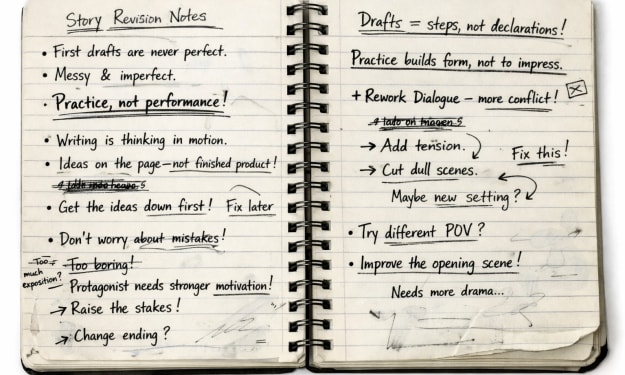
One of the quiet pressures shaping modern communication is the assumption that anything written should be immediately shareable. Drafts blur into declarations, and exploration is mistaken for conclusion. Under this pressure, writing becomes performative by default. The moment words are placed on a page, they are treated as finished statements rather than steps in a process. This expectation distorts both how writing is produced and how it is received, collapsing practice into performance and leaving little room for genuine development.
By Peter Thwing - Host of the FST Podcast9 months ago in Critique
AI as a Reflective Surface
Much of the confusion surrounding artificial intelligence comes from treating it as an agent rather than a surface. When people speak about AI “doing the thinking,” “creating the ideas,” or “speaking for someone,” they are often projecting agency onto a system that does not possess intention, belief, or understanding. This projection obscures what is actually happening in many real-world uses. In those cases, AI is not acting as a source of meaning, but as a surface that reflects, redirects, and reshapes what is already present.
By Peter Thwing - Host of the FST Podcast9 months ago in Critique
The Blue Sword
The Blue Sword by Robin McKinley Nothing says a childhood classic like white savior Mary Sue! I snagged this one after listening to an episode of Brandon Sanderson’s podcast where he said this inspired one of the stained glass windows decorating his house (because of course he has presumably awesome stained glass windows).
By Matthew J. Fromm9 months ago in Critique