
Attack on Titan: The Masterpiece That May Have Outgrown Its Own Story
When mystery, ambition, and expectations become too heavy for one story

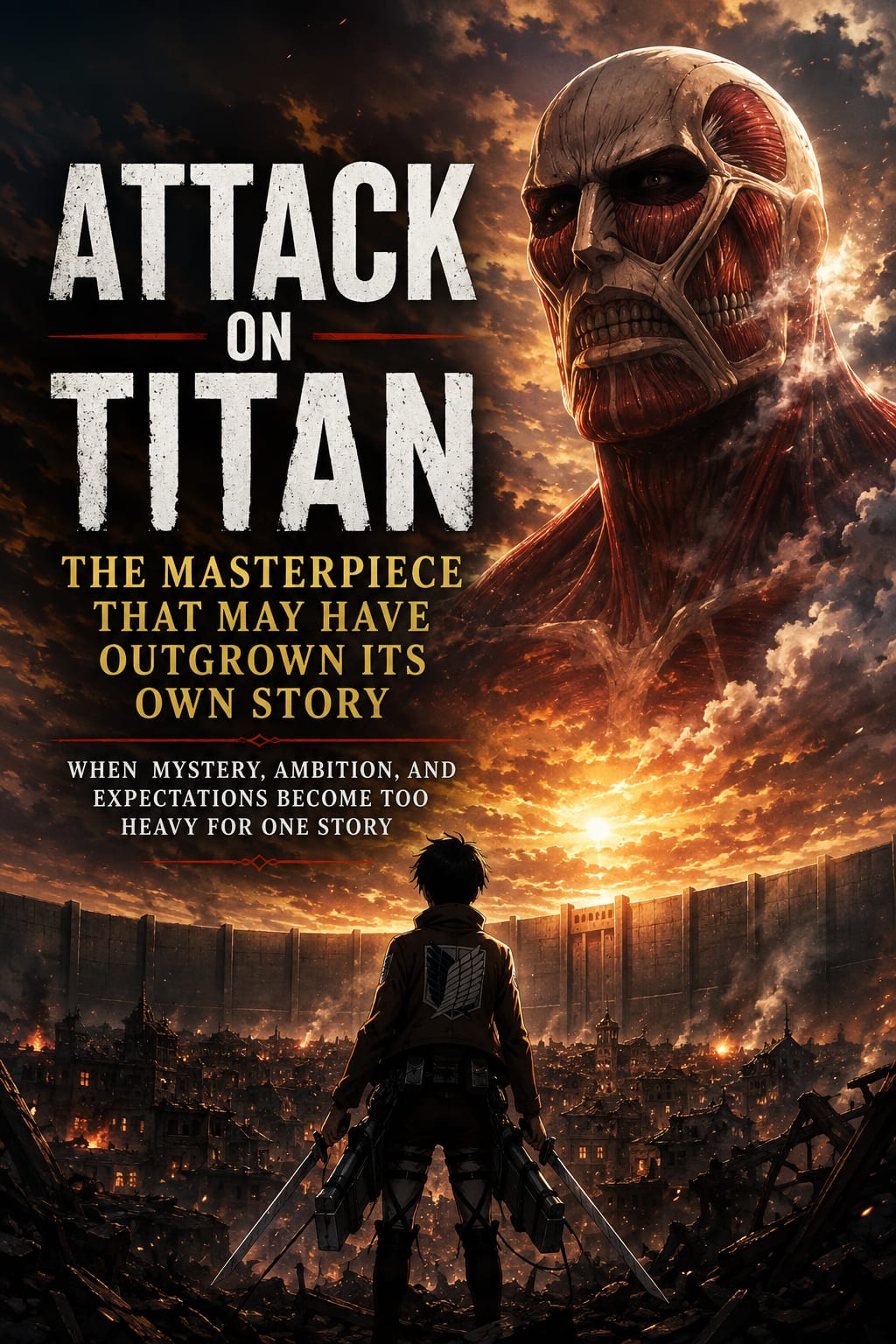
Few anime have created expectations as enormous as Attack on Titan.
When the series began, its premise was almost brutally simple: humanity lives behind enormous walls, terrified of giant humanoid creatures called Titans. People are dying, the world seems hopeless, and a young boy named Eren Yeager dreams of freedom beyond the walls.
It was thrilling.
It was mysterious.
And, for a long time, it felt like every episode was leading toward something extraordinary.
But after finishing the entire story, I found myself asking an uncomfortable question:
Did Attack on Titan actually become as great as we expected it to become?
I don't think the answer is a simple yes.
The Mystery Was Better Than the Answers
One of the greatest strengths of Attack on Titan was its mystery.
What are the Titans?
What is hidden in Eren's basement?
What exists beyond the walls?
Who is really controlling this world?
These questions made the early seasons incredibly addictive. Every answer revealed another question, and every revelation made the world feel larger.
Then came the answers.
Titans were connected to humans. The walls were part of a much larger political and historical conflict. Humanity existed beyond the walls. The story expanded from a desperate fight for survival into a complicated tale about nations, history, hatred, revenge, and inherited trauma.
It was ambitious.
Perhaps too ambitious.
The original mystery had a beautiful simplicity: What is outside the wall?
Once we finally discovered what was outside, the story became much harder to emotionally follow.
The world became bigger.
But bigger does not always mean better.
Eren Became More Complicated—But Did He Become Deeper?
Eren is one of the most interesting characters in modern anime.
At first, he is almost painfully straightforward.
He hates the Titans.
He wants freedom.
He wants to destroy anything that prevents him from seeing the world beyond the walls.
That simplicity is powerful.
But later, Eren becomes increasingly difficult to understand. His motivations become darker. His relationship with his friends changes. Eventually, he becomes responsible for an enormous act of destruction.
This transformation is fascinating.
But I sometimes wonder whether we confuse complexity with depth.
A character becoming harder to understand does not automatically mean the character has become deeper.
Eren's transformation certainly gives audiences plenty to analyze. But analysis itself is not proof of great writing.
Sometimes we spend hours explaining a character because the character is brilliantly constructed.
And sometimes we spend hours explaining a character because the story has made that character extremely complicated.
Those are not necessarily the same thing.
The Ending Is Where Expectations Became a Problem
The ending of Attack on Titan was never going to satisfy everyone.
The series had spent years building enormous expectations.
Every mystery created another theory.
Every character decision generated another interpretation.
Every new piece of information made fans believe that the final answer would somehow make everything perfectly clear.
But stories rarely work that way.
By the final chapters, Attack on Titan was carrying the weight of years of speculation, theories, symbolism, political commentary, and fan expectations.
That is an almost impossible burden for any ending.
And perhaps that is why the conclusion feels less powerful than the beginning for some viewers.
The early Attack on Titan made me want to know what would happen next.
The later Attack on Titan sometimes made me want to understand what had already happened.
That is a very different experience.
Maybe We Loved the Questions More Than the Story
This is ultimately why I think Attack on Titan may be slightly overrated.
Not because it is bad.
It isn't.
The series has spectacular animation, memorable characters, incredible music, fascinating world-building, and some genuinely unforgettable moments.
Its influence is undeniable.
But there is a difference between saying:
“This is one of the most ambitious anime ever made.”
and saying:
“This is one of the best stories ever told.”
I'm much more comfortable with the first statement.
Attack on Titan was incredibly ambitious.
It constantly expanded its world, challenged its characters, changed its genre, and refused to remain the simple survival story it appeared to be at the beginning.
That is impressive.
But sometimes, I miss the smaller story that existed behind the walls.
The frightened soldiers.
The mysterious basement.
The impossible dream of seeing the ocean.
The simple idea that freedom was waiting somewhere beyond the horizon.
Perhaps the greatest irony of Attack on Titan is that the more the characters discovered about their world, the less mysterious that world became.
And maybe that is why the beginning still feels so magical.
We didn't know what was beyond the wall.
We only knew that we desperately wanted to see it.
And sometimes, the mystery is better than the answer.
About the Creator
Takashi Nagaya
I want everyone to know about Japanese culture, history, food, anime, manga, etc.
Enjoyed the story? Support the Creator.
Subscribe for free to receive all their stories in your feed.
Comments
There are no comments for this story
Be the first to respond and start the conversation.