
When Is Surveillance Footage Admissible as Evidence in a Personal Injury Lawsuit?
Understand the legal requirements for using security camera footage in personal injury claims, including admissibility, authentication, privacy laws, and evidence preservation.

Surveillance footage can be some of the strongest evidence in a personal injury lawsuit, but having a video of an accident does not automatically mean a court will accept it. Judges consider how the footage was obtained, whether it accurately represents the incident, and whether it complies with applicable evidence rules. Even a clear recording can face challenges if it has been edited, improperly preserved, or collected in violation of privacy laws.
For accident victims, business owners, and attorneys, understanding when surveillance footage is admissible as evidence can make a significant difference in how a personal injury claim develops. Security cameras, dashcams, doorbell cameras, and workplace surveillance systems can help establish liability, challenge conflicting statements, and document circumstances that might otherwise be difficult to prove.
Can Surveillance Footage Be Used in a Personal Injury Lawsuit?
Yes. Surveillance footage can generally be introduced as evidence in a personal injury lawsuit when it is relevant, properly authenticated, and legally obtained.
Under the Federal Rules of Evidence, which apply in federal courts, several provisions may affect whether a video is admitted:
Rule 401: Evidence must have a tendency to make a consequential fact more or less probable.
Rule 403: Courts may exclude relevant evidence when its probative value is substantially outweighed by certain risks, including unfair prejudice, confusion, or misleading the jury.
Rule 901: The party introducing footage must provide sufficient evidence that the recording is what they claim it is.
Rule 1002: When proving the contents of a recording, the original is generally required unless another rule or statute provides otherwise.
State courts have their own evidence rules, which may differ from the federal standards.
For example, a grocery store security camera showing a customer slipping on a wet floor may help establish how the accident occurred. However, the recording must still be authenticated, and it may not establish how long the hazard existed or whether the store had notice of it.
What Types of Surveillance Footage Can Be Used as Evidence?
Common sources of video evidence in personal injury claims
Business Security Cameras
Recordings from retail stores, restaurants, parking garages, and office buildings may help establish hazardous conditions, employee actions, or the sequence of events leading to an injury.
Dashcams and Traffic Cameras
These recordings may capture vehicle movements, traffic signals, road conditions, and driver behavior before a collision.
Doorbell and Residential Cameras
Footage from residential security systems may document dog attacks, pedestrian accidents, property hazards, and incidents near driveways or sidewalks.
Workplace Surveillance Systems
Workplace recordings may help establish how an injury occurred, whether safety procedures were followed, and which equipment or individuals were involved.
The usefulness of each recording depends on its quality, authenticity, relevance, and the circumstances surrounding its collection.
What Makes Surveillance Footage Admissible in Court?
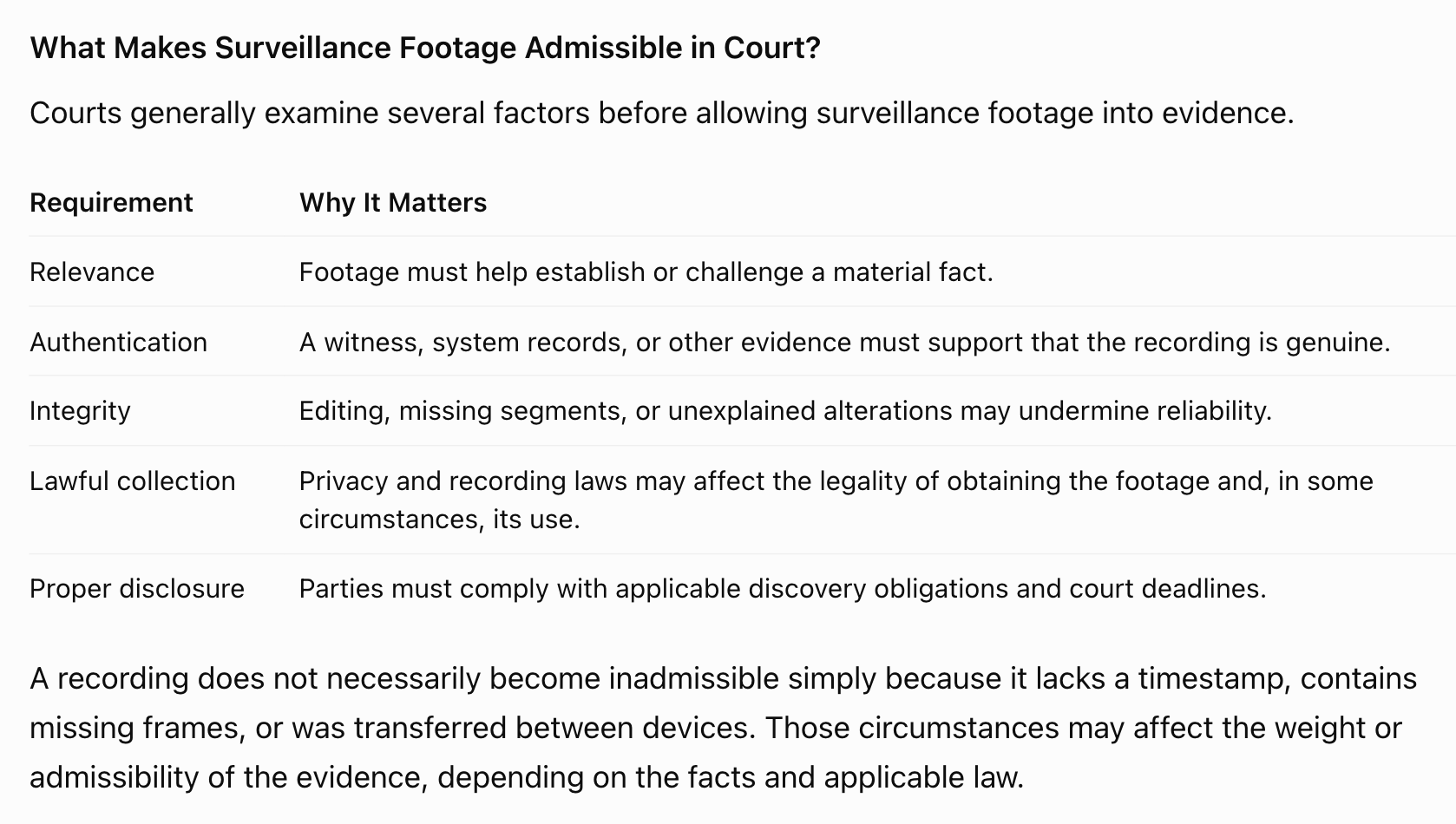
A recording does not necessarily become inadmissible simply because it lacks a timestamp, contains missing frames, or was transferred between devices. Those circumstances may affect the weight or admissibility of the evidence, depending on the facts and applicable law.
How Attorneys Establish the Authenticity of Video Evidence
Reginald Greene, Attorney and Managing Partner at The Super Lawyer - Greene Legal Group, provides a useful professional perspective for understanding the importance of authentication and evidence preservation in personal injury litigation.
A central issue attorneys must address is whether a video can be connected reliably to the incident it supposedly depicts. That requires more than simply submitting a digital file to the court.
For instance, imagine a restaurant customer suffers a serious injury after falling near an entrance. A security recording appears to show the accident, but the restaurant's surveillance system has an incorrect clock setting. The footage may still be useful if witnesses, transaction records, or other evidence can establish when the recording was made.
Attorneys evaluating this kind of evidence should consider:
Identifying the person or system responsible for creating the recording.
Preserving the original footage and associated metadata when available.
Documenting who accessed, copied, or transferred the file.
Comparing timestamps with independent records.
Determining whether relevant portions of the recording are missing.
These measures help establish a credible foundation for the footage and reduce opportunities for disputes over its reliability.
Can Surveillance Footage Be Used Against an Injury Victim?
Yes. Surveillance evidence can support either side of a personal injury lawsuit.
Insurance companies and defense attorneys sometimes use surveillance footage to challenge claims about physical limitations, daily activities, or the severity of injuries.
Consider a claimant who reports difficulty lifting heavy objects after a workplace accident. If surveillance footage later shows that person carrying furniture, the defense may argue that the activity contradicts the claimed limitations.
However, a short recording does not necessarily establish that someone has recovered from an injury. A person may perform an activity briefly while experiencing pain, requiring medication, or suffering worsening symptoms afterward.
Seann Malloy, Managing Partner at Malloy Law Offices, is another legal professional whose role is relevant to the evaluation of disputed injury evidence.
An important litigation consideration is whether surveillance shows a claimant's actual functional capacity or only a limited moment without sufficient context.
Attorneys should evaluate the duration of the recording, the physical demands of the activity, medical restrictions, and whether the footage fairly represents the claimant's condition.
A 20-second clip of someone lifting a box may raise legitimate questions, but it cannot independently establish their overall medical condition or ability to work.
What Happens if Surveillance Footage Was Recorded Illegally?
Illegally obtained footage may face additional legal challenges, but its exclusion from a civil lawsuit is not always automatic.
Courts may consider the applicable recording statute, the conduct involved in obtaining the evidence, and whether a specific legal rule requires exclusion.
Audio recordings deserve particular attention. Under federal law, intercepting certain communications is generally prohibited unless a statutory exception applies. Federal law permits qualifying one-party-consent recordings, but some states impose stricter requirements.
For example, a security camera that records a private conversation without legally required consent may create complications even if the video itself captures an important accident.
The distinction matters because the legality of collecting evidence and its admissibility in court are related but separate questions.
How to Preserve Surveillance Footage After an Accident
One of the biggest challenges in personal injury litigation is obtaining surveillance footage before it disappears.

Many commercial surveillance systems automatically overwrite recordings after a configured retention period. Depending on the system, that period might be several days, weeks, or longer.
Someone injured in an accident should act promptly to identify potential recordings and request their preservation.
1. Identify nearby cameras
Look for cameras operated by businesses, residential properties, transportation agencies, or other parties that may have recorded the incident.
2. Request preservation in writing
Send a prompt, specific request identifying the date, approximate time, location, and footage that should be retained. An attorney can assess whether a formal preservation notice is appropriate.
3. Preserve original files
If footage is available, retain the original format and associated information where possible rather than relying exclusively on screen recordings or compressed copies.
4. Document the evidence
Record the source of the video, the circumstances of its collection, and who has handled it.
A preservation request does not automatically compel an unrelated third party to provide footage. Depending on the circumstances, obtaining the recording may require a subpoena, discovery request, or court order.
Can Missing or Deleted Surveillance Footage Affect a Personal Injury Case?
Potentially. When relevant surveillance footage is destroyed after a duty to preserve it has arisen, courts may consider remedies for spoliation of evidence.
Spoliation refers to the destruction, alteration, or failure to preserve evidence relevant to litigation.
However, not every deleted video constitutes spoliation. Courts generally examine whether the party had a duty to preserve the footage, whether reasonable preservation steps were taken, and whether its loss prejudiced another party.
For electronically stored information in federal civil litigation, Rule 37(e) establishes standards for addressing certain failures to preserve evidence.
Possible consequences can include corrective measures or, when the rule's more demanding requirements are satisfied, serious sanctions.
The timing of the deletion, the foreseeability of litigation, and the availability of replacement evidence can all matter.
Frequently Asked Questions About Surveillance Footage in Personal Injury Lawsuits
1. Can surveillance footage prove who was responsible for an accident?
Yes, footage can help establish responsibility by showing what happened before, during, and after an incident. However, it may need to be evaluated alongside witness statements, accident reports, and other evidence.
2. Can I request security camera footage from a business after an injury?
Yes, you can ask a business to preserve and voluntarily provide relevant footage. However, a business is not necessarily required to release it merely because you request it. Formal legal procedures may be needed.
3. Can edited surveillance footage be admitted in court?
Possibly. Edited footage is not automatically inadmissible, but the party introducing it may need to establish that the relevant portions accurately represent the underlying recording. Courts may consider whether omitted material changes its meaning.
4. Can insurance companies use surveillance footage against injury claimants?
Yes. Insurers may use lawfully obtained surveillance to investigate claims and challenge reported limitations. However, the footage must be assessed in context, and admissibility depends on applicable law.
5. How long should surveillance footage be preserved after an accident?
There is no universal retention period applicable to every accident or surveillance system. When litigation is reasonably anticipated, relevant footage should be preserved in accordance with applicable legal obligations. Prompt preservation is especially important because automatic overwriting can result in permanent loss.
The Bottom Line
Surveillance footage can strengthen a personal injury lawsuit by providing an objective record of an accident, but its legal value depends on much more than what appears on screen.
Authenticity, relevance, lawful collection, preservation, and proper disclosure all influence whether a recording can be used effectively in court. For injured individuals and businesses alike, the most practical approach is to identify potential footage quickly, protect its integrity, and obtain legal guidance before important evidence is lost.
Legal information is provided for general educational purposes and is not a substitute for advice from a licensed attorney. The attorney discussions above are editorial analysis, not verified interviews or quotations from Reginald Greene or Seann Malloy.
About the Creator
Dan Woodland
Dan is a freelance writer and contributor who explores a wide range of topics, from business, entrepreneurship, technology, design, marketing, and finance to emerging trends, culture, and everyday ideas that spark curiosity.
Enjoyed the story? Support the Creator.
Subscribe for free to receive all their stories in your feed.
Comments
There are no comments for this story
Be the first to respond and start the conversation.