
We Sit in the Dark and Stare at the monster
How the true crime industry turned real human suffering into the world's most consumed entertainment and why we keep watching.

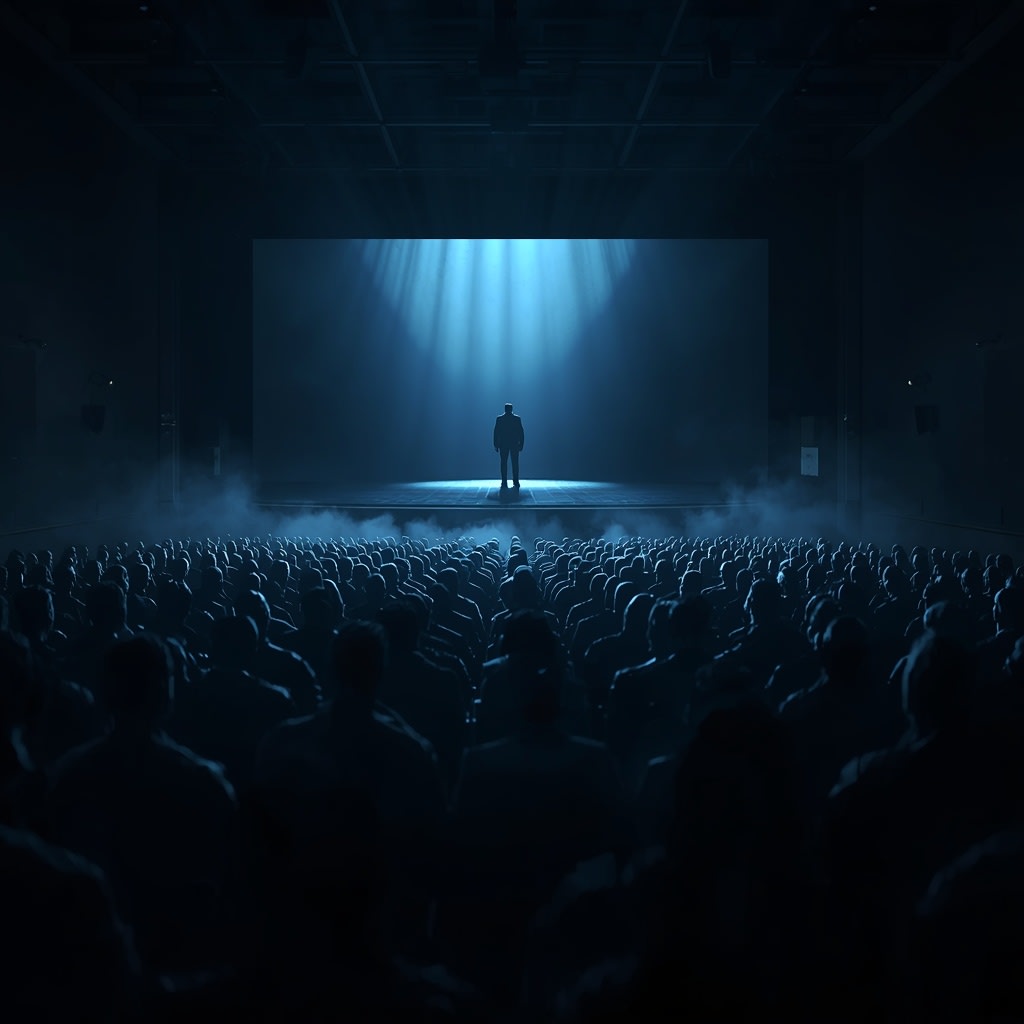
There is a moment, familiar to anyone who has spent time in the true crime universe, when the episode ends and the screen goes dark and you sit with a specific kind of silence. The case has been laid out. The victims have been named briefly. The killer has been profiled at length. The narrative has reached its resolution an arrest, a conviction, an execution, or the unsatisfying anti-climax of a cold case still open.
And then you press play on the next episode.
This is the rhythm of an industry that has become one of the most commercially successful entertainment categories in the history of modern media built almost entirely on the raw material of real human death, real family destruction, and real suffering that did not end when the credits rolled.
Understanding why requires looking honestly at both the psychological mechanisms that drive the consumption and the industrial structures that have learned, with increasing sophistication, to exploit them.
The Scale of What Has Been Built
The numbers behind the true crime industry are, at this point, large enough to constitute a significant economic sector in their own right.
According to data from Edison Research's True Crime Consumer Report, the number of Americans aged 18 and older who listen to true crime podcasts on a weekly basis has tripled since 2019, surging from 6.7 million to over 19.1 million by 2024. That trajectory has not slowed. In 2025, listening hours of true crime on Spotify alone increased around 50 percent year over year.
The advertising market has followed the audience with precision. True crime podcasts secured $10.5 million in US podcast ad revenue between 2020 and 2025, placing the genre fourth overall, behind only technology, news, and business, and ahead of health, comedy, and sports. Ad revenue for major true crime podcasts continues to grow; one leading show reported 68 percent growth in the first quarter of 2026 compared to the previous quarter.
Streaming platforms have recognized true crime as one of their most reliable audience acquisition tools. Netflix, HBO Max, Amazon Prime, and Apple TV+ have all invested heavily in true crime documentaries and drama series, with several becoming among the most-watched titles in their respective libraries. The production values have risen accordingly. What began as low-budget documentary television has evolved into a genre with film-level cinematography, original scores, and multi-episode narrative architectures designed with the explicit sophistication of serialized drama.
Shows like Crime Junkie, Morbid, and Conspiracy Theories, Cults, and Crimes regularly land at the top of the overall podcast charts, and as one industry executive noted, it is a category where the audience simply cannot get enough.
The machine is well-constructed. It is also built on something that deserves more scrutiny than it typically receives.
What the Industry Is Actually Selling
True crime content is not, in the first instance, a product about crime. It is a product about narrative. The crimes provide the raw material, the characters, the stakes, the tension, and the resolution. What the industry provides is the architecture that transforms that raw material into a consumable experience: the pacing, the revelation structure, the musical cues that signal danger or sorrow, the authoritative narration that guides the listener from confusion to understanding.
This architecture is not neutral. It makes choices about whose perspective to center, how much time to spend on the victim versus the perpetrator, which details to include and which to omit, how to frame the resolution, and what emotional response to engineer in the audience. These choices are made, in most cases, not primarily on ethical grounds but on audience engagement grounds. What keeps people listening? What drives completion rates? What generates the emotional investment that translates into subscriptions, reviews, and word-of-mouth growth?
The answer, consistently, is the perpetrator.
Victims, by the structural logic of most true crime content, are narrative functions. They establish the stakes. They provide the emotional weight that makes the story matter. They are introduced, mourned briefly, and then largely set aside as the narrative pivots to the more compelling figure, the killer, whose psychology, biography, and methods receive the sustained analytical attention that drives the genre's intellectual appeal.
Critics argue that the true crime industry often exploits victims' stories for profit, with little regard for their families or the trauma involved. This criticism is not new, and it has not meaningfully altered the structural logic of how most true crime content is produced.
The Audience and Its Demographics
True crime's audience has historically skewed toward women aged 25 to 54, though recent data shows a significant uptick in male viewers, now accounting for nearly 40 percent of the audience, and younger demographics between 18 and 24. The expansion of the audience across gender and age lines suggests that whatever psychological need true crime content addresses, it is not a niche preference; it is something broadly distributed across the adult population.
Several explanatory frameworks have been advanced. The evolutionary psychology argument holds that consuming narratives about predatory behavior serves an adaptive threat-calibration function—essentially, a form of risk assessment conducted from a position of safety. Research by Amanda Vicary at Illinois Wesleyan University found that women's higher historical consumption rates aligned with their statistically greater vulnerability to certain categories of violent crime, suggesting that threat processing is a meaningful component of the genre's appeal.
The controlled fear argument draws on Paul Rozin's concept of benign masochism, the human capacity to deliberately seek negative emotional states in contexts of known safety. The fear generated by true crime content is genuine; the threat is sufficiently remote to be manageable. The resulting experience is stimulating in a way that many people find, in Rozin's framework, genuinely enjoyable—a feature, not a bug.
The moral engagement argument identifies the deeper function: true crime content allows audiences to process extreme behavior within a narrative framework that moves from incomprehensibility toward explanation. The structural movement from mystery to resolution—who did it, why, and how they were caught—satisfies a fundamental cognitive need to make moral sense of events that resist ordinary understanding.
All three of these explanations are plausible and supported by evidence. None of them fully accounts for the specific form the industry has taken: the celebrity perpetrators, the merchandise, the fan communities, and the aestheticized production, which suggests that what began as a psychological need has been shaped, amplified, and monetized into something more complicated than the sum of its psychological parts.
The Celebrity Killer Problem
One of the more uncomfortable features of contemporary true crime culture is the degree to which certain perpetrators have acquired something that functions, culturally, like celebrity.
Ted Bundy is the most documented example, but far from the only one. Jeffrey Dahmer became the subject of a Netflix miniseries in 2022 that generated more than 196 million viewing hours in its first month, making it, briefly, one of the most-watched series in the platform's history. The series was criticized extensively by the families of Dahmer's victims, several of whom described the experience of watching their loved ones' deaths dramatized for entertainment as deeply retraumatizing. Netflix proceeded regardless.
The phenomenon extends beyond streaming. True crime conventions attract thousands of attendees. Merchandise featuring serial killer imagery, clothing, prints, and accessories is sold openly across major e-commerce platforms. Some true crime podcasters have become cultural figures in their own right, with listener communities that function as fan bases. The line between reporting on violence and celebrating the people who committed it has, in several documented cases, been crossed without significant consequence to the parties who crossed it.
This is not an accusation directed at true crime audiences as a whole. The vast majority of people who consume true crime content are not glorifying perpetrators. They are, by most accounts, doing exactly what the psychological frameworks suggest: processing fear, engaging with moral questions, and seeking narrative resolution. The problem is structural: an industry that generates revenue from perpetrator-centered storytelling has incentives that point consistently in the direction of more perpetrator content, more dramatization, and more aesthetic investment in the figure of the killer, regardless of what those choices cost the people who did not choose to become part of the story.
What the Victims' Families Actually Experience
The most direct evidence of what the true crime industry costs comes from the families of victims who have spoken publicly about their experiences.
The pattern in their accounts is consistent. Initial media coverage of a violent crime is already traumatic; families are thrust into public attention at the worst moment of their lives, their grief made into news content. The true crime industry extends this exposure indefinitely. A case that was closed decades ago can be reopened as a documentary series or podcast season, bringing renewed public attention, online speculation about the victim's behavior and the family's role, and in some cases active harassment from amateur investigators who believe they have identified new suspects or explanations.
Several families have described receiving messages from true crime listeners who had become convinced, based on podcast speculation, that a family member was responsible for the victim's death. Others have described watching their loved ones reduced to a supporting character in a narrative about the person who killed them, mentioned, summarized, and moved past in the service of a story that was fundamentally about someone else.
The legal frameworks governing this situation are limited. The perpetrators of documented crimes are public figures in the legal sense. The victims frequently are not, or were not, and yet their deaths have made them subjects of public consumption without their consent and without, in most cases, any meaningful mechanism for their families to influence how their stories are told.
The Ethical Reckoning the Industry Is Slowly Having
It would be inaccurate to suggest that the true crime industry has been entirely unresponsive to these criticisms. There is a visible, if uneven, movement within the genre toward more ethically considered production.
Some of the most prominent true crime podcasters have adopted practices that were not standard a decade ago: consulting with victim families before publication, centering victim narratives more deliberately, including resources for trauma support in their episode notes, and being more transparent about the limits of what amateur investigation can and should do. Several documentary makers have made the decision not to name or extensively profile perpetrators, keeping the focus on victims and the systemic failures that enabled the crimes.
There is also a documented shift in audience preference: viewers, particularly women, increasingly view staged re-creations as inauthentic, and development executives confirm that "real" is now critical for a successful commission. This preference for authenticity, whatever its other implications, has at least made it harder to aestheticize violence in ways that feel clearly exploitative.
These are meaningful developments. They do not resolve the underlying tension, which is structural rather than procedural: an industry funded by audience attention to violent crime will always have incentives that point toward the content most effective at generating that attention, and that content has consistently centered perpetrators over victims.
Why We Keep Watching — And What That Requires of Us
The question of why we keep watching is answerable. The psychological mechanisms are documented, the cultural functions are real, and the need to engage with darkness in a controlled context is a legitimate feature of human psychology rather than a pathology.
What is less often asked is what watching responsibly requires.
It requires, at minimum, awareness that the entertainment being consumed has a human cost that is not evenly distributed. The audience experiences the narrative from safety. The families of victims do not have that option. The perpetrators receive sustained cultural attention that their victims, in most cases, do not. The industry generates substantial revenue from material that the people most directly harmed by it did not consent to provide.
None of this means the genre should not exist. Journalism about crime serves genuine public functions. Understanding the psychology of extreme violence has real value for prevention, policy, and collective moral reckoning. The best true crime work is careful, victim-centered, analytically rigorous, and genuinely contributes to public understanding in ways that justify its existence.
What it does mean is that sitting in the dark and staring at the monster is not a neutral act. It is a choice that has consequences for what gets produced, for who profits, for whose story gets told, and for the people who never asked to become anyone's entertainment.
Knowing that does not obligate us to stop watching. It does obligate us to watch with more honesty about what we are doing when we do.
About the Creator
Enjoyed the story? Support the Creator.
Subscribe for free to receive all their stories in your feed.
Comments
There are no comments for this story
Be the first to respond and start the conversation.