
Two Class Periods, Six Felonies, and One Very Uncomfortable Question About Accountability
Miss Lil’s Tea Table: Sometimes tea simply will not cut it. Today, we're reaching for something a little stronger.

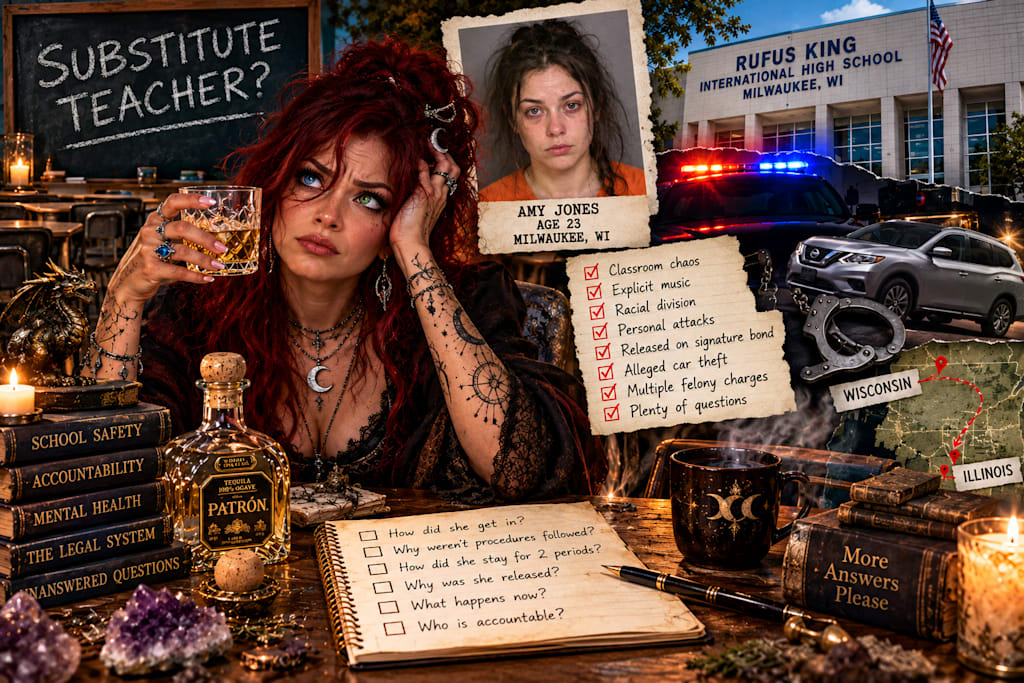
Two Class Periods, Six Felonies, and One Very Uncomfortable Question About Accountability
Miss Lil’s Tea Table: Sometimes tea simply will not cut it. Today, we're reaching for something a little stronger.
Miss Lil settles into her chair, reaches for her glass of Patrón, and pours herself a generous helping. She takes one sip, sets the glass down, and folds her hands on the table.
"All right, my lovelies. We need to talk."
She pauses, picks up the bottle, and gives it a thoughtful look.
"Actually, we might need the whole bottle for this one."
My friends, pull up a chair. This story has left me with more questions than answers, and I haven't even gotten past the first cup. We're heading to Milwaukee, Wisconsin, where a 23-year-old woman named Amy Jones allegedly walked into a high school, posed as a substitute teacher, and spent two class periods turning an ordinary school day into something students won't soon forget.
And what did she allegedly do while she was there?
She hurled insults, played explicit music, divided students according to race and gender, and reportedly used personal attacks about their appearances and family finances to humiliate them.
Miss Lil slowly lowers her glass.
"Excuse me. She did WHAT?"
Now, if that were the end of the story, we'd already have plenty to discuss. But no. After her arrest, Jones was released on a signature bond. Then came allegations of another crime involving a stolen vehicle.
Miss Lil closes her eyes, rubs her temples with two fingers, and reaches for her drink again.
"Lord, give me patience. Because if you give me strength, somebody's going to hear about it."
So settle in, my tea drinkers. We're going to examine what reportedly happened, ask some uncomfortable questions, and look beyond Amy Jones herself to the systems that were supposed to prevent this situation in the first place.
The Substitute Teacher Nobody Hired
Let's start at the beginning.
On September 24, 2026, Jones allegedly entered Rufus King International High School in Milwaukee and represented herself as a substitute teacher. She was reportedly a former student at the school, and according to the criminal complaint, she managed to get through the front office process and into a classroom despite not being an authorized substitute.
There were staff absences that day, and at least one substitute position remained unfilled. School officials later acknowledged that office staff failed to follow the proper district protocol for verifying substitute teachers.
Jones reportedly told investigators that she entered alongside students, blended in, and then told a secretary she was a substitute.
Miss Lil stops stirring her drink.
She looks at the ceiling. She looks at the floor. Then she looks directly at her readers.
"Let me make sure I've got this straight. We have a school full of children, staff members trying to keep everything running, and somebody who allegedly isn't an approved substitute manages to talk her way into a classroom?"
She slowly shakes her head.
"How? Just... how?"
I understand that schools are busy. People call in sick. Schedules change. Staff members are stretched thin. Anyone who has worked in a school knows that a normal Tuesday can turn into a circus before lunchtime.
But verifying the identity and employment status of someone being placed in charge of children isn't an optional administrative chore. It's a basic safeguard.
Miss Lil puts her glass down and begins counting on her fingers.
"Identification. Credentials. Authorization. Surely we have a process for this."
She pauses, glances at her fingers, and throws both hands into the air.
"Apparently, somebody forgot to use it!"
Here's the question I keep coming back to: If a person can walk into a school, claim to be a substitute, and get handed a classroom, what exactly is the verification process accomplishing?
This isn't about expecting school employees to predict every imaginable scenario. It's about following the safeguards already in place.
Milwaukee Public Schools acknowledged that those procedures weren't followed. That's an important admission, and it deserves more than a passing mention.
Because this wasn't an empty office building. It was a school full of children whose parents trusted the adults there to keep them safe.
Two Class Periods of Absolute Chaos
Miss Lil takes another sip, settles back into her chair, and opens the criminal complaint.
"All right. Let's see what happened once she got into that classroom."
According to court documents described in local reporting, Jones allegedly began acting out after the teacher who initially helped set up the classroom left.
Students reported that she used profanity, racial slurs, and sexually explicit language. She allegedly made degrading remarks about students' weight, appearance, race, and financial circumstances, played music loudly, and separated students according to race and gender.
Reports also describe deeply inappropriate questions about students' sexuality and sexual experiences. Students subsequently reported what had happened to school staff, helping bring the situation to an end.
Miss Lil's eyebrows climb higher with every sentence.
By the time she reaches the end of the account, she has stopped reading altogether. She lays the papers on the table, takes off her glasses, and presses her fingertips against her forehead.
"These are CHILDREN."
She lets the words hang in the air for a moment.
"Children who showed up to school expecting to learn. They weren't signing up for some stranger's personal circus."
She picks up her glass, takes a long drink, and puts it down with a little more force than necessary.
"Two whole class periods. Two. And we're talking about a person who allegedly used that time to humiliate students?"
High school is difficult enough without an adult turning the classroom into a place where students are singled out for their bodies, their backgrounds, or their families' financial situations.
Teenagers are already navigating friendships, insecurity, social pressure, and the daily struggle of figuring out who they are. They shouldn't have to wonder whether the person standing at the front of their classroom is going to make them the target of the day.
And let's be clear about something.
This isn't simply about a teacher using a bad word or having a personality that rubs somebody the wrong way.
It's about an adult allegedly using a position of authority to target children.
Miss Lil folds her arms across her chest and leans forward.
"I don't care whether you're having the worst day of your life. You don't get to walk into a room full of young people and decide they're going to be your punching bags."
She pauses, her expression softening slightly.
"And I hope those students have somebody checking on them, because what happened in that classroom matters. Their experience shouldn't get lost in all the noise surrounding this case."
That's something worth remembering. The students aren't background characters in a bizarre news story. They're the people who had to sit through it.
According to reporting on the criminal complaint, Jones told investigators she went to the school because she was bored.
Miss Lil freezes with her glass halfway to her mouth.
Slowly, she lowers it.
She blinks twice.
Then she looks directly at the reader.
"Bored?"
She waits a beat.
"She allegedly walked into a high school, took over a classroom, and subjected students to all of that because she was BORED?"
She reaches for the bottle, stops herself, and lets out a long, exhausted sigh.
"Somebody explain to me how we're supposed to process that."
Of course, we cannot know everything that motivated Jones from a reported statement. We shouldn't pretend to have access to her thoughts or assume we understand the full circumstances.
But whatever her motivation, those students deserved better.
Then Came the Courtroom
Miss Lil straightens in her chair and reaches for her reading glasses.
"Now let's talk about the part that's going to get people arguing."
Jones appeared in court on October 6, 2026. Prosecutors charged her in connection with the school incident, including impersonating a public employee and five counts involving exposing children to harmful descriptions.
She was released on a $5,000 signature bond, with conditions that included no contact with the school and certain students.
Miss Lil sets her glasses down, picks up her drink, and gives the table a little tap with her index finger.
"All right. Before everybody starts throwing their phones across the room, let's get the terminology straight."
People have described Jones as being released without bail. More precisely, the reports say she was released on a $5,000 signature bond.
That isn't the same as paying $5,000 in cash to get out of jail. A signature bond generally involves a promise to pay the stated amount if the defendant violates its conditions or fails to appear, subject to the applicable court process.
And yes, a person facing serious charges can still be released before trial. An arrest is not a conviction, and a criminal charge doesn't automatically mean somebody must remain behind bars until the case is finished.
Miss Lil nods, takes a small sip, and raises one finger.
"Now, listen. Understanding how the law works doesn't mean we aren't allowed to question decisions made within that system."
She leans back and gestures toward the imaginary courtroom in front of her.
"I'm not asking for pitchforks. I'm asking for answers."
Pretrial release decisions involve legal standards, the circumstances of the case, public safety considerations, and the conditions a court believes are appropriate. They aren't supposed to be decided by whichever side of the internet is shouting the loudest.
That doesn't mean every decision is beyond criticism. It means we should look at what the court actually ordered and what happened afterward before deciding what the facts tell us.
Miss Lil picks up her glass again.
"Because, my friends, what happened afterward is precisely why this story didn't end at the school doors."
She takes a sip, pauses, and gives the reader a look.
"And you're not going to believe the next part."
Another Alleged Crime, Another Arrest
According to local reporting, Jones was accused of stealing a vehicle from a Brookfield gym on October 9, just days after her initial court appearance.
Investigators alleged that she used a false name to gain entry to a Crunch Fitness location, took the keys to a blue 2017 Nissan Pathfinder, and left with the vehicle.
Authorities subsequently located Jones and the SUV in Illinois. She was taken into custody there, and additional charges followed.
Miss Lil stares at the page.
Then she turns it over, as though there might be a missing paragraph that makes everything make sense.
She checks the other side.
Nothing.
She slowly places the paper on the table and looks at the reader.
"You have GOT to be kidding me."
She reaches for her drink, takes a long sip, and shakes her head.
"We went from an alleged fake substitute teacher in a Milwaukee classroom to an alleged vehicle theft in Brookfield, followed by an arrest across the state line?"
She spreads both hands across the table.
"Somebody tell me we're not skipping chapters here."
I couldn't make this sequence up if I tried.
But the sarcasm has to stop somewhere, because the legal implications are serious.
The new allegations resulted in additional charges, including taking a vehicle without the owner's consent, misdemeanor theft, and felony bail-jumping counts. Those are allegations, not convictions, and the charges must be resolved through the courts.
Still, the timing raises a legitimate question about the effectiveness of pretrial conditions and the challenges courts face when a defendant is accused of further offenses while a case is pending.
A signature bond isn't a declaration that the court thinks nothing happened. Nor is it a guarantee that the person released will follow every condition.
It's a legal decision made within a system that must balance public safety with the presumption of innocence.
Miss Lil rests her elbows on the table and clasps her hands together.
"So here's what I want to know. When somebody is released while a case is pending and then gets accused of another crime, what happens next? What does the court consider? What conditions can be changed? And what protections are available to the public?"
She reaches for her glass again.
"Those are reasonable questions. We don't need to turn this into a circus to ask them."
What About the School?
Miss Lil pushes her glass aside and leans forward.
"Now we're going back to the school, because I refuse to let this part get buried underneath everything else."
Milwaukee Public Schools acknowledged that office staff did not follow the proper protocol for verifying the substitute teacher.
That admission deserves attention in its own right.
Who was responsible for confirming that the person standing in front of those students was actually employed by the district or an approved staffing provider?
What information did the office staff check?
Was the process unclear, rushed, or simply ignored?
And what has changed since this incident to make sure it doesn't happen again?
Miss Lil begins tapping one finger against her folded arm.
"Because if we don't figure out how this happened, what exactly have we learned?"
She raises an eyebrow.
"And please don't tell me the lesson is to be more careful. That's not a plan. That's a fortune cookie."
The fact that Jones was reportedly a former student makes the situation even more unsettling. Familiarity can sometimes make a person seem less suspicious than a stranger, but recognizing a face is not the same as verifying someone's credentials.
A former student isn't automatically a current employee. A confident voice and a plausible story don't constitute a background check.
Parents send their children to school trusting that the adults responsible for them have been properly vetted. Students should be able to assume that the person giving them instructions in a classroom has a legitimate reason to be there.
When that trust is shaken, a statement saying the district takes the matter seriously is only the beginning. Families deserve to know what practical steps are being taken to prevent a repeat.
Miss Lil sits back, folds her arms, and gives a slow, deliberate nod.
"Show me the changes. Show me the safeguards. Show me that the next person who walks through those doors claiming to be a substitute will actually be checked."
She picks up her glass.
"That's what accountability looks like before the next crisis happens."
Mental Health, Responsibility, and a Difficult Conversation
Miss Lil's expression grows more serious as she turns to the next section.
"All right, my friends. This next part deserves a little care."
During court proceedings, Jones' defense attorney reportedly told the court that she manages bipolar disorder and had experienced a medication-delivery problem that contributed to an acute manic episode. The attorney argued for her release to an inpatient treatment facility.
That is information presented by the defense, not a medical conclusion I can independently establish. It isn't a reason to speculate about her diagnosis, mock her mental health, or assume that people living with bipolar disorder behave this way.
Miss Lil sets her glass down and shakes her head.
"We are not going to turn mental illness into a punchline at this table. Not today. Not ever."
Mental illness is not a synonym for dangerousness, and people living with the same diagnosis can have very different experiences.
At the same time, a possible mental health crisis doesn't make the experience of the students disappear.
We can recognize that a person may need treatment while also acknowledging that the alleged conduct was harmful. We can ask whether appropriate care was available while insisting that the safety of children and the accountability of adults remain priorities.
Those ideas aren't mutually exclusive.
Miss Lil opens her hands in a small, questioning gesture.
"Why do we keep acting as though we must choose between compassion and accountability? Why can't we care about someone's need for treatment and care about the people who were hurt?"
She pauses, allowing the question to settle.
"If mental health played a role in what happened, then understanding that role may be important to the court's decisions and to any treatment she receives. If medication access was a factor, that deserves examination too."
But none of us should be diagnosing Jones from a collection of news stories, and none of us should decide her guilt based on a headline.
The courts have a job to do. So do the school district, the investigators, and the people responsible for ensuring that students are protected.
And the public has every right to ask whether those systems are working.
What Does Accountability Actually Look Like?
Miss Lil reaches for the bottle, notices how much she's poured into her glass, and decides to set it back down.
"Let's take a breath. Because underneath all the frustration, there's a serious question here."
Does accountability mean punishment? Sometimes.
Does it mean treatment? That may be appropriate, depending on the evidence and the circumstances.
Does it mean stronger security procedures at schools? In this case, a review of those procedures certainly seems warranted.
Does it mean that a person accused of a crime should automatically be denied release? No. That would ignore the legal principles that protect everyone, including people accused of terrible things.
Accountability means examining what happened, establishing the facts, enforcing the law fairly, and taking reasonable steps to prevent similar incidents.
It also means remembering the people who were affected.
The students in those classrooms were not supporting characters in somebody else's bizarre day. They were children who came to school expecting an ordinary lesson and reportedly encountered behavior that was humiliating, offensive, and deeply inappropriate.
They deserve support. Their families deserve clear communication. And the school community deserves confidence that its safeguards are being taken seriously.
As for Jones, the allegations must be addressed through the legal process, and any consequences should follow the evidence and the law.
Miss Lil folds her hands on the table.
"That's not being soft on crime. That's expecting the system to do its job properly."
She glances at her drink, then back at the reader.
"And frankly, I think we can expect that much."
Miss Lil Has Questions, and the Tea Is Getting Cold
Miss Lil picks up her glass, takes one last sip, and places it carefully on the table.
Then she looks straight at you.
"All right, my lovelies. I've done enough talking. Let's hear from you."
How did an unauthorized person get placed in charge of a classroom, and why weren't the verification procedures followed?
What safeguards should schools have in place to prevent someone from falsely claiming to be a substitute?
When a defendant is released on a signature bond and is subsequently accused of another crime, what factors should courts consider when reviewing pretrial conditions?
And perhaps most importantly, how do we protect students while preserving the legal rights of people who have been accused but not convicted?
Miss Lil rubs her temples, lets out a weary sigh, and reaches for the bottle one final time.
"I started this afternoon thinking I needed a little tea and a quiet conversation. Now I'm sitting here with a headache, a list of unanswered questions, and a glass that somehow isn't helping."
She pours herself a little more, shakes her head, and gives a tired smile.
"Somebody pass me the tea. I've had enough Patrón for one afternoon."
Then her expression turns serious again.
"I don't have a tidy little bow to put around this story. Real life rarely provides one, especially when the legal process is still unfolding."
What I do know is that the story is bigger than one woman's alleged actions. It touches school security, court decisions, public accountability, mental health, and the responsibilities we owe to children.
Those aren't small matters. They deserve more than a few angry comments and a quick scroll past the headline.
Where does personal accountability end and institutional responsibility begin?
And what should happen when the systems designed to protect us appear to fall short?
Miss Lil leans back, folds her arms, and raises one eyebrow.
"Keep it civil, bring your evidence, and remember that allegations are not convictions. We can have a spirited discussion without losing sight of the facts."
She lifts her glass in a small toast.
"Until next time, my friends. Keep asking questions, keep checking the facts, and never be afraid to look beyond the headline. Because sometimes the most important questions are the ones nobody thought to ask until something went terribly wrong."
She takes a sip.
"And somebody hide that bottle before I start reading the next court docket."
Follow Miss Lil and Join the Conversation!
If you enjoy Miss Lil's investigations, strange stories, criminal cases, and the occasional serving of uncomfortable truth, come join the conversation!
Join my Facebook group for more discussions, new articles, and plenty of topics worth bringing to the tea table:
https://www.facebook.com/groups/2155720388491578
Follow and subscribe to my content on Vocal Media! Every follow, subscription, share, and thoughtful comment helps keep these conversations going. If you enjoy digging beyond the headlines with Miss Lil, I'd love to have you along for the next cup.
Until next time, my friends. Keep your eyes open, your questions sharp, and your tea close at hand. ☕🥃
AI Content Disclaimer
AI was used to assist with text editing and image generation. Readers should consult the cited news reports and court records to verify case details. The allegations discussed remain subject to the legal process.
About the Creator
Lilithea Adasia
I dig where others look away. 🖤 True crime, paranormal mysteries, uncomfortable truths, and the beautifully broken human experience. I chase the stories others bury and ask the questions others avoid. Come curious. Leave questioning.
Enjoyed the story? Support the Creator.
Subscribe for free to receive all their stories in your feed.
Comments