
They Raised Their Grandson for 8 Years. A DNA Test Said He Wasn’t Theirs.
A court ruled they had no right to ask. The Guangxi case shows why the law protects family stability over blood truth.
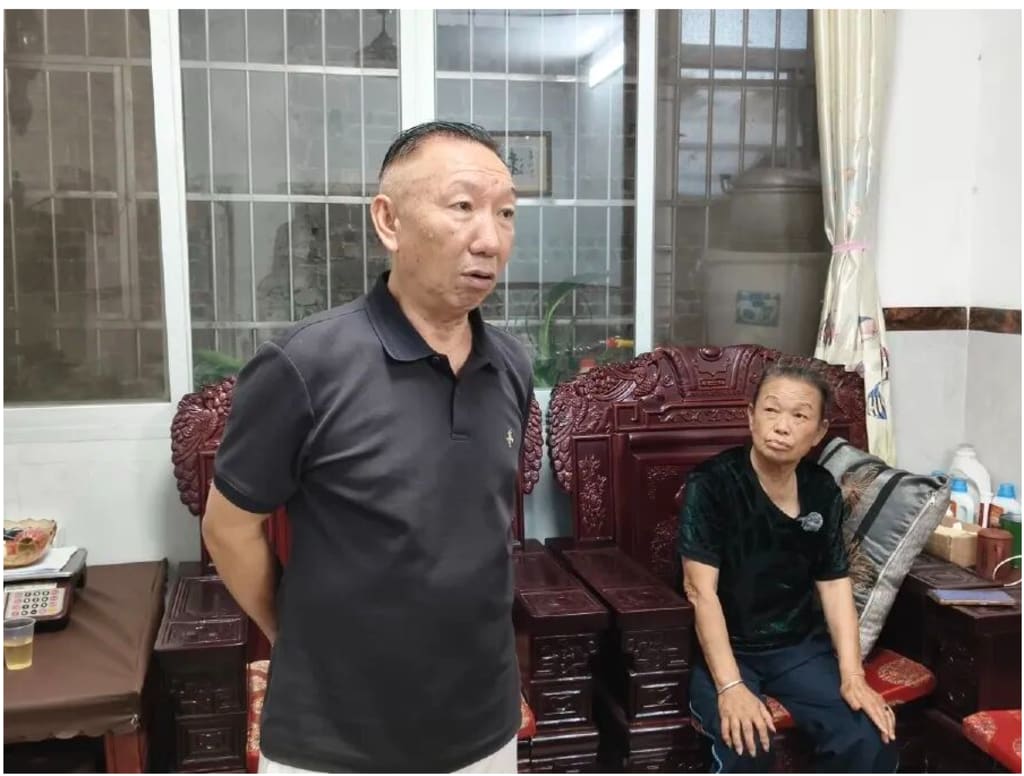
The legal predicament and institutional questions in Guangxi’s “grandson not biological” case
I
In May 2024, Lu Xiaodong of Yulin, Guangxi, was hit by a truck while delivering food. He died at the scene.
On the day the accident report was issued, Mr. Lu and his wife, Ms. Zhu, saw their son for the last time in the hospital morgue. The traffic police handled compensation with the liable party. The body stayed at the funeral home until accident procedures were complete and cremation could proceed. Local custom called for the eldest son or eldest grandson to keep vigil and carry the urn. Lu Xiaodong had one child, eight-year-old Xiaohai.
Ms. Zhu called her daughter-in-law, Ms. Huang. Ms. Lu later heard her mother’s version of the call. Her mother said that if the child belonged to the Lu family, he should stay and keep vigil for his father. If not, she should take him away.
Ms. Huang’s answer was repeated by Ms. Lu many times, each time with the same pause and tone: “So what if he is? So what if he isn’t?”
That sentence stuck. Ms. Zhu hung up and sat on a plastic stool in the living room. She stared at a photo of Xiaohai at age three on the coffee table. In the photo, the child sat on Lu Xiaodong’s neck, holding an ear of corn, grinning with a missing front tooth.
II
The Lu family lived in a self-built three-story house on the outskirts of Yulin. White tiles covered the outside. Some had yellowed and peeled. The first floor had the living room and kitchen. The second floor had the bedrooms of Mr. Lu and his wife and Adong’s old room. The third floor was used for storage. Xiaohai had lived there since birth. Milk powder, diapers, kindergarten fees, elementary school pickup and drop-off all fell to the two elderly people. Ms. Huang worked as a cashier at a supermarket in the city. She left early and returned late, often working overtime on weekends.
Ms. Lu said her sister-in-law’s attitude toward the child was “not exactly bad, but just not very attentive.” When Xiaohai had a fever of 39 degrees Celsius, her mother carried him on her back to the clinic in town in the middle of the night. Of ten parent-teacher meetings, eight were attended by her father or mother. Adong delivered food, so his hours were flexible. He picked up and dropped off the child more often than Ms. Huang did.
These were subtle feelings inside the family. No one connected them to blood relation.
After the phone call at the funeral, Ms. Zhu began searching old things at home. In the drawer of Adong’s room, she found a lock of hair tied with a red string. It was the fetal hair shaved when Xiaohai was one month old. She also took a few hairs with follicles from Adong’s comb and put them in a clean envelope. A few days later, she took these two things and rode a two-hour bus to Nanning.
A forensic appraisal center accepted the commission. In the client column, Ms. Zhu wrote her own name. She told no one.
Ten days later, the center called her to pick up the report. She sat in a chair in the reception room, opened the kraft-paper envelope, and pulled out the A4 sheet. The conclusion column contained a sentence saying that, based on the available materials, the “grandfather” and “grandmother” samples did not support a biological grandparent-grandchild relationship with the “grandson” sample.
Ms. Zhu folded the report and put it in the cloth bag she carried. She took the bus back to Yulin. It was dark when she got home. Mr. Lu was sitting at the door smoking. He asked where she had been. She said she had gone to Nanning to see an old friend.
III
In October 2024, the Lu family filed a lawsuit. Ms. Lu hired a lawyer from Nanning. The complaint had three demands. Xiaohai should lose the statutory right to inherit Adong’s estate. Ms. Huang should make a public apology. Ms. Huang should pay child support and compensation for mental distress totaling more than 360,000 yuan.
To strengthen the evidence, the Lu family applied to retrieve the blood samples the traffic police had preserved from Adong’s emergency treatment. They sent the samples to another appraisal institution for a paternity test. The result again denied a biological father-son relationship between Adong and Xiaohai.
The first instance was heard in a district court in Yulin. Ms. Huang appeared without a lawyer and defended herself. The judge asked whether she agreed to a paternity test. She said she did not. The judge asked what she thought of the two appraisal reports the Lu family submitted. She said, “I do not accept them, but I will not apply for a re-appraisal.”
The judgment came quickly. The court dismissed all of the plaintiffs’ claims. It gave two main reasons. First, under Article 1073 of the Civil Code, only the father or mother and an adult child may bring an action to deny a parent-child relationship. Grandparents do not have standing. Second, the commissioning procedures for the two appraisal reports had defects. They could not be used as the basis for a finding.
The Lu family appealed. The second instance upheld the original judgment. The appellate court emphasized the “principle of the best interests of the minor.” Adong had never objected to the parent-child relationship during his lifetime. Xiaohai’s guardian did not agree to an appraisal. Under those conditions, the court said, it was not appropriate to overturn an established parent-child relationship by force.
IV
The matter should have ended there. But the appraisal report that the court found to have “procedural defects” started another story.
In early 2025, the Nankai District Justice Bureau of Tianjin received a complaint and opened an investigation into the forensic appraisal center. The investigation results were more specific than the Lu family had expected. When the center accepted the grandparent-grandchild kinship appraisal, the client, Ms. Lu, was not Xiaohai’s legal guardian. The center did not require proof of guardianship. It did not record identity verification. It did not preserve the guardian’s identity information. More critically, the Adong DNA sample used in the appraisal was a sample the traffic police had entrusted to the center for traffic accident handling. The center used this sample for a civil paternity test without authorization from the public security organ.
The Justice Bureau found that these acts violated the General Rules on Forensic Appraisal Procedures regarding the extraction, preservation, and use of appraisal materials. They also violated the Ministry of Justice’s requirements on regulating paternity testing. The final disposition was admonition.
Admonition is an administrative measure. It does not involve a fine. It does not affect the institution’s qualifications to practice. When the disposition circulated online, people often simplified it to “the appraisal agency was punished for falsifying an appraisal.” That simplification triggered a second round of questions about why the court did not accept the report.
The court’s reason for not accepting it matched the reason in the disposition. The legality of the appraisal procedure had fundamental defects. An appraisal report that violated rules in three areas, commissioning subject, identity verification, and source of test material, lacks evidentiary qualification. That is true regardless of whether the conclusion is correct.
V
On September 16, 2026, the Guangxi High People’s Court held a retrial hearing. Mr. Lu and his wife, Ms. Lu, and Ms. Huang all attended. Xiaohai did not come.
The hearing lasted more than three hours. According to Ms. Lu’s later account, the judge focused on two questions. First, had Adong ever objected to the parent-child relationship during his lifetime? Second, was Ms. Huang willing to cooperate with a paternity test? The answer to the first was no. The answer to the second was silence.
No judgment was announced in court. When Ms. Lu walked out, reporters stopped her and asked what she expected. She said: “My mother is seventy this year. My father is seventy-three. They raised that child for eight years. Now they cannot even see him. The law says we have no standing to sue. Then what are we supposed to do?”
In the current legal framework, there is no ready answer to that question.
VI
A search of China Judgments Online shows that the Lu family’s experience is not isolated. Courts in Mudanjiang, Heilongjiang; Xining, Qinghai; Zhangzhou, Fujian; Guiyang, Hunan; Harbin, Heilongjiang; Ninghe, Tianjin; and Nanjing, Jiangsu, have heard highly similar cases. At least seven regions have used the same reasoning. Grandparents are not proper plaintiffs in an action to deny a parent-child relationship. The lawsuit is dismissed.
The Mudanjiang Intermediate People’s Court of Heilongjiang stated in (2023) Hei 10 Min Zhong No. 1291: “Under Article 1073 of the Civil Code, the subjects of an action to confirm or deny a parent-child relationship are limited to the father or mother and an adult child. Grandparents do not have the standing to bring an action to deny a parent-child relationship.” The Xining Intermediate People’s Court of Qinghai added in (2023) Qing 01 Min Zhong No. 3571 that the grandfather “has no direct interest in the case.”
The Supreme People’s Court’s case database has included related cases and set a unified rule. Inheritance litigation cannot be used as a disguised exercise of the parent-child denial right that belongs only to parents. Grandparents are not proper parties. Their applications for paternity testing in inheritance disputes will not be supported.
This means that under the current system, the Lu family’s litigation path is blocked. Their only hope is that Xiaohai, after reaching adulthood, will bring an action to confirm or deny the parent-child relationship. That will be in 2036.
VII
If one takes a longer view, one finds that family stability over blood truth is not a judicial logic unique to China.
Michael H. v. Gerald D., decided by the U.S. Supreme Court in 1989, is often cited in this field. The facts resemble the Guangxi case in some ways. Carol, while separated from her husband Gerald, had a daughter, Victoria, with her lover Michael. She then returned with the child to live with Gerald. Michael sued to assert his rights as the biological father and sought visitation. The California courts relied on then Article 621 of the Evidence Code. They held that the presumption of legitimacy was irrebuttable and dismissed Michael’s claim. The case went to the U.S. Supreme Court. The nine justices upheld the lower court by 5 to 4. The majority argued that maintaining the stability and harmony of an existing family is more important than satisfying a biological father’s demand for a paternity test.
In a 2016 ruling, the German Federal Constitutional Court held that grandparents do not have a constitutionally protected interest in challenging the parent-child relationship between their grandchild and the child’s legal father. Article 1600 of the German Civil Code limits the subjects of a paternity denial action to the legal father, the mother, and the child. Japan’s Personal Status Litigation Act is the same.
France, the United Kingdom, Sweden: in all these countries, the plaintiff’s qualification in a parent-child denial action is limited to members of the core family. Grandparents, siblings, and other relatives are excluded.
Chinese law shares this approach with many other legal systems.
VIII
Outside the global mainstream, there is an exception.
Article 64 of Taiwan’s “Family Proceedings Act” provides: “An action to deny parentage may be brought by a person whose inheritance rights are infringed. If one of the spouses or the child dies within the statutory period or before the period begins, the person whose inheritance rights are infringed may bring the action. If the action is brought under the preceding paragraph, it shall be brought within one year from the death of the decedent.”
The logic is this. When the person qualified to bring a denial action has died, and the inheritance rights of others, such as grandparents, are thereby infringed, the law gives them a limited “relay” right to sue. The action must be brought within one year after the decedent’s death.
Article 1063 of Taiwan’s Civil Code provides that the exclusion period for a denial action is “within two years from the time one learns that the child is not a legitimate child.” In a 2007 case, a maternal grandmother lost because she had exceeded the exclusion period. The court reasoned that the stability of the presumption of legitimacy is highly public in nature and cannot be challenged indefinitely.
Taiwan’s institutional design is not perfect, but it gives a legislative sample for one question. How may other interested parties protect their rights after the father or mother dies? Associate Professor Wu Yiming of East China University of Political Science and Law noted when commenting on the Guangxi case that legislators at the time may have considered only disputes between the child’s parents. They did not consider this extreme situation. He said there is also a possibility of expanding judicial interpretation in the future.
IX
After the retrial hearing, Ms. Lu took her parents to stay overnight in Nanning. The next morning, she saw her mother sitting by the hotel window, holding her phone. On the screen was a photo of Xiaohai on his first day of elementary school. In the photo, the child wore a white school uniform and a blue backpack. He stood at the school gate and smiled back.
Ms. Lu said her mother wanted to set this photo as her phone wallpaper but did not know how. She set it for her. Her mother stared at the screen for a long time and then said: “I wonder how tall he is now.”
Ms. Lu did not answer. She later told reporters that the elderly people’s greatest wish now is not to win the lawsuit or get money back. It is to see the child once. “Raising him for eight years, saying you don’t miss him, that would be false.”
After the hearing, the lawyer, Zang Fanqing, said he was considering filing a separate visitation rights action. “Although legally speaking, grandparents have no statutory right to visit grandchildren, the elderly people actually raised the child for eight years and formed a de facto raising relationship. The court has some discretion.”
Whether this direction will work remains to be seen. But it offers a path that does not depend on the parent-child denial action. The blood truth cannot be confirmed through litigation under the current system. So the effort may start from the emotional facts and the raising facts and seek a more pragmatic solution.
X
The first-instance court made some balance in the property distribution. In the distribution of death compensation, property losses, and compensation for mental distress, Mr. Lu and his wife received 60 percent. Ms. Huang and Xiaohai received 40 percent. This ratio was not strictly calculated according to the statutory inheritance order. It was a discretionary decision to give the elderly people more.
This shows that the court did not completely ignore the elderly people’s situation. But this discretion cannot answer their core demand. They want confirmation that the child is not biological. They want acknowledgment of the deception they feel.
“So what if he is? So what if he isn’t?” Ms. Huang’s sentence has been quoted online many times. It has almost become a classic villain line. But put it back in context. Her husband had just died. Her parents-in-law proposed at the funeral that if the child was not of the Lu family, she should take him away. She was alone with an eight-year-old child. She had no stable housing. Her supermarket cashier’s salary barely covered the two of them. How much of her answer was indifference and how much was fear is hard for outsiders to tell.
Ms. Lu said: “I don’t hate her now. I just feel that my brother was too wronged in this life.”
XI
The Guangxi High People’s Court did not announce its judgment at the retrial hearing. As of publication, the case is still under review.
From a legal-technical perspective, a retrial reversal is unlikely. The current law’s provisions on standing are clear and explicit. It is difficult for a court to break through them. But the discussion this case has triggered goes beyond the individual case. When one parent dies and the other refuses to bring a parent-child denial action, should other people whose interests are harmed by that parent-child relationship have a limited remedy channel?
Taiwan’s system of a person whose inheritance rights are infringed bringing a denial action, the German Federal Constitutional Court’s case law on the boundary between the legal father and the biological father, and the different choices made by U.S. states between the presumption of legitimacy and biological truth may provide references for future legislation or judicial interpretation.
Until then, Mr. Lu and his wife can only wait. Wait for the retrial result. Wait to see whether the visitation action can be filed. Wait for Xiaohai to grow up.
Ms. Zhu changed her phone wallpaper to that first-day-of-school photo. She is not very good with smartphones. But she lights up the screen several times a day to look at the child in the white school uniform and blue backpack. She does not know how tall he is now. She does not know whether he still remembers the longan tree at his grandparents’ house. Every summer, Xiaohai would climb it to pick fruit. Adong would stand below holding a bamboo pole to catch them.
The tree is still there. This year it bore especially many longans. They ripened and no one picked them. They fell all over the ground.
About the Creator
Jin
Writer of reamstories
https://reamstories.com/jin
Enjoyed the story? Support the Creator.
Subscribe for free to receive all their stories in your feed. You could also become a paid subscriber, letting them know you appreciate their work.
Comments
There are no comments for this story
Be the first to respond and start the conversation.