
They Kept a Secret From Jensen Huang for a Year. Then They Handed It to The New York Times in Twelve Days.
A Chinese spy got close to America's top chip CEO. The FBI stayed silent for a year. Then the leaks began.
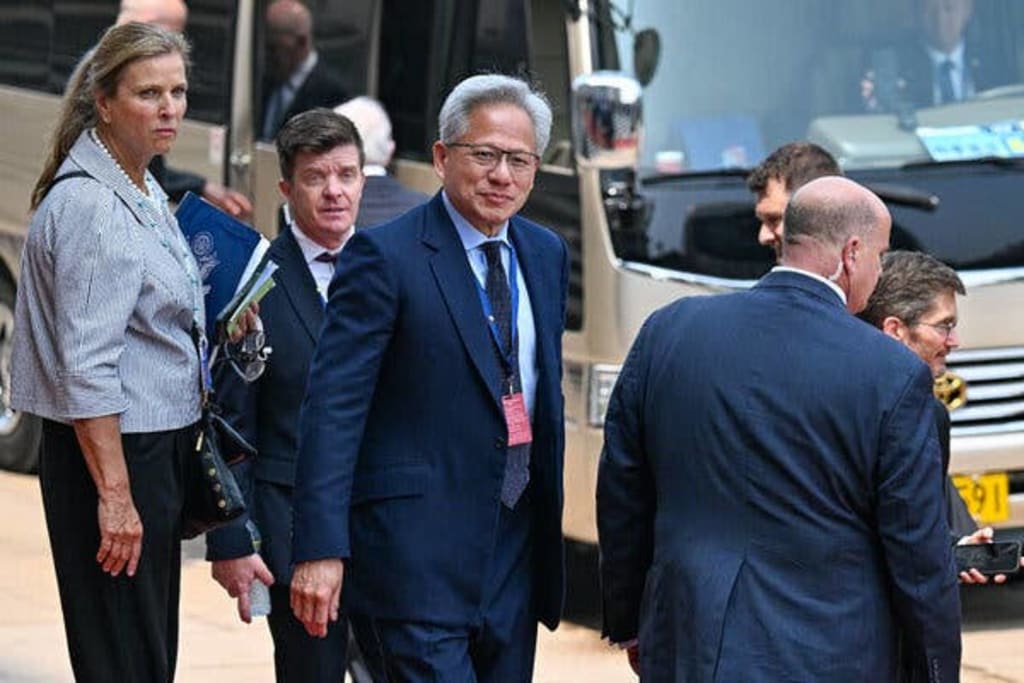
November 9, 2026, the White House lawn. Trump was cornered by reporters asking whether, when he took Jensen Huang to Beijing in May, he knew that the woman close to the Nvidia CEO had been identified by U.S. intelligence as a Chinese spy.
Trump said: "No, I didn't hear about that at the time."
Less than twenty-four hours later, The New York Times published details of a one-on-one conversation inside the cabin of Air Force One. In May, shortly before the plane landed in Anchorage to refuel and pick up Huang, Secretary of State and National Security Advisor Marco Rubio walked into the cabin and briefed the president in person on a highly classified memo he had overseen that spring: Huang had a close relationship with Alice Huang, and Alice Huang had been recruited by China's Ministry of State Security. This was at least the second time in seven months that Trump had been told of the relevant intelligence.
The president said he hadn't heard. The newspaper said you heard it on the plane.
What lies in between is a whole set of rules about which secrets can be shown to whom, and which secrets can be fed to whom.
Huang was initially not on the list of business leaders accompanying Trump to China. When the list was published, the media noticed that the head of the world's most valuable chip company was absent. Trump saw the reports and personally called Huang to invite him to join mid-trip. The two agreed that Huang would fly himself to Anchorage and board Air Force One when it stopped to refuel. When Rubio learned of the arrangement, he briefed Trump face to face on the plane.
The briefing did not change any practical arrangement. The cabin door opened as usual, Huang boarded as usual, and Trump later called him "a great Jensen Huang" on social media.
Look from the cabin to the policy table, and the choice is not hard to explain. The export ban on Blackwell and the next-generation Rubin chips to China stayed in place. What was opened was only the downgraded H200, subject to case-by-case review, with 25 percent of each sale going to the U.S. Treasury. Megaspeed's procurement network in Southeast Asia was still under investigation by the Commerce Department, the Justice Department, and the FBI; the case had been referred to the Justice Department. To leave Huang to a media siege halfway to Beijing would be to surrender America's tech presence; to bring him aboard while keeping the chip ban and the criminal investigation in hand was to hold the stage above the table and guard the door beneath it.
The stranger fact: a secret so precise that it could reconstruct a one-on-one conversation inside the cabin of Air Force One. Why, for a full year, could it not be told to the person who was being targeted by a foreign spy?
According to standard U.S. counterintelligence procedure, when intelligence agencies confirm that an American citizen, especially a central figure holding the keys to AI computing power, is being approached by a target of a foreign intelligence service, and the person is likely unaware, the first move should be a "defensive briefing": the FBI goes to the person, lays out the other side's identity, and has him cut contact and check for vulnerabilities.
Huang never received that briefing. Multiple independent sources confirm this.
Intelligence agencies began monitoring Alice Huang in late 2024. U.S. officials concluded that she was gathering information for China's Ministry of State Security and might establish a close relationship with Huang to obtain Nvidia's plans and Washington's export-control intentions. For more than a year, they identified the person on the other end of her contacts as Jensen Huang, yet they never gave him any warning.
The standard explanation from Washington's intelligence circles is four words: protect sources and methods. Once Huang was told, he would inevitably cut off contact with Alice Huang; once Alice Huang noticed, China's Ministry of State Security would know her communications had been intercepted, and a monitoring line more than a year in the making would be wasted.
That logic sounds tight. But in the twelve days from late October to early November 2026, it was torn apart by the same people who held the classified clearances.
On October 29, anonymous officials first disclosed to The New York Times the electronic surveillance of Alice Huang and the fact that Huang had been identified. On November 7–8, contents of Rubio's spring memo about the "romantic relationship" were fed to the media, forcing out Huang's all-staff acknowledgment and the board's independent investigation. On November 9, Trump had just softened the blow for Huang in front of White House reporters ("I really believe him"). On November 10, even the one-on-one briefing Rubio had given the president inside the cabin of Air Force One, complete with the coordinates of the Anchorage refueling stop, was printed verbatim in The New York Times.
If telling Huang would tip off the target, then why is telling The New York Times, which means telling Beijing and the whole world at the same time, any different? If a monitoring line more than a year in the making was so precious, why could it be uprooted and spread across the newspaper within twenty-four hours of the president saying one soft sentence?
What happened in those twelve days follows political logic. When a secret is used to protect a president who does not follow the bureaucracy's script, "protect sources and methods" is the reason to refuse to tell. When the same secret can be used to create a siege, to embarrass the president on camera, to force him to defend his judgment, "protect sources and methods" is no longer an obstacle.
This system is tight-lipped with its own victims and responsive to newspaper editors.
Whether Alice Huang is a spy, where Megaspeed's $4.8 billion in chips went, whether the FBI investigation and the House's three committees' closed-door questioning scheduled for November 18 should continue: these questions should be answered by evidence and law, not arranged by the rhythm of selective leaks. Beijing's purchase of chips through Singapore data centers and its deployment of someone close to Silicon Valley's gatekeeper of computing power is penetration aimed at America's tech lifeline. None of it should be dismissed.
But when a counterintelligence system can selectively hand to a newspaper, within twenty-four hours, a secret it says cannot be told to Jensen Huang, in order to punish a president who said something soft in public, people have reason to ask: the classified file they refuse to let go of, is it guarding against spies on the other side of the ocean, or against the man sitting in the front cabin of Air Force One?
About the Creator
Jin
Writer of reamstories
https://reamstories.com/jin
Enjoyed the story? Support the Creator.
Subscribe for free to receive all their stories in your feed. You could also become a paid subscriber, letting them know you appreciate their work.
Comments
There are no comments for this story
Be the first to respond and start the conversation.