
The Street Where Everyone Has a Right to Be and No One Is Safe
A motorcycle crash in George Town shows what happens when one road is asked to be a dining room, a highway, and a sidewalk at the same time.
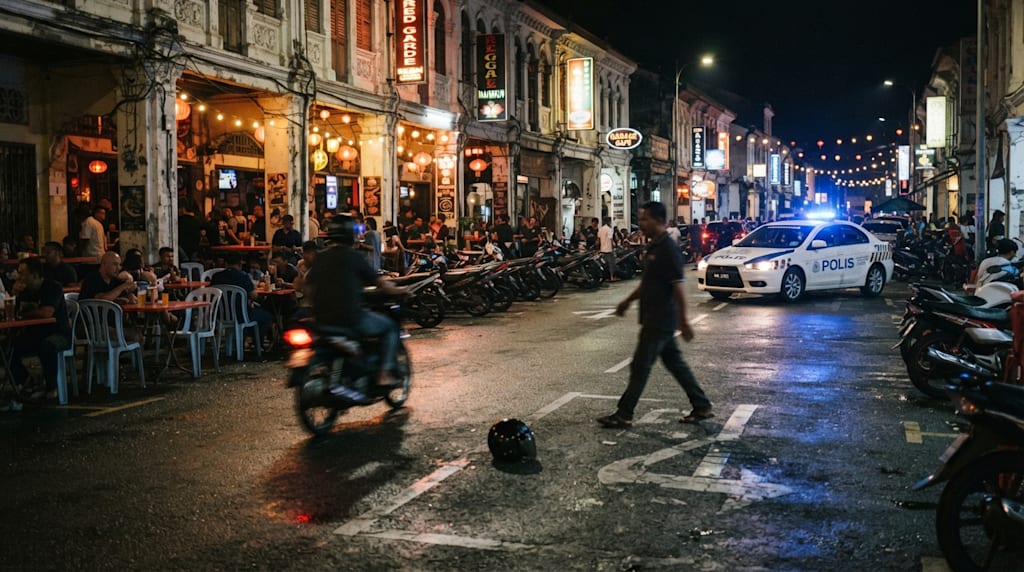
At nine in the evening, Chulia Street is still busy. Bars hang lights under the five-foot way. Plastic chairs sit partly on the asphalt. Beer crates are stacked near the curb. A menu lies in the road. Diners sit with knees close to the lane. A motorcycle comes from far away. You hear it before you see it. A pedestrian stands at the roadside. He looks left. He looks right. He steps out.
In the video, he reaches the centre line. The motorcycle hits him. The impact is short. The sound is dull. A helmet rolls away. The exhaust pipe still rings. People run over. Someone raises a phone. A patrol car’s roof lights start turning. Less than a minute has passed.
Then the internet argues. Some blame the pedestrian for crossing carelessly. Others say the motorcycle was speeding. Others ask why the police car arrived so fast. Was it chasing the rider? There is no official answer. The video lasts twenty seconds. That is enough to show the street’s problem.
The street serves many uses at once. It is a dining area, a walkway, a parking spot, a tourist photo spot, and a motorcycle shortcut. A white line runs down the middle. People are on both sides of it. Tables sit beyond the line. A van parks by the curb. Pedestrians come out between vehicles. Motorcycles pass through gaps between people. Everyone uses the road. No one owns it. When space is tight, speed decides who goes first. The slow one pays.
Businesses need customers. Tourists want to drink outside. The council has to manage. Motorcycles need to move. Pedestrians need to cross. These needs are reasonable. The problem is that they are packed into one undivided road. There are no speed bumps, no barriers, no time restrictions, and no clear crossing point. There is only habit. At nine in the evening, habit fails.
Some say the pedestrian should have watched the traffic. He should have. But watching needs a clear view. Parked vans block the view. Tables and chairs block it. Lights and crowds block it. Some say the motorcycle should have slowed down. It should have. But slowing down needs a reason. The road does not force it, nothing ahead blocks it, and no railing lines the side. The speed limit sign may be hidden behind a tree. A road built for speed invites speed. A road that mixes everything invites collisions.
After the crash, the patrol car arrived quickly. Some people suspect the rider was being chased. That suspicion has no answer. It does show something else. Police cars are usually on this street. A parked police car means order is needed. Yet chairs still come out. Pedestrians still weave through traffic. Motorcycles still accelerate. Order has not become rules. It has become occasional patrols. A patrol can catch one person. It cannot change a road.
The council has choices. It can treat this as a traffic road. Then it must clear the roadside tables, mark lanes, add speed bumps, and enforce the law. It can treat it as a pedestrian street. Then it must close the road to vehicles at night and allow legal outdoor seating. It can divide the road by time. Traffic during the day, no traffic at night. Each choice has a cost. Merchants will complain. Riders will detour. Tourists will be inconvenienced. The mixed state also has a cost. The cost is a body, a motorcycle, and one night’s news.
In Malaysia, motorcycles are part of daily life. They are cheap and fast, and many people rely on them. Riders are also the least protected people on the road. In one impact, the pedestrian flies out and the rider flies out. Neither wins. Blaming the pedestrian will not make motorcycles slow down. Blaming the rider will not give pedestrians a place to cross. Blaming individuals leaves the road as it is. The next day, chairs come out again. Motorcycles pass again.
The street has to share its space differently. That means limiting speed, dividing space, and setting times for vehicles and pedestrians. Diners need a place to sit. Walkers need a place to cross. Riders need to know where they must slow down. This is not complicated. Speed bumps, barriers, lighting, and a zebra crossing cost little. The expensive part is the crash.
In the video, the pedestrian lies on the road and does not get up. The rider stands and walks a few steps. The patrol car arrives. The crowd gathers. Phones record. Twenty seconds end. Then the video loops.
The next night, the lights on Chulia Street come on again. Plastic chairs return to the roadside. Beer crates are stacked again. A motorcycle comes from far away again. The brake mark on the road is shallow. Rain washes it away. No one stops.
A road is not natural. It is a set of decisions. Someone painted the line. Someone allowed the tables. Someone skipped the crossing. Someone chose how often to patrol. Someone decided this street could be everything at once. Those decisions can be made differently. A diner can sit without blocking traffic. A pedestrian can cross without gambling. A rider can move without racing. A business can operate without pushing chairs into the path of a motorcycle. A council can manage without waiting for a viral video. These are small choices. They are timetables, paint on asphalt, removed obstacles, and steady enforcement. The crash in George Town was one night. The argument online was one day. The road, the chairs, the motorcycles, and the pedestrians are still there. Who gets the space, who gets the speed, and who takes the risk? Until that is answered with changes on the ground, the same twenty seconds will play out again. The street will still be awake at nine, pretending to be a dining room, a walkway, a parking lot, and a road at the same time.
About the Creator
Jin
Writer of reamstories
https://reamstories.com/jin
Enjoyed the story? Support the Creator.
Subscribe for free to receive all their stories in your feed. You could also become a paid subscriber, letting them know you appreciate their work.
Comments
There are no comments for this story
Be the first to respond and start the conversation.