
The Silent Mass Disaster of John and Jane Does:
America, Sit the Hell Down. We Need to Talk.

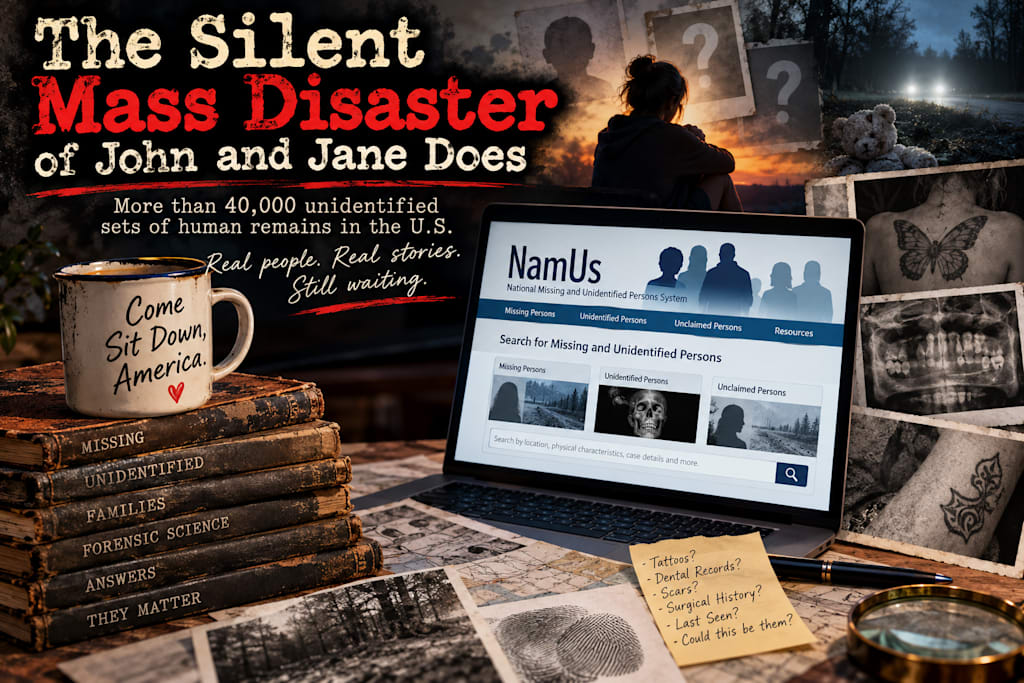
More than 40,000 unidentified sets of human remains. Families still waiting. And a national database that gives ordinary people a chance to help put names back where they belong. So, pour yourself a cup of tea, pull up a chair, and let's talk about the people America keeps leaving behind.
Let me tell you something, folks.
We live in a country that can identify a person from a fingerprint, track a phone across half a continent, recognize a face through a camera, and tell us what we might want to buy before we've even finished thinking about it.
Artificial intelligence? Check.
Facial recognition? Check.
A thousand ways to find somebody who owes us twenty dollars? Apparently, check, check, and check again.
But identifying thousands upon thousands of human beings who have died without anyone knowing their names?
Well, now. Suddenly, things get complicated.
And that, my friends, is where Miss Lil would like everyone to come sit the hell down.
Because buried beneath the headlines, beneath the political shouting matches, beneath the endless parade of celebrity nonsense and internet arguments, there is a national tragedy that doesn't get nearly enough attention.
It is a tragedy made up of people who had mothers, fathers, siblings, children, friends, favorite songs, bad habits, embarrassing childhood photographs, and lives that mattered to somebody.
People who disappeared.
People who died.
People whose remains were recovered, examined, documented, and ultimately left unidentified.
They are known by names that aren't really names at all.
John Doe.
Jane Doe.
Baby Doe.
And behind every one of those labels is a human being whose story remains unfinished.
Welcome to America's silent mass disaster. And no, we're not going to whisper about it just because the subject makes people uncomfortable.
The Number That Should Make Every Damn One of Us Uncomfortable
Let's start with the number that put this issue on the map.
In 2007, the National Institute of Justice described America's missing-person and unidentified-remains crisis as the nation's "Silent Mass Disaster." At that time, estimates included more than 100,000 active missing-person cases and more than 40,000 sets of unidentified human remains.
The problem was not simply a lack of forensic science. It was a lack of coordination, accessible information, and communication between agencies and the public.
Now, before somebody runs off with that number and presents it as today's confirmed total, let's put our investigative britches on.
That figure is a historical estimate, not a verified count of how many unidentified remains exist today. Current NamUs figures tell a different part of the story: as of June 1, 2026, the system listed more than 15,000 active unidentified-decedent cases. The agency also estimates that approximately 4,000 unidentified decedents are recovered nationwide, with roughly another 1,000 added each year.
Those figures describe different measures, and NamUs cautions that its database does not capture every case in the country.
And there's our first problem.
We have a crisis that has persisted for decades, but even understanding its full scale is complicated by inconsistent reporting and incomplete records.
If we cannot reliably count the people we're failing to identify, how the hell are we supposed to measure the full extent of that failure?
Sit with that one for a minute.
Because every statistic represents a person who may have been somebody's missing child, somebody's beloved partner, somebody's best friend, or somebody who simply slipped through the cracks of a system that was never designed to make every disappearance easy to track.
And those cracks can become chasms.
John and Jane Doe: The Names We Give People When We Cannot Give Them Their Own
There is something deeply unsettling about the term Jane Doe.
Not because the name itself is sinister, but because of what it represents.
Imagine a person whose remains are discovered in a wooded area, near a highway, in an abandoned building, or somewhere nobody expected to find them.
Investigators arrive. Evidence is collected. A medical examiner works to determine the person's identity and the circumstances of death.
They may establish an estimated age, height, biological sex, dental characteristics, or other identifying features. They may document healed injuries, surgical hardware, scars, and tattoos.
Perhaps the person has a distinctive tattoo of a butterfly on their shoulder. Perhaps they have a surgical plate in their leg. Perhaps their teeth reveal years of dental treatment.
Those details can become clues.
But clues are not names.
Without a confirmed identification, the person may remain a Jane or John Doe while investigators attempt to connect the available evidence to a missing-person report.
Meanwhile, somewhere else, a family might be searching for someone whose description fits.
Perhaps they have called hospitals. Perhaps they have filed reports. Perhaps they have spent years searching online, hoping for a breakthrough.
And the heartbreaking possibility is that the answer could exist in another jurisdiction's files, separated from their search by a database that was never updated, a missing dental record, an incomplete report, or information that nobody thought to compare.
Two investigations. One missing connection. And a family left wondering whether their loved one is still alive.
This is why information-sharing matters so much.
The National Institute of Justice created NamUs to help bridge those gaps, connecting missing-person cases with unidentified remains through centralized records, investigative support, and forensic science.
And thank goodness for that, because we should not need a miracle to accomplish what careful recordkeeping, collaboration, and science can make possible.
Enter NamUs: The Database That Needs More Eyes on the Evidence
Meet NamUs, the National Missing and Unidentified Persons System.
Administered by the National Institute of Justice, NamUs provides a centralized database and investigative resources for missing people, unidentified decedents, and unclaimed persons.
It also provides forensic services, including DNA analysis, fingerprint examination, forensic anthropology, and forensic odontology. Its resources are available at no cost to participating agencies and eligible users.
Here is the part I want you to pay attention to.
You do not have to be a police detective, a forensic anthropologist, or the person wearing the expensive lab coat to help.
Members of the public can search publicly available case information, enter eligible missing-person cases, follow cases, and submit potential matches or tips.
NamUs reviews public case submissions with the appropriate investigating agency before publishing them. Sensitive information, including restricted dental records and fingerprint information, remains available only to authorized professional users.
In other words, the public can help connect dots without being handed the keys to the entire forensic kingdom.
And that distinction matters.
This is not an invitation to play internet detective by accusing strangers, harassing grieving families, or announcing that you've solved a murder because two people have similar tattoos.
It is an opportunity to notice something meaningful and report it through the proper channels.
Sometimes, the smallest observation can give an investigation somewhere new to go.
How Can Ordinary People Help?
1. Tattoos and distinctive markings
A rose, a name, a religious symbol, a set of initials, or an unusual design can be an important identifying clue. If a publicly available Doe profile describes a distinctive tattoo that resembles one remembered on a missing loved one, that resemblance may be worth reporting.
2. Dental characteristics
Dental records and X-rays can help forensic professionals compare an unidentified person's teeth with records belonging to a missing person. But the actual dental records are not an open public browsing resource. Authorized professionals handle those comparisons.
3. Scars, surgeries, and medical history
A remembered fracture, surgical implant, healed injury, or unusual physical feature may help narrow the possibilities. These details are particularly useful when considered alongside other evidence rather than in isolation.
4. Dates, locations, and physical descriptions
A person's last known location, approximate age, height, clothing, and circumstances of disappearance may help someone recognize a possible connection between cases that otherwise appear unrelated.
And let me make one thing crystal clear: a resemblance is a lead, not proof.
A tattoo may have been described incorrectly. A dental history may be incomplete. A person may look different from an old photograph because of age, illness, injury, or the circumstances in which their remains were found.
The goal is to provide useful information to investigators, not to deliver a verdict from your living room.
The Tattoo That Could Change Everything
Let's talk about tattoos for a moment, because this is where the average person may have something genuinely useful to contribute.
Think about the people you know.
You might remember your cousin's dragon tattoo, your old school friend's butterfly, or the name your brother had inked across his chest. Maybe you remember the placement, the colors, the lettering, or the fact that one wing was unfinished.
You might not remember their exact last known address. You might not know which police department handled their disappearance. You might not have a complete medical history.
But you remember that tattoo.
Now imagine coming across a publicly accessible unidentified-person case with a description that resembles what you remember.
You have not solved the case. You do not know that the person is your missing friend.
But you may have noticed a detail worth passing along.
That is the power of public participation.
The National Institute of Justice has documented how members of the public have helped identify unidentified people by noticing similarities between case descriptions. In one example, a volunteer recognized a matching physical feature, including a distinctive scar. Subsequent DNA testing confirmed the identification.
Read that again.
A detail someone remembered helped direct attention toward a possible match, and forensic testing established the truth.
This is why those little details matter.
A scar is not just a scar. A tattoo is not just a tattoo. A dental record is not just another piece of paperwork.
In the right investigation, each can be a thread connecting a person without a name to a family searching for answers.
And sometimes, that thread is all investigators need to begin pulling the case in a new direction.
Dental Records: The Unsung Heroes of Identification
Let's give dentistry a moment in the spotlight, shall we?
Because while everybody loves a dramatic DNA breakthrough on television, dental evidence deserves considerably more appreciation than it gets.
Teeth can survive conditions that destroy or obscure other identifying features. Dental X-rays, treatment histories, and the distinctive arrangement of a person's teeth may provide evidence that investigators can compare against records from a dentist.
This process is known as forensic odontology.
NamUs supports these comparisons by helping authorized professionals access and evaluate relevant dental information. Its forensic resources have helped resolve cases through dental comparisons, among other identification methods.
Think about it.
Somewhere in a filing system, a dental office may have an X-ray taken years ago. That image may document a root canal, a missing tooth, a crown, or a pattern of previous treatment.
If a missing person can be connected to those records, investigators may be able to compare them with an unidentified person's dental evidence.
It is not glamorous. It does not come with dramatic chase music. Nobody is running down an alley while a detective shouts, "We got him!"
It's science. It's careful comparison. It's patient work.
And it can be the difference between an unidentified decedent remaining nameless and a family finally receiving an answer.
So, yes, let's hear it for the dentists.
Who knew all those years of telling people to floss might eventually help solve a decades-old mystery?
The Real Problem: We Have Tools, but the System Still Has Gaps
Now we get to the part where Miss Lil sets down her teacup.
Because I do not want this article to become a cheerful little story about a helpful website while we ignore the reasons so many cases remain unresolved.
NamUs is an important resource. It is not a magic wand.
The National Institute of Justice has identified fragmented information-sharing, limited investigative resources, and the volume of missing-person cases as continuing challenges. Participation in NamUs is not universally mandatory, and its database does not contain every missing, unidentified, or unclaimed-person case in the United States.
That means an individual case may not be represented in the database at all.
Records may be incomplete. Information may not have been collected. A family may not know where to turn. An investigation may require specialized testing that takes time to arrange.
And the evidence itself may be difficult to work with.
Some remains are recovered after years of exposure to the elements. Some cases involve only partial remains. Some individuals have no known relatives available for comparison. Some cases require new forensic techniques or the recovery of records that have been lost, misplaced, or never created.
There is no single explanation for every unidentified person.
But there is a common thread running through many of these cases: identification depends on information being collected, preserved, shared, and properly evaluated.
A brilliant forensic scientist cannot compare records that do not exist.
A family cannot recognize a case they never encounter.
A database cannot match a person who was never entered into it.
And an investigator cannot follow a lead that nobody reports.
This is not an argument for blaming every medical examiner, police department, or coroner. Many professionals work under difficult circumstances, with limited resources and enormous caseloads.
It is an argument for treating the problem as the serious public responsibility it is.
Better reporting. Better coordination. Better access to forensic resources. Better communication with families. More consistent use of available systems.
And a recognition that an unidentified person is not an administrative inconvenience.
They are a human being.
What About the People Who Have Nobody Looking for Them?
This is the question that breaks my heart.
We often imagine unidentified people as someone whose family is frantically searching, whose photograph is taped to a telephone pole, whose mother is checking every possible lead.
Sometimes that is exactly the situation.
But not every person has a family member who can search.
Some have become estranged from relatives. Some were experiencing homelessness. Some moved frequently. Some had lost contact with the people who once knew them. Others may have lived with circumstances that made their disappearance less likely to be noticed quickly.
And some families may have searched for years without realizing that the person they love has died.
We must be careful not to assume that an unidentified person was unloved simply because nobody has identified them yet.
Absence of a visible search does not mean absence of a life that mattered.
It does not tell us whether the person had children, whether they were kind, whether they struggled, or whether someone still thinks about them every birthday.
It tells us only that their identity remains unresolved.
And if the person has been identified but no next of kin can be located to receive notification or claim the remains, that is a different problem entirely. NamUs calls these cases unclaimed persons.
Identified is not the same as reunited. And neither is the same as forgotten.
Every person deserves dignity in death, whether a hundred relatives are waiting for answers or nobody has yet come forward.
That is the standard we should be holding ourselves to.
So, What Can YOU Actually Do?
All right, tea drinkers. We've talked about the scale of the problem, the science, and the gaps.
Now let's talk action.
Because outrage without action is just noise wearing a fancy hat.
Here are a few practical ways to help.
1. Explore the official database.
Visit https://namus.nij.ojp.gov/
Search publicly available missing-person and unidentified-person cases. You can narrow your search using information you already know, such as location, approximate age, or physical characteristics.
2. Pay attention to the details.
Read case descriptions carefully. Notice tattoos, scars, surgical history, clothing, jewelry, and other distinctive features. A meaningful combination of details is more useful than a vague resemblance.
3. Report a potential match responsibly.
If you notice a credible connection, use the official NamUs contact page at https://namus.nij.ojp.gov/contact-us and select the appropriate tip-submission option. Provide the case information, explain the similarity, and include relevant details. Investigators determine whether the lead warrants further examination.
4. Share cases with care.
Share official case links rather than unverified accusations or graphic images. Respect families, avoid speculation about the cause of death, and never publish private information about someone you suspect may be involved.
5. Support families and responsible advocacy.
Missing-person organizations and volunteers can help spread accurate information, encourage reporting, and support relatives navigating a painful and confusing process.
One more important thing: do not upload somebody else's DNA, publish private medical records, or contact a suspected relative or potential offender to investigate on your own. Report what you know to the appropriate professionals and let them handle the sensitive evidence.
You do not need to solve the entire case.
You just need to pass along information that might help the people who can.
The Names We Owe Them
Here is what I want you to take away from this.
When we talk about unidentified human remains, it is easy to let the numbers swallow the people.
Forty thousand becomes a statistic.
Fifteen thousand becomes a database count.
A case number becomes another line on a screen.
But every number represents a human being whose identity is not yet known to the people responsible for the case, or whose story has not yet been fully resolved.
We cannot promise that every person will be identified. We cannot promise that every family will receive the answers they deserve. For some cases, the evidence may be limited, and the road ahead may be long.
But we can refuse to treat the problem as somebody else's concern.
We can support the tools that help investigators do their jobs.
We can encourage better reporting and information-sharing.
We can learn how to recognize a credible lead and how to report it responsibly.
And we can stop assuming that the absence of a name means the absence of a story worth telling.
The man found near a highway had a life.
The woman whose remains were recovered in a wooded area had a life.
The person whose identity has remained unknown for thirty years had a life.
They were not born John Doe or Jane Doe. Those were labels assigned when the people trying to identify them did not yet know their names.
Their real names may still exist in an old photograph, a family memory, a dental file, a missing-person report, or a detail someone has never thought to mention.
Sometimes, finding that connection requires advanced forensic science.
Sometimes, it begins when someone notices a detail and has the sense to report it.
Either way, the work matters.
And we owe it to the people who can no longer speak for themselves to keep doing it.
Miss Lil's Final Word: Come Sit Down, America.
I'm going to put this as plainly as I know how.
We have the technology to compare fingerprints. We have forensic specialists who can examine skeletal remains. We have dental records, DNA analysis, investigative databases, and people willing to spend their time looking for answers.
We have NamUs, a resource that allows the public to search cases and contribute information that may help connect missing people with unidentified remains.
Yet the work is unfinished.
And it will remain unfinished if we decide that unidentified people are somebody else's problem.
These people do not need us to turn their deaths into entertainment. They do not need wild theories, internet accusations, or strangers competing to see who can crack a case first.
They need careful investigation.
They need accurate records.
They need people willing to care about a case even when it is old, difficult, or no longer attracting headlines.
And the families who are still searching deserve to know that their loved ones have not simply been filed away and forgotten.
A name is not a small thing.
A name can tell a family where their loved one is. It can correct a missing-person record. It can give investigators a starting point. It can allow someone to be buried under their own name rather than an assigned label.
It cannot undo a death. It cannot erase years of uncertainty. It cannot repair every wound.
But it can restore something that should never have been lost in the first place: recognition of who that person was.
So, the next time you see a missing-person post, take a moment to read it.
The next time you hear about an unidentified person, remember that the absence of a name does not make that person less worthy of attention.
And if you have information that could help, do not assume someone else has already reported it.
Check the facts. Find the appropriate channel. Speak up responsibly.
Because somewhere in this country, someone may still be waiting for a name.
And somewhere else, someone may remember the detail that helps provide it.
Miss Lil has had her tea. The kettle is empty, but the point stands.
These are not just cold cases. They are unfinished human stories. And every one of those stories deserves a chance to be told.
Now, America, what are we going to do about it?
Further Reading and Official Resources
National Missing and Unidentified Persons System (NamUs): https://namus.nij.ojp.gov/
NamUs Frequently Asked Questions: https://namus.nij.ojp.gov/frequently-asked-questions
National Institute of Justice: Lost but Not Forgotten: Finding the Nation's Missing: https://nij.ojp.gov/topics/articles/lost-not-forgotten-finding-nations-missing
NamUs Fiscal Year 2024 Annual Report: https://www.ojp.gov/library/publications/namus-fiscal-year-2024-annual-report
About the Creator
Lilithea Adasia
I dig where others look away. 🖤 True crime, paranormal mysteries, uncomfortable truths, and the beautifully broken human experience. I chase the stories others bury and ask the questions others avoid. Come curious. Leave questioning.
Enjoyed the story? Support the Creator.
Subscribe for free to receive all their stories in your feed.
Comments