
The Poor Don’t Choose Scammers Because They’re Foolish. They Choose Them Because They Can’t Afford to Wait.
At the bottom, certainty is a drug, and the honest man is always outbid by the liar who promises zero risk.
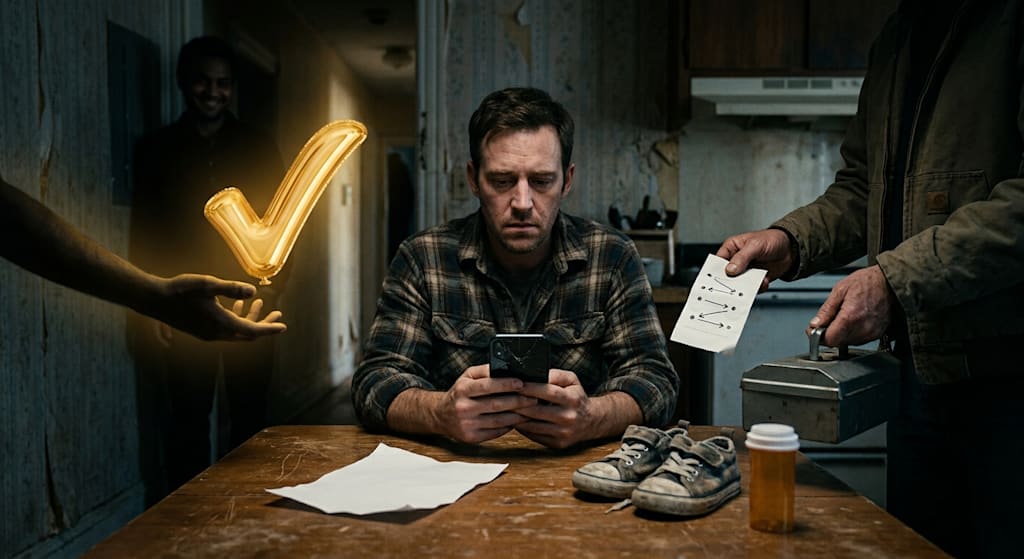
The scammer and the honest man at the bottom
A man stands in front of you with a cracked phone screen. He turns it toward you. The crack runs corner to corner. The message is still readable. He asks if you can handle it. Can you guarantee it will work?
You tell him the truth. It will probably work. But one step might get stuck. If the office refuses the first submission, he will need a second document. That could take another week. It could cost more.
He stops listening at “might.”
He waves his hand. Forget it.
You leave. Another man comes along. He says: No problem. It will definitely work. If it doesn’t, I won’t charge you. Here, take this first. No cost.
The man with the cracked phone looks up. His eyes change.
The man with the cracked phone is not stupid. He knows risk and reward usually travel together. But his rent is due on the fifth. His daughter needs shoes. His mother’s medicine runs out in six days. A middle-class family can lose two thousand yuan on a failed tutoring class and recover next month. He cannot. One wrong move and the whole month collapses.
So he does not want a careful explanation. He wants a guarantee. He wants the risk to disappear. He wants you to say: It will work, and you will not lose anything.
The honest man cannot say that. The scammer can.
The scammer sells certainty
The scammer does not sell a service. He sells a feeling. He sells: You do not need to understand. You do not need to worry. Just give me the money, or give me the documents, or give me your time, and I will take care of everything.
He starts small. He does not ask for a large sum upfront. He gives something away. A free consultation. A small favor. A promise that costs him nothing today. The man with the cracked phone begins to hope. He tells his wife: This one is different. He tells his friend: This guy knows what he is doing.
Then the deadline gets closer. The scammer calls. There is a problem. A document is missing. A fee was not included. The office changed its rule. The man with the cracked phone cannot walk away now. He has already paid the first installment. He has already taken two days off work. His wife has already told her mother it is being handled. He cannot say forget it. He has to pay more.
The risk he refused to admit in the beginning has not disappeared. It has simply waited. And now it costs more.
Why the honest man loses
In any market where trust is low, the loudest promise wins. The honest man says: There is a seventy percent chance. The client hears: You are not sure. The scammer says: One hundred percent. The client hears: This one has confidence.
The honest man says: I need a deposit to start, because I have to spend time. The client hears: You only want my money. The scammer says: Pay me after it works. The client hears: He believes in himself.
So the honest man starves. The scammer gets the order. This is a selection problem. The market selects for the people who are most willing to lie.
At the bottom, this selection is brutal. The rich have contracts, lawyers, insurance, and savings. They can absorb a bad deal. The poor have none of that. They cannot afford a bad deal. So they reach for the one person who promises no risk at all.
But no risk at all does not exist. Someone always pays. The question is only who pays, and when.
The cycle of mutual harm
There is a cycle at the bottom. Because people are poor, they fear being cheated. Because they fear being cheated, they refuse to leave a profit margin for anyone. They want the service free. They want to try first. They want a gift on top. Because no one has a profit margin, no one wants to do good work. Because no one does good work, everyone turns to scammers. Because there are too many scammers, everyone trusts less.
The cycle turns. The honest man leaves. The scammer stays. The man with the cracked phone gets burned. Next time, he trusts no one. Next time, he demands even more guarantees. Next time, he is even easier for a scammer to catch.
Poor people are not bad. They have no room to be patient. No margin means no patience. No patience means no long-term deals. No long-term deals means only one-shot deals. In a one-shot deal, the scammer wins and the honest man loses.
What to do instead
If you are also at the bottom, you cannot afford to be a scammer. A bad reputation travels faster than money. In a neighborhood, in a village, in a chat group, one angry customer can close ten future doors. And a person with nothing left to lose can make your life very difficult. The scammer wins one deal and loses the next fifty.
So do not become a scammer. Become the person who sells certainty in small, real pieces.
Sell the process, not the result. Do not say: It will definitely work. Say: Here is step one. Here is what you get. Here is what it costs. Here is what happens if it fails. You are not promising the ending. You are promising the road.
Cut the risk into steps. The man with the cracked phone cannot swallow a large risk. So make it small. First step: a small fee, a short wait, a clear deliverable. If it works, continue. If it fails, he loses little. You lose little. Both of you can walk away without a broken leg.
Charge in stages. Take a small deposit to start. Take the next payment when the first step is done. Do not advance money you cannot afford to lose. Do not ask him to empty his pocket on day one. This protects both of you.
Write down the ugly parts. Use a chat message. Write the scope. Write the deadline. Write what is not included. Write how changes are charged. Write what happens if the office refuses. The man with the cracked phone may not read it carefully, but it will be there when the problem comes. And the problem always comes.
Screen the clients. If someone runs away the moment they hear the word risk, they are not your client yet. If someone wants everything free, they are not your client. If someone demands a guarantee and a gift and a trial, they are not your client. Let them go. You are running a small, fragile business.
Do not advance money. Do not break the law. Do not make verbal guarantees. The bottom is full of stories about people who tried to help a friend, a cousin, a neighbor, and ended up with nothing. Loyalty at the bottom often means one poor person dragging another poor person down. Be kind, but be clear. Be helpful, but be paid.
Make certainty small, but make it real. You cannot promise one hundred percent success. But you can promise: I will call you before five. I will send you the receipt tonight. I will tell you by Friday if this cannot be done. Small promises kept build trust. Small promises kept are the only currency that works when money is thin.
The long game
A mechanic who does not cheat you will see you again. A paperwork handler who explains the risk and refunds the unused part will see you again. A lender who pays back on time, even a little, will be lent to again. This is compound interest. It is slow. It is boring. It is the only way out.
The scammer makes fast money. The honest man makes slow money. But at the bottom, slow money is the only money that lasts. The bottom cannot afford a lawsuit, a revenge, a bad review, a broken reputation. The bottom survives on repeat business.
So when the man with the cracked phone comes back, do not promise him the moon. Tell him the first step. Tell him the price. Tell him what could go wrong. Then do the first step well. When he comes back the second time, he will not need a guarantee. He will remember.
The scammer wins one deal. Trust keeps the door open.
At the bottom, trust is the road. It is the only road that does not collapse after the first rain.
The mechanic puts his wrench back in the toolbox. He wipes his hands on a rag. He tells the man with the cracked phone: Come back tomorrow. We will do the first part. If it works, we do the next. If it doesn’t, you pay nothing for today. The man nods. He puts the cracked phone in his pocket. He walks out. The mechanic turns off the light. The shop is small. The night is quiet. Tomorrow, the man will come back. That is enough.
About the Creator
Jin
Writer of reamstories
https://reamstories.com/jin
Enjoyed the story? Support the Creator.
Subscribe for free to receive all their stories in your feed. You could also become a paid subscriber, letting them know you appreciate their work.
Comments
There are no comments for this story
Be the first to respond and start the conversation.