
The Persian Princess Hoax: How a Forged Mummy Nearly Fooled the World
Experts revealed the “ancient” mummy was actually the body of a woman who died in 1996.


In October 2000, Pakistani police received a tip about a Karachi resident allegedly in possession of a videotape showing a mummy inside a wooden sarcophagus. Rumor was that Ali Akbar was attempting to sell the artifact on the black market for 600 million rupees (about 11 million US dollars).
When questioned by investigators, Akbar admitted the video was real and told them the mummy was being kept in the city of Quetta under the care of tribal leader Wali Mohammad Reeki.
On October 19, authorities raided the estate where Reeki lived with his two pet camels. He was arrested and led police to a relative’s home, where officers found the sarcophagus in a locked room hidden beneath a carpet.
The tribal leader told investigators he had obtained the ancient relic from Sharif Shah Bakhi, an Iranian man who allegedly discovered it after an earthquake in a nearby town. The two men agreed to sell it and split the profits, though it remains unclear how Akbar was benefiting from the deal.
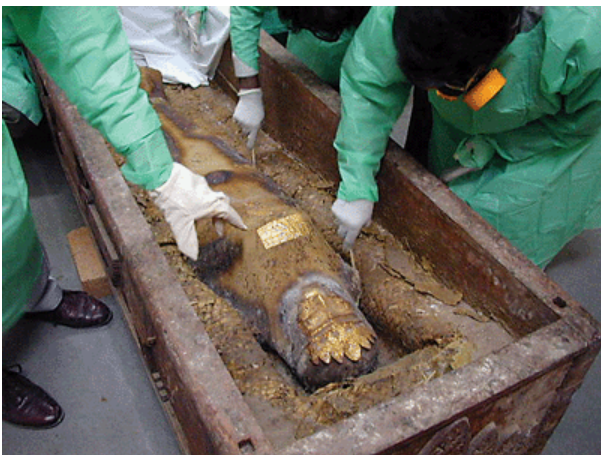
The artifact was taken to the National Museum of Pakistan in Karachi, where curator Dr. Asma Ibrahim and her team spent several months meticulously examining the mummy and its coffin.
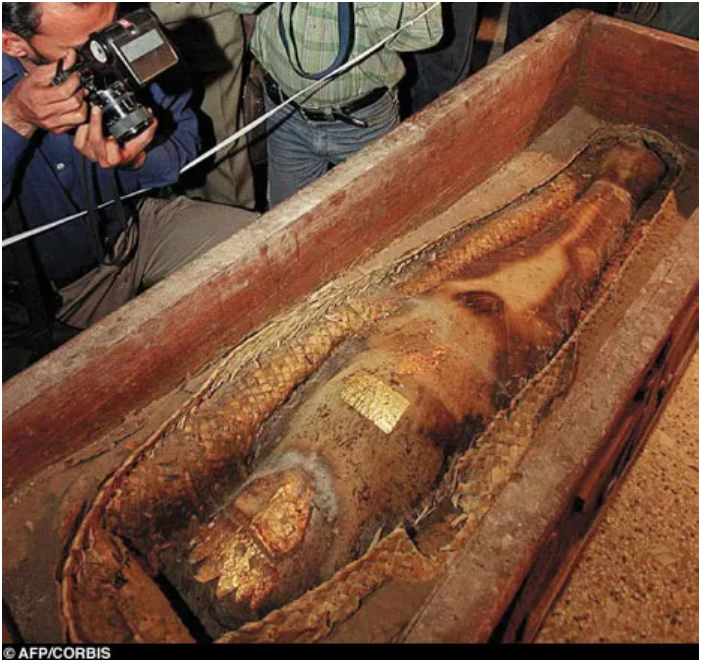
The preserved body had been placed on a reed mat, enclosed in a carved stone cover, and then set inside a carved wooden coffin.
The coffin featured cuneiform inscriptions, an early writing system used in Persia, alongside illustrations of Ahura Mazda, the supreme deity in Zoroastrianism.
Despite these Persian elements, the female corpse was mummified using Egyptian techniques. She was wrapped in cotton cloth and coated with resin, which formed a hardened protective shell. Her arms were crossed over her chest, and she was adorned with a gold crown, a mask, and a breastplate inscribed with cuneiform that read:
“I am the daughter of the great King Xerxes. Mazereka protect me. I am Rhodugune, I am.”
Based on these inscriptions, the remains were believed to belong to a Persian princess who died around 600 BCE, making the body approximately 2,600 years old. Historians know very little about Princess Rhodugune, including how she died or how old she was.
According to CT scans, the mummified woman was 4 feet 7 inches tall and at least 21 years old. All of her internal organs had been removed, and her abdominal cavity was filled with a powdery substance.
A chemical analysis showed that the substance was a mixture of drying agents, such as baking soda and table salt. However, gas was still in the abdomen and pelvis, indicating that the body had not been properly dried.
Egyptian mummification rituals typically required that a person’s heart remain in their body, as they believed it was the center of one’s being and intelligence. In this case, the mummy was found without her heart. Additionally, her brain had been extracted through her mouth rather than the more common nasal method used in ancient Egypt.
Experts determined that the woman died from a broken neck caused by blunt force trauma to the cervical vertebrae, though it remains unclear whether the injury was deliberate.
Finally, carbon dating of the remains revealed that she was not an ancient Persian princess, but a woman who had actually died around 1996.
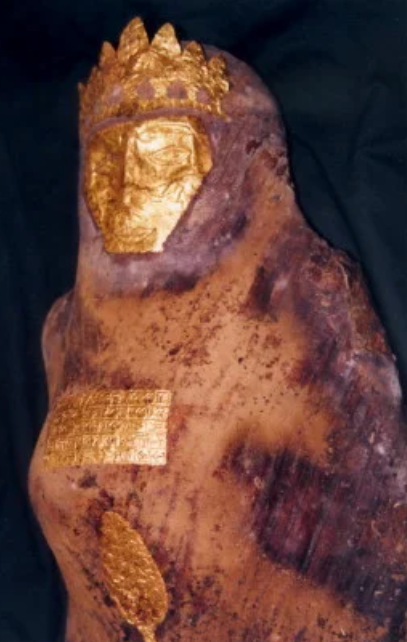
While Dr. Ibrahim’s team conducted numerous tests on the body, experts in Old Persian script identified several inconsistencies and grammatical errors on the coffin and breastplate.
The most glaring mistake was that the engravers referred to the princess as Rhodugune, the Greek translation of her name from a later era, rather than using the Persian Wardegauna.
Experts also found pencil marks on the coffin, likely traced from a monument and used to guide the carving. They noted that the engravers had used lead pencils, which have been in use for only about 200 years.
Furthermore, Dr. Ibrahim remarked that the reed mat on which the woman rested could not have been more than fifty years old.
News of the mummy’s discovery spread quickly and made international headlines. Iran (historically known as Persia) and Pakistan both claimed ownership of the find. Given that the two countries share a border, it was theorized that the relic had been brought across it.
Even the Taliban, who controlled neighboring Afghanistan at the time, reportedly expressed interest in claiming the mummy.
Nevertheless, the relic’s authenticity was immediately called into question. No mummy had ever been discovered in Pakistan, and there was no evidence that the Persians practiced mummification, particularly using Egyptian techniques.
Six months after authorities recovered the artifact from Reeki’s custody, Dr. Ibrahim officially announced that both the mummy and the coffin were forgeries.
Pakistani police believe the con artists obtained the body from grave robbers who had looted a burial site in the border region between Pakistan and Iran. They then spent several months drying the body and likely had the help of someone familiar with anatomy.
In March 2000, seven months before Pakistani authorities discovered the fake mummy, Oscar White Muscarella, an archaeologist at New York’s Metropolitan Museum of Art, was contacted by Amanollah Riggi, a New Jersey resident.
Riggi, a middleman acting on behalf of an unidentified dealer in Pakistan, showed Muscarella four Polaroid photographs of a mummy inside a sarcophagus, along with a one-page translation of the cuneiform inscription on its breastplate.
Riggi explained that the mummy belonged to a Pakistani acquaintance and had been brought from Iran to Pakistan by Zoroastrian families years earlier. He added that he could send Muscarella a video of the artifact if the museum was interested in buying it.
Muscarella immediately suspected it was a forgery and did not pursue the matter further. The mummy shown in the Polaroids was later confirmed to be the same one in Reeki’s custody.
Seven months later, when investigators questioned Reeki, he told them that a representative of an anonymous foreign buyer had offered him and Bakhi 60 million rupees (about 1.1 million US dollars). They declined because the offer was well below their asking price.
Although it could not be determined whether the woman’s neck had been broken intentionally, Pakistani authorities opened a murder investigation. Wali Mohammad Reeki and Ali Akbar were charged with violating Pakistan’s Antiquities Act, which carries a maximum sentence of ten years. Sharif Shah Bakhi was never located.
Once the museum realized that neither the body nor the coffin held historical significance, the remains were handed over to the Edhi Foundation, Pakistan’s largest charitable organization.
The foundation had to ask the authorities’ permission to bury the body because the case was still under investigation. However, according to a spokesperson, the police had “forgotten the mummy” and repeatedly failed to respond to correspondence.
As a result, the foundation was left paying years’ worth of expenses to keep her in a morgue. Finally, in early 2008, she was laid to rest. Another spokesperson, Anwer Kazmi, stated,
“It had to be buried. We waited for eight long years for approval from the authorities. The approval never came.”
Twenty-six years after the discovery, the case has seen no new developments, and the victim’s identity remains unknown.
About the Creator
Cat Leigh
Visit my publication on Medium for more true crime cases.
Enjoyed the story? Support the Creator.
Subscribe for free to receive all their stories in your feed.
Comments
There are no comments for this story
Be the first to respond and start the conversation.