
The Man in the Wheelchair: Inside Haiti's Assassination Case and the Miami Trial That Took It Over
Five years after President Jovenel Moïse was shot 12 times, 18 suspects were flown to Florida. Haiti's courts never got the chance to try them.
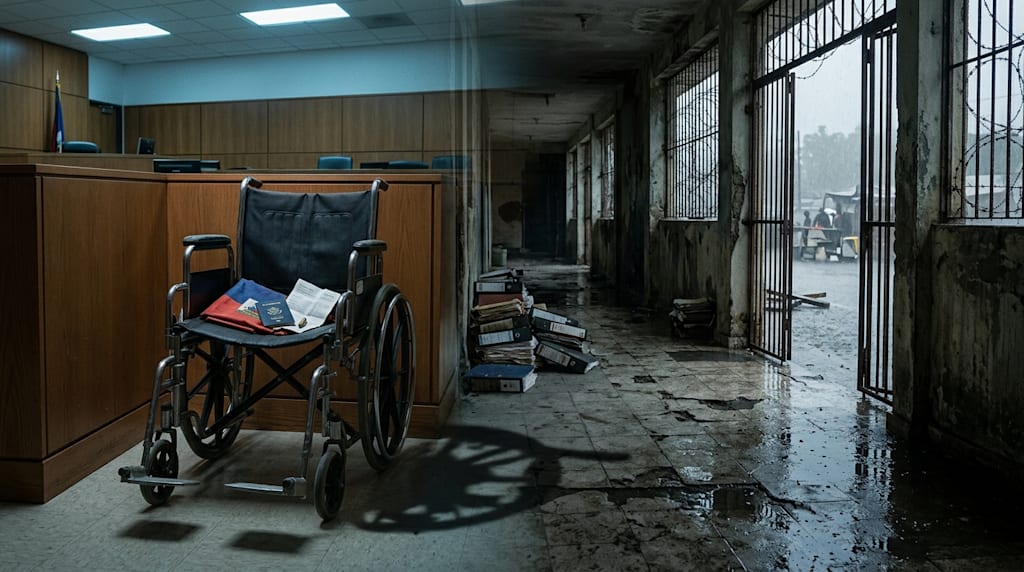
The Man in the Wheelchair
September 21, 2026, Miami federal court. When Joseph Badio was pushed into the courtroom, he was sitting in a wheelchair.
He had once worked in the anti-corruption unit of Haiti’s Ministry of Justice. In 2018, he took part in an investigation involving the embezzlement of billions of gourdes. In October 2023, he was arrested after more than two years on the run. On September 20, 2026, a military plane carried him and 17 others from Port-au-Prince to Florida.
Federal prosecutor Quiñones did not release the names of the 18. But a statement from Haiti’s Justice Ministry confirmed them: 17 former Colombian soldiers, plus Badio. A U.S. Department of Justice spokesperson did not respond to a reporter’s email on Sunday.
Badio’s lawyer had previously written in court documents: his client was accused of being the “mastermind” behind the assassination of Moïse. Prosecutors did not confirm that account. They only said that 30 people had been indicted, five had pleaded guilty, and four were convicted by a jury in May.
July 7, 2021, 1 a.m. Pelerin 5, Port-au-Prince.
Moïse’s residence was at the end of a narrow road. The attackers drove two cars, a Toyota pickup and a Hyundai SUV. They used a loudspeaker and claimed to be DEA agents. Security personnel at the residence later testified that they heard commands mixed in Spanish and English.
Moïse was shot 12 times. The autopsy report showed that one bullet entered through his left eye. His wife, Martine, was shot in the right arm and abdomen and was taken to Jackson Memorial Hospital in Miami. She spent three days in the ICU.
When the attackers left, they took Moïse’s briefcase, two hard drives, and some cash. Haitian police later found one of the cars on the outskirts of Port-au-Prince. Inside were a cap with an insignia, an empty magazine, and a copy of a Colombian passport.
Five years passed. Haiti has not completed a single full trial.
In August 2021, the first presiding judge appointed by the Port-au-Prince court resigned after receiving death threats. The second judge resigned three months later. The third resigned in January 2022. Records from the Haitian Judges Association show that by the end of 2023, seven judges had withdrawn from the case because “their personal safety could not be guaranteed.”
In April 2022, the courthouse in downtown Port-au-Prince was occupied by gangs. The occupation lasted two years and three months. Judges could not enter to interrogate suspects because between the courthouse gate and the third-floor interrogation room there were at least three gang checkpoints.
In October 2025, Haiti’s Court of Appeal ordered a new investigation. It was the third time. The files from the first two investigations were stored in the basement of the Port-au-Prince courthouse. In January 2026, an internal memo from Haiti’s Justice Ministry showed that the basement had been flooded by rainwater, and more than 60% of the files were illegible.
Haitian human rights activist Pierre Esperance said by phone: “This is not a judicial failure. This is the absence of justice.”
In Miami, prosecutors started with the money.
In June 2021, a company called Counter Terrorist Unit Federal Academy received a transfer of $175,000. It was registered in South Florida and operated by Arcángel Pretel Ortiz and Antonio Intriago. Prosecutors said the money came from a company called Worldwide Capital Lending Group, operated by Walter Veintemilla.
The money was used to buy ammunition, pay travel expenses for Colombian mercenaries, and rent a safe house on the outskirts of Port-au-Prince.
Prosecutors showed a bank statement in court. In May 2021, Veintemilla’s company received a loan from the U.S. Small Business Administration’s COVID-19 relief program. The amount was $300,000. Prosecutors said part of it was transferred to CTU’s account.
In May 2026, a jury convicted Ortiz, Intriago, Veintemilla, and James Solages. Solages is Haitian-American and had served in the U.S. Army Reserve. He testified in court that he was promised a contract in Haiti’s security sector after Moïse was removed.
Five others pleaded guilty and were sentenced to life in prison. They included a retired Colombian army officer and a Haitian-Chilean businessman. The latter had once been an informant for the U.S. government.
Christian Sanon is still awaiting trial. Prosecutors said he was chosen to replace Moïse. Once in power, he would award contracts for infrastructure, security forces, and military equipment to CTU. Sanon is a Haitian-American citizen and lives in Broward County, Florida.
When news of the extradition reached Colombia, Diana Marcela Arbeláez Llano was in a supermarket in Bogotá.
Her husband was one of the 17 former Colombian soldiers. She put down her shopping cart, walked outside the supermarket, and made three calls. The first went unanswered. The second was busy. The third connected; the person on the other end was another suspect’s wife, already crying.
“We never imagined the United States would take them so suddenly,” she said in a phone interview on Sunday. “I don’t know why the United States would take them. It’s a state of total uncertainty.”
She said the detained Colombians were in poor health in Haitian prisons. Port-au-Prince’s prisons are known for overcrowding and lack of medical care. A 2021 survey showed that the main Port-au-Prince prison held 454% of its design capacity. Prisoners slept on concrete floors and had less than an hour of outdoor time each day.
“I hope they get better in the United States,” Diana said. “But I don’t know.”
Colombia’s Foreign Ministry said in a statement on Sunday that Bogotá “did not intervene” in the decision or process of handing its citizens over to the United States, and that the matter “falls within the jurisdiction of the relevant national authorities.”
Haiti’s Justice Ministry statement had only two paragraphs.
The first said the suspects were handed over “to allow the trial to proceed.” The second said proceedings in Haiti “continue to face significant difficulties,” so it decided to “strengthen cooperation with U.S. judicial authorities.”
The statement did not mention that Haiti has not held national elections since 2016. There is no president. Parliament is not functioning. The Supreme Court has no judges. In 2026, armed gangs carried out at least 8,100 killings. About 1.5 million people have been displaced. Six million need emergency humanitarian aid.
The Port-au-Prince courthouse is still in a gang-controlled area. On the judges’ desks, case files from five years ago are still there. Rainwater seeps through the broken ceiling; the papers are stuck together, the handwriting blurred.
The air conditioning in the Miami federal courtroom blows over the indictment. Badio’s wheelchair is pushed to the defendant’s dock. The judge asks whether he pleads guilty. He says not guilty.
The next hearing is in November.
About the Creator
Jin
Writer of reamstories
https://reamstories.com/jin
Enjoyed the story? Support the Creator.
Subscribe for free to receive all their stories in your feed. You could also become a paid subscriber, letting them know you appreciate their work.
Comments
There are no comments for this story
Be the first to respond and start the conversation.