
The Father Who Admitted to Dismembering His Son's Ex-Wife — and Blamed Everyone Else
Inside the Abby Choi trial, where a retired detective weaves a story of panic, plastic boxes, and carrot juice, while prosecutors see a family conspiracy hiding in plain sight.
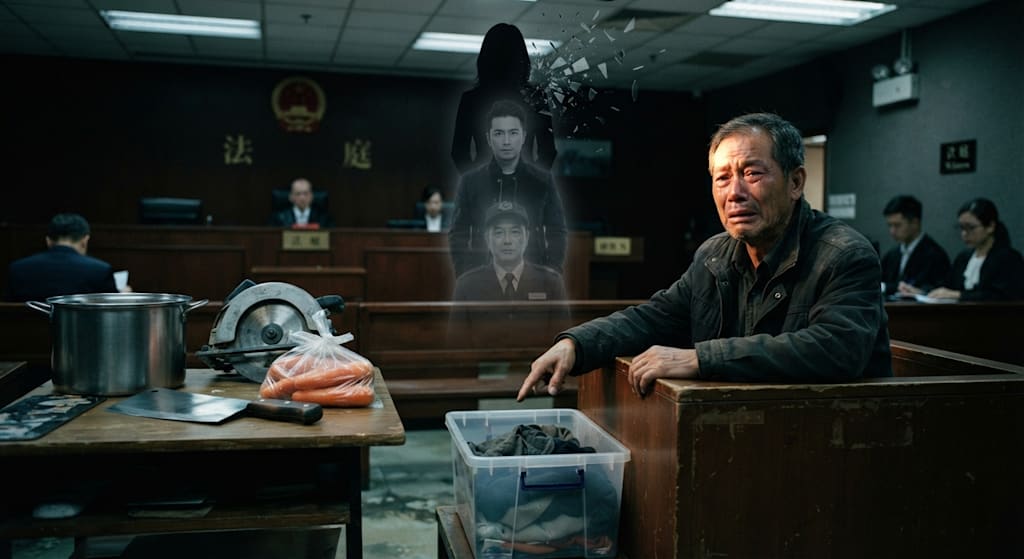
The first thing Kwong Kau did after he saw Abby Choi lying motionless in the back of a seven-seater was not call an ambulance. He called his older son. Then he drove to a village house in Tai Po, fetched a plastic box, and eventually chopped the body into pieces. On the witness stand this week, the 69-year-old retired detective admitted all of that. He just denied it was murder.
“I was protecting my two sons,” Kwong told the High Court, dabbing his nose with a tissue. He said he alone dismembered and cooked Choi’s remains. His sons, he insisted, had nothing to do with it. No one planned to kill her. “Absolutely not.”
The prosecution’s version is less tidy. Kwong Kau, his elder son Kwong Kong-kit (35), and his younger son Kwong Kong-chi (32, Choi’s ex-husband) are accused of murdering Choi on February 21, 2023, and of preventing the lawful burial of her body. All three deny murder. They have pleaded guilty only to the burial charge. The trial, which began in mid-November, has become a slow, grisly exercise in watching a family point fingers at itself.
The Car Park, the Plastic Box, and the Missing Pulse
Kwong Kau’s account of that afternoon has the quality of a bad dream retold too many times. He was at a car park in Tai Mei Tuk, he said, when his elder son called. “Something very serious has happened,” Kong-kit told him. “Abby seems to have no consciousness. Alex is crying.” Kwong told them to meet him at the car park.
When the seven-seater arrived, Kwong said he opened the sliding door, put a finger under Choi’s nose, felt no breath, then touched her chest and hand. No heartbeat. No pulse. He did not see blood. He told his younger son to stop crying, then drove to the village house in Lung Mei Tsuen. With Kong-kit’s help, he lifted Choi’s body into a plastic box and carried it inside. Then he told both sons to leave.
“I stood there,” Kwong recalled, “and I didn’t know what I was doing. I just stood there, staring at the box.”
He now admits that what followed was dismemberment. He says he used a meat cleaver, a knife, and a circular saw. He put the head in a large soup pot and cooked it. He cut the legs, removed skin and muscle from the left leg, and froze it. He cannot remember how he cut through the pelvis. His mental state, he said, had “collapsed.” He bought the tools, he explained, for other reasons: the electric saw for building a bamboo fence, the large soup pot as a planter for climbing vines, the meat cleaver and chopping board for “buying a big plate of food and cutting it up.”
The prosecution finds these explanations extraordinary. Why would a man who had just discovered a body in his son’s car not call police? Why would he buy a 14-inch-by-14-inch soup pot that happened to be useful for boiling a human head? Why would the cleaver later test positive for DNA? Kwong said he could not explain the DNA. As for the red liquid his elder son noticed on the knife that night, Kwong first said he didn’t know, then offered: “It might have been carrot water. He thought it was blood because it was soaking in the bucket.” He had bought the carrots, he said, to feed stray cats and dogs at the village entrance. “I’ve seen them eat a whole bag of them.”
The Forensics Tell a Different Story
The medical evidence, presented earlier in the trial, does not support a sudden panic. Choi’s skull had a large hole on the right side, a depressed fracture, and intracranial bleeding. She had been struck with a hard object. Her head was later found in a soup pot in the kitchen. Her legs had been cut with sharp tools after death. The left leg’s skin and muscle had been removed and frozen in the refrigerator. In the shower area, police found a gray plastic box containing human tissue. Nearby: a beef knife, a cleaver, and a circular saw.
The prosecution argues that these items were not bought in a moment of crisis. They were assembled. The village house was rented. The tools were purchased. The plastic box was waiting. Kwong Kau, they say, was not protecting his sons. He was executing a plan to kill Choi and divide the proceeds from the sale of a property on Kotewall Road. Kwong denies this. He says he rented the village house because it was quiet and convenient for trips to mainland China. He says the property sale was for his two grandchildren. “Everything is for the two grandchildren,” he told the court. “What problem is there?”
A Family Run on Money and Silence
The trial has also exposed the financial architecture of the Kwong family, and it is not flattering. Kwong Kau admitted that Choi handled the family’s money. He would wire funds from mainland China, and she would distribute them. “If the family needed money, we would ask Abby,” he said. “Abby’s job was to give money.” He claimed he sent her 300,000 to 400,000 Hong Kong dollars a month between 2017 and 2019. He also admitted that his wife, Lee Shui-heung, had been bankrupt until 2021, yet during that period he bought a Rolls-Royce for his younger son to use in Macau. He said his wife’s bankruptcy was from a failed fashion business and had nothing to do with family money. He never discussed repaying her debts.
He also admitted that in 2015, when his younger son was wanted for theft and fled to mainland China, Kwong handled the aftermath. He personally took more than HK$6 million in cash to a law firm to compensate the victim. He said he asked Choi for money because his son could not open a bank account in mainland China. He did not know whether his son sent money back to Hong Kong.
The prosecution pressed him on his claim that he had a real estate business in mainland China from 2001 to 2009, earning HK$5 million and sending half to Choi. They pointed out that immigration records showed he was out of Hong Kong for only about a month in 2016 and 2017. They suggested he had no business there, that he lived on a pension. Kwong denied it. He insisted he had sent money. He also denied knowing whether Choi’s family, the Tams, were wealthy. Asked about Tam Jai Yunnan Mixian, the noodle chain sold for HK$1 billion, he said, “I don’t know that person. I don’t even eat that kind of rice noodle.”
The Crying, the Carrots, and the Unanswered Question
Kwong Kau cried several times on the stand. He cried when he described finding Choi’s body. He cried when he said he was protecting his sons. He agreed that his elder son was “loyal and family-oriented” and that his younger son was “more self-centered.” He agreed that he did not call police because he wanted to protect Alex. He agreed that he told his elder son to return to the village house that night, even though it would make him more suspicious. “I wanted someone to keep me company,” he said.
But when the prosecution asked him to explain the carrot juice, the soup pot without drainage holes, the cleaver with DNA, the circular saw, the plastic box, the timing, the lies — he returned to the same phrase. “I don’t remember.” His mental state had collapsed. He was not thinking. He was just doing what he had to do.
The trial continues. The court has not yet heard from the sons in their own defense. But the image that lingers is of a father in the witness box, weeping, insisting he acted alone, while the physical evidence assembles itself into a different story: a story of planning, of tools bought in advance, of a family that knew how to keep secrets and how to spend money. The question the jury must answer is not whether Kwong Kau dismembered Abby Choi. He says he did. The question is why, and who else was there when the first blow landed.
About the Creator
Jin
Writer of reamstories
https://reamstories.com/jin
Enjoyed the story? Support the Creator.
Subscribe for free to receive all their stories in your feed. You could also become a paid subscriber, letting them know you appreciate their work.
Comments
There are no comments for this story
Be the first to respond and start the conversation.