
The Doctor Who Threw Feces in a Peking Union Clinic Had Been Torn Apart by Childbirth
A fourth-degree tear, a vaginal fistula, a failed repair, and the year that ended with three interns in the wrong room.
One
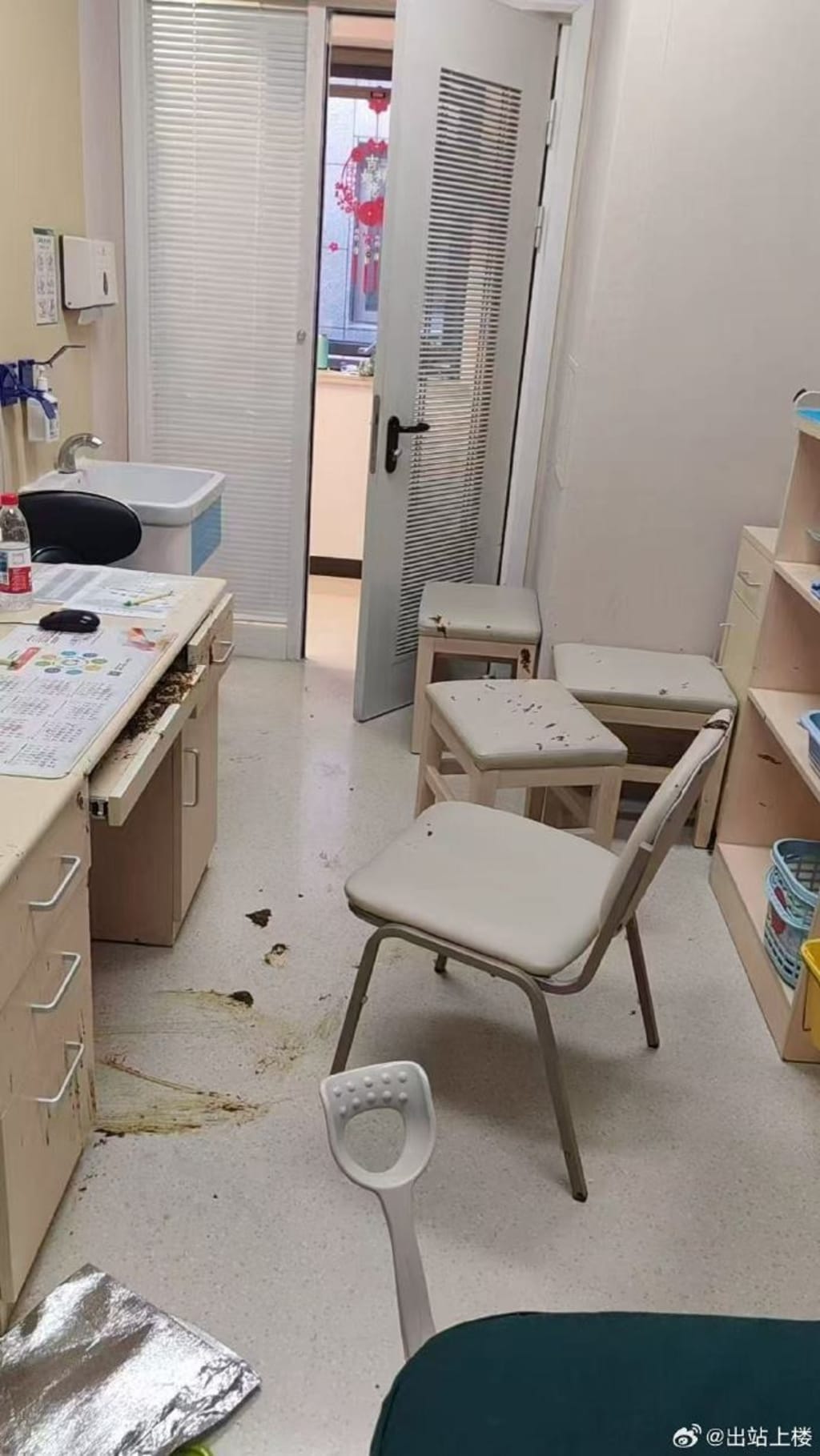
On the afternoon of September 8, 2026, in an obstetric clinic at Peking Union Medical College Hospital.
A woman wrapped feces in foil, forced her way into the clinic, and threw the waste at the obstetrics department director and three medical interns present. The clinic was severely contaminated. Police detained the patient at the scene.
Her surname is Wei. She graduated from Peking Union Medical College. She is also a doctor.
The three medical interns who were splattered with feces had nothing to do with the delivery a year and a half earlier. They were in that clinic that afternoon perhaps because of rotation scheduling, perhaps because they wanted to learn a little more. Then they were dragged into a dispute they had never been part of.
This needs to be said before any discussion of understanding begins: the white coats that were soiled in that clinic that afternoon belonged to three people who had nothing to do with this matter.
Two
In January 2025, Wei gave birth at Peking Union Medical College Hospital.
After delivery, she suffered a fourth-degree perineal laceration. It was complicated by a vaginal fistula. According to reports, the repair failed.
Perineal lacerations are classified into four degrees. A first-degree laceration is a superficial tear of the skin and mucosa. A second-degree laceration involves muscle but does not reach the anal sphincter. A third-degree laceration involves the anal sphincter and is subdivided into IIIa, IIIb, and IIIc according to extent. A fourth-degree laceration means the tear penetrates the internal anal sphincter, the external anal sphincter, and extends into the rectal mucosa. The full thickness of the structures between the vagina and rectum is completely torn through.
Between the rectum and the vagina, there are mucosa, muscle layer, and fascia. Each layer exists to prevent one thing: intestinal contents entering the vagina. After a fourth-degree tear, all these layers are broken.
A vaginal fistula goes one step further. Even if sutured, if healing fails, an abnormal channel remains permanently in the body. Feces can exit through the vagina without passing through the anus.
The incidence of obstetric anal sphincter injury varies across studies. A study published in 2024 reported 1.1%. Prospective studies in the UK show that the incidence of fourth-degree laceration among primiparous women is about 0.3%. Domestic reports put the incidence of fourth-degree perineal laceration at 0.03% to 0.05%.
0.03%. Behind every decimal point is a specific person.
Three
The tear was severe for several reasons.
A retrospective analysis in China of 83 cases of third- to fourth-degree perineal laceration found: the incidence of severe laceration was 0.433% among primiparous women and 0.246% among multiparous women. Among those using forceps-assisted delivery, the incidence was 3.120%. Among spontaneous cephalic deliveries, 0.231%. Among macrosomic infants (birth weight ≥4000 g), the incidence was 1.225%, nearly four times that of non-macrosomic infants. Among those with prolonged second stage of labor, the incidence was 2.381%.
In another study, the odds ratio linking forceps-assisted delivery to obstetric anal sphincter injury was 4.43.
These are risk factors in statistical numbers. In a specific delivery, the situation is far more complex. The force of uterine contractions, the degree of dilation of the birth canal, the speed of fetal head descent, the attendant's technique in protecting the perineum: each link jointly determines the final outcome. Forceps-assisted delivery carries high risk because it means the fetus can no longer be delivered on its own and requires external traction. If the direction and force of traction deviate even slightly, it can completely tear tissue that is already extremely stretched. The shoulder of a macrosomic infant may become stuck behind the pubic symphysis, causing shoulder dystocia, leaving doctors a time window measured in seconds.
Among these factors, some could be foreseen, some could be avoided, and some belong to the inherent obstetric risks that cannot be fully avoided even if foreseen. Answering which is which requires complete medical records, labor records, surgical records, and a medical damage appraisal.
At present, none of this information has been disclosed.
Four
Even if the initial suturing was technically completed, the body's recovery is far from guaranteed by suturing.
Surgical repair of rectovaginal fistula, even when performed by experienced specialists, still has an overall failure rate of about 22.7%. In some cases, wound dehiscence may occur after surgery, a fistula may form again, and second or even multiple surgeries may be required.
Long-term outcomes for patients whose surgery succeeded are also documented.
A study of patients who underwent early secondary repair after obstetric anal sphincter injury showed, at long-term follow-up: 91% reported fecal urgency. 82% had gas and liquid incontinence. 55% had staining. 55% experienced unpredictable bowel accidents. 45% needed to arrange daily activities around fecal incontinence. 27% became housebound as a result. 64% said fecal incontinence restricted their sexual relationships.
Another 12-year follow-up study confirmed that women who experienced obstetric anal sphincter injury, even 12 years after delivery, were still more likely than women without such injury to suffer from fecal incontinence, including involuntary passing of gas and liquid stool incontinence, and relied more on sanitary pads.
These numbers describe daily life. They mean a person has to calculate before leaving home: can I find a toilet today? They mean that in the middle of a meeting, on the subway, on a friend's sofa, something uncontrollable can happen at any time. They mean intimacy becomes a burden requiring repeated explanation and apology. They mean 27% of people choose not to leave home anymore.
The body's most basic excretory control has been taken away. This is the ability humans learn earliest and take most for granted.
Five
Wei was not an ordinary patient ignorant of medicine. She is a graduate of Peking Union Medical College and a doctor. She understands the medical definition of complication and knows that childbirth itself carries risks.
But between knowing it can happen and it happening to you lies the distance of an entire life.
According to reports, after the dispute arose, the hospital repeatedly took the initiative to communicate. The president and vice president met with her and spoke with her by phone, informing her that she could pursue lawful channels such as third-party mediation, medical damage appraisal, and filing a lawsuit in court.
In institutional design, these paths are complete.
But between having paths and the paths being viable lies a huge gulf.
Medical damage appraisal usually requires joint commissioning by both doctor and patient, and the appraisal period is measured in months. Litigation may last years. For a woman whose daily life has already been utterly disrupted by fecal incontinence, every day of waiting is itself a form of torment.
The harder problem is proving causation. In the highly complex physiological process of childbirth, proving that a particular tear was caused by operational error rather than an unfortunate result under the combined action of fetal factors, labor factors, and individual anatomical differences is extremely difficult in both medicine and law.
Not every misfortune can be attributed. The dilemma of the system is that it cannot provide sufficient support for misfortunes that cannot be attributed.
If a woman who suffered a fourth-degree tear and vaginal fistula after childbirth ultimately receives an appraisal conclusion of not a medical accident, she faces a specific outcome.
She will return to a world that has no compensation mechanism designed for this outcome, with a permanently altered body. Her medical expenses may be covered by health insurance. But her incontinence care costs, her loss of work capacity, her psychological trauma, her lost social life because she dare not leave home: these are not on any compensation list.
Six
Wei ultimately chose to wrap feces in foil, force her way into the clinic, and throw it.
This act legally constitutes a serious disruption of medical order. Her suffering does not blur that.
The three medical interns had nothing to do with the delivery a year and a half earlier. The clinic was contaminated. Medical order was disrupted. She was detained by police.
These are facts.
Another set of facts is this: a woman lost the most basic control over her own body after childbirth. Her suffering, for more than a year, was not caught by any institutional force.
Between these two sets of facts, there is no although-but that can connect them. They coexist and do not cancel each other out.
Seven
As of writing, Peking Union Medical College Hospital and official police have not issued a formal notice. The complete facts of the incident still await confirmation by authoritative sources. Fetal weight, mode of delivery, presence of shoulder dystocia, records of the first repair, whether healing failed: none of this key information has been disclosed.
In the absence of this information, any judgment about responsibility is unrigorous.
But one thing is already clear enough: a woman lost the most basic control over her own body after childbirth, and her suffering, for more than a year, was not caught by any institutional force.
This is not a problem of Peking Union Medical College Hospital alone.
Every woman who may experience severe childbirth trauma is affected. The medical dispute resolution mechanism must answer whether it can provide a sufficiently powerful response to the worst case. A society must admit that once some injuries occur, repair itself is a luxury.
The woman who wrapped feces in foil was once a medical student too. She sat in a classroom at Peking Union Medical College and studied the grading of perineal lacerations, the repair of vaginal fistulas, the management of obstetric complications.
She studied these things.
Then these things happened to her.
About the Creator
Jin
Writer of reamstories
https://reamstories.com/jin
Enjoyed the story? Support the Creator.
Subscribe for free to receive all their stories in your feed. You could also become a paid subscriber, letting them know you appreciate their work.
Comments
There are no comments for this story
Be the first to respond and start the conversation.