
The Dad Who Sent His Son to the Police Station Got the Hard Part Right
Copy the apology, the pocket money, and the walk back to the store. Skip the handcuffs.
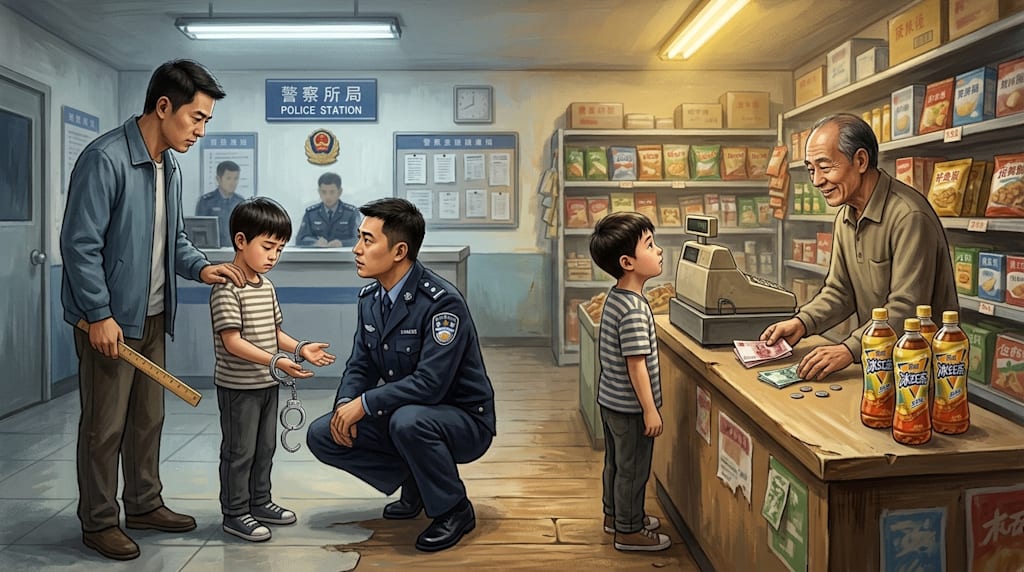
A bottle of iced black tea went into a school uniform and came home. The father found out. He took a wooden ruler, took the boy by the hand, and walked him into a police station. An officer squatted, laid a pair of handcuffs on the boy’s hands, and said, “Do not commit a small wrong just because it is small.” Then father and son went back to the supermarket. The boy paid the shopkeeper with pocket money he had saved, apologized, and the shopkeeper forgave him.
Five actions: hid, led, placed, paid, forgave. That is the story.
The father got three things right, and none required a police station
Many readers focus on the police station. The education came from three other moves.
First, he did not say “It’s only a few yuan.” A bottle of drink costs little. Many parents stop there: “Forget it,” “He’s young,” “Just don’t do it again.” This father did not stop. A few yuan can be repaid. The belief that taking other people’s things without permission does not matter cannot be repaid with a few yuan. He did not cover for the boy. He showed that by refusing to say the easiest sentence in the room.
Second, he did not leave the boy with the police. He walked in with the ruler and with the boy’s hand in his. He stayed. The boy got a clear message: Dad is facing this with me. He did not get the message that Dad had abandoned him. Deterrence-based parenting fails when it creates abandonment. A child handed to a stranger in uniform, then left to look around for a parent who is gone, remembers fear. The father left no room for that fear.
Third, he made the boy pay and speak. The police station was not the end. The officer went with them back to the supermarket. The boy used his own pocket money. He apologized with his own mouth. The shopkeeper said “It’s all right” to his face. Four steps: admit, pay, apologize, receive forgiveness. The boy did every step. A beating teaches pain. This chain teaches something else: I took what belonged to someone else, and I have to return it with my money, my words, and my actions. The matter ends when I do that.
These three moves work at home. A parent can send the child back to the store to apologize and pay, deduct pocket money, or assign chores as compensation. The father chose a heavier setting. The education came from the moves.
The officer avoided a disaster with three restraints
The incident did not become a scare tactic. The officer controlled that.
He did not cuff the boy. He laid the handcuffs on the boy’s hands. The boy felt the weight. The fear stayed within bounds.
He did not talk down to the boy. He squatted and looked into the boy’s eyes. The boy heard a serious explanation. He did not hear a verdict.
He did not stop at the station. After the talk, the officer went with father and son back to the supermarket. The warning led to repair. The boy did not go home after a lecture. He returned what he should return and said what he should say. Fear produces short-term obedience. Repair produces long-term judgment.
Remove one restraint and the result may change. An impatient officer, bystanders taking photos, or a more sensitive child can turn “feel the weight of the handcuffs” into “be publicly humiliated.” This time it worked. That does not make the action safe.
What I would not copy
Support for the father’s logic does not mean support for the handcuffs. Three risks matter.
First, deterrence and humiliation have no guardrail. The officer was gentle. The handcuffs were laid down. The words were spoken while squatting. Now imagine a parent who learns only “send him to the police station.” The officer is busy. Customers stand nearby. The child stands in the hall with his head down. He will remember the crowd watching him lose face. He will not remember “Do not commit a small wrong just because it is small.” Public punishment teaches shame. Rules get lost.
Second, the police are not a parenting tool. The family is the first line of defense. Public authority should be an exception. If a child grows up thinking “If I disobey, the police will take me away,” trust in the police bends. Police resources should not go to a bottle of drink. The officer’s cooperation was goodwill. Goodwill is not policy. Parents cannot turn goodwill into a system.
Third, children differ more than parents expect. Some children need a clear explanation. Some need clear consequences. Some are sensitive and introverted. One heavy deterrent can leave long-term fear or damage trust between parent and child. A police station suits some ages, some temperaments, and some kinds of wrongdoing. Another family’s child may go through it once and be fine. Your child may not.
What parents can copy
The lesson is not “send the child to the police station every time he does wrong.” The lesson is three principles with everyday versions.
Do not cover up. Do not say “It’s only a few yuan” or “He’s young.” Send the child back to apologize and pay. Deduct pocket money. Assign chores as compensation. The form can be light. The attitude cannot be soft.
Do not shift the blame. Do not push the job onto the school, society, or the police. Go with the child. Stay. The child needs to know that the consequences are shared, while the apology comes from him.
Let the child face it. Do not apologize for him. Do not pay for him. The money comes from his pocket money. The apology comes from his mouth. He receives the forgiveness. A parent can stand beside him. A parent cannot stand in for him.
Warning education can happen without a police station. Rule-of-law picture books, a police open day, safety videos, and a later conversation about “How would the other person feel?” and “How do you get something you want next time?” all work. They are lighter and easier to repeat. The goal is understanding.
Closing
“Do not commit a small wrong just because it is small” holds. A bottle of drink is small. The belief that taking other people’s things does not matter is not small. The father’s best move was refusing to dissolve the wrong with “It’s only a few yuan” or “He’s still young.” He made the boy pay with his own pocket money and apologize with his own mouth. That completed the most important step in responsibility education.
Copy that step. Leave the handcuffs.
Handcuffs can teach weight. The weight that lasts comes from the father’s presence, the officer’s patience, the shopkeeper’s forgiveness, and the boy taking out his pocket money and saying “I’m sorry.”
The end of education is understanding, not fear.
About the Creator
Jin
Writer of reamstories
https://reamstories.com/jin
Enjoyed the story? Support the Creator.
Subscribe for free to receive all their stories in your feed. You could also become a paid subscriber, letting them know you appreciate their work.
Comments
There are no comments for this story
Be the first to respond and start the conversation.