
The Court Called Him a Father. It Never Asked If He Agreed.
A twins paternity case shows how biology, IVF allegations, and a refused DNA test can decide child support before anyone settles the consent question.
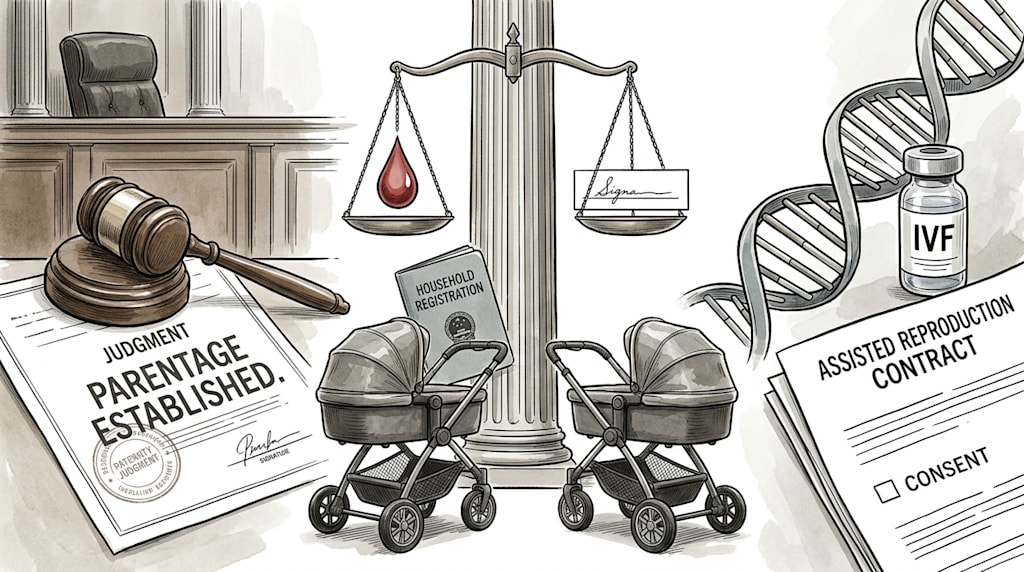
A parentage case in Jiangsu has drawn public attention because of a few details: a married company chairman, twin babies, a DNA report, an assisted reproduction agreement, and a refused paternity test.
According to Huashang Daily’s Feng News, Yuan Yuan (pseudonym) gave birth to twins and sued Zhang Bo (pseudonym), a married company chairman, to confirm that he was the father. The first court relied on chat records, evidence about reproductive intent, and Zhang’s refusal to take a court-ordered paternity test. It ruled that parentage was established. Zhang appealed. In the second round, he applied for a DNA test but did not pay the fee. The lab returned the case. The Nantong Intermediate People’s Court upheld the first judgment in July 2026.
The legal rule is straightforward. If one side offers necessary evidence, the other side offers no contrary evidence, and the other side refuses a paternity test, a court may presume parentage. That is what happened here.
The public argument is about a different question. Zhang says Yuan may have conceived through IVF, possibly without his consent to sperm retrieval or insemination. If that claim were proven, would the law still make him support the children because he is the biological father?
This question sits between four areas of law and policy: children born outside marriage, assisted reproduction, reproductive autonomy, and the child’s best interests.
I. What the court found, and what it did not
The reported timeline matters. The two met in November 2021 and added each other on WeChat. They later began a relationship. Yuan said she was divorced. She later heard from Zhang’s employees that he had a family and tried to end the relationship. Zhang did not agree. In May 2023, Yuan found out she was pregnant and told Zhang. He said he did not want the child. She refused to end the pregnancy. They argued. In January 2024, she gave birth to a girl and a boy. The birth certificate listed Zhang as the father.
Zhang did not accept parentage and did not pay support. Yuan commissioned a DNA test from a Suzhou company. The result supported Zhang as the biological father. In January 2025, she sued to confirm parentage. Zhang produced an assisted reproduction agreement signed on November 12, 2022 between Yuan and a Shanghai medical technology company, plus receipts. He argued the documents made IVF likely.
The first court found that the two had a relationship, discussed the children’s sex and names in chats, and that Zhang asked Yuan for a confidentiality undertaking in July 2023. The court treated that request as evidence that he had some willingness to have the children. The court also found that Zhang had not proved the assisted reproduction agreement was carried out. With no contrary evidence and no paternity test from Zhang, the court found Yuan’s evidence strong enough. It confirmed parentage in May 2025.
Zhang appealed. He argued that courts cannot replace review of conception timing, conception method, and causation with emotion or with a refusal-to-test presumption. In the second round, he applied for a DNA test. Yuan agreed. The court sent the case to the Forensic Identification Center of Soochow University. Zhang did not pay on time. The center returned the case because the party refused to pay. The second court held that Yuan had provided preliminary evidence of a long extramarital sexual relationship before conception and of reproductive intent. It also held that conception timing can only be estimated and cannot be fixed to a day. Zhang’s evidence could raise doubt that a natural conception timeline was unreasonable, but it could not directly prove that he was not the biological father. Because Zhang applied for the test and then failed to pay, he bore the consequence of failing to prove his case. The court upheld the judgment.
Two findings need to be kept separate. The court found legal parentage. It did not find whether conception was natural or through IVF. It also did not decide whether, if IVF happened without consent, Zhang’s reproductive autonomy was violated.
II. Five doubts that remain
1. Why did the assisted reproduction agreement appear, and why was it not enough?
The agreement is dated November 12, 2022. Yuan found out she was pregnant in May 2023. The timeline invites suspicion. The two met in November 2021. One year later, she signed with an assisted reproduction agency. Six months later, she was pregnant.
The court’s answer was narrow. Zhang did not prove the agreement was carried out. Yuan denied IVF and gave medical records to explain. The agreement can prove contact with an agency. It cannot prove treatment happened. It cannot prove sperm was taken without consent. The open questions are concrete: What services did the agreement cover? What did the receipts pay for? Did Yuan go through ovulation induction, egg retrieval, sperm retrieval, or embryo transfer? Do her medical records fit a natural conception timeline? An agreement and receipts do not answer those questions.
2. Where did the man’s sample in the private DNA report come from?
Yuan submitted a “DNA genetic marker consultation report” from a Suzhou company. It was not a court-commissioned forensic test. Zhang said he did not accept it. He said the content about him came from Yuan’s own statements. He said he never went to the lab and never gave a sample.
A private test is not automatically invalid in civil litigation. Its weight is usually lower, especially when the sample source, collection process, and identity checks are unclear. The court did not rely on the report alone. It combined the report with chats, the birth certificate, the relationship, and Zhang’s refusal to take a court test.
The sample question remains. If Zhang never gave a sample, where did the lab get his material? Hair, mouth swab, blood, or something else? Was the sample taken with his knowledge? Those questions affect the report’s weight. The court used the refusal presumption to strengthen the evidence chain. It did not answer the sample question.
3. Did the confidentiality undertaking mean consent to children, or a cover for an affair?
The first court used Zhang’s July 2023 request for a confidentiality undertaking as one sign that he tacitly accepted the pregnancy. The reasoning has force. If he opposed the pregnancy completely, why ask for secrecy instead of demanding an abortion?
There is another reading. The undertaking may have been meant to hide the affair from his family and business contacts. Hiding an affair is not the same as consenting to a child. It is also not the same as consenting to assisted reproduction. A finding about reproductive intent should look at the whole conversation, not one document.
The court used phrases such as “tacit attitude” and “reproductive intent and conduct.” Those are factual inferences. The inference can be argued about. After the appeal, it stands as part of the final judgment.
4. Why does an “unreasonable” conception timeline not defeat parentage?
The second court said something important. Zhang’s evidence could reach the preliminary level of showing that Yuan’s claimed natural conception timeline and pregnancy length were unreasonable. It could not directly prove that he had no blood tie to the children.
That wording accepts that Zhang’s challenge is not empty. If conception timing, last menstrual period, early ultrasound, and HCG levels conflict with a claimed natural conception, the method of conception becomes a fair question. The court also said conception timing cannot be fixed to a day. Sex can only define a range of possible conception. Time math alone cannot disprove a blood relationship.
The evidence-law point is correct. An odd timeline does not equal no blood relationship. The clean way to disprove parentage is a court-ordered DNA test. Zhang asked for that test in the appeal and then did not pay. The case was returned.
That is the turning point. Zhang attacked the conception method on the facts. He then gave up the one test that could settle the blood question.
5. If this was “sperm-theft IVF,” does the law still require support?
This is the largest unresolved issue.
Current parentage law centers on biological blood relationship. Article 39(2) of the Supreme People’s Court interpretation on the Civil Code marriage and family book says that when one side sues to confirm parentage with necessary evidence, and the other side has no contrary evidence and refuses a paternity test, the court may find the claim established. This case applies that rule.
The law is less clear on whether “parentage is established” always means “support liability follows” in extreme cases.
A Guangdong case offers a different path. A woman used embryos that the parties had agreed to store and arranged a surrogacy. The man did not know and did not consent. The court found that he did not owe support. The reason was that a person cannot be forced to become a father. The woman’s act violated his reproductive choice.
That case is not the same as this one. Guangdong involved stored embryos used by one party. This case involves a man who denies natural conception and alleges sperm theft. If sperm theft were proven, the intrusion on reproductive autonomy could be greater. But the fact was never established in court. Zhang refused to pay for the test. The court did not try the tort question of whether sperm retrieval was consented to.
The result is uneasy. The law used a refusal presumption to name a biological father. It did not evaluate whether his reproductive intent was violated. The trial judge applied the rules. The space belongs to legislation and judicial interpretation.
III. Why the court ruled this way
Many readers saw the judgment as the court endorsing a setup. That reading is too simple.
The court’s logic has three steps.
First, Yuan offered preliminary evidence: a long extramarital relationship, chats about children, a confidentiality request, a birth certificate naming Zhang, and a private DNA report. Together they formed a chain.
Second, Zhang did not offer contrary evidence strong enough to defeat that chain. The assisted reproduction agreement proved a signing, not treatment. An odd conception timeline raised suspicion, not proof.
Third, Zhang refused a court-ordered paternity test twice. He refused in the first instance. He applied in the second and then did not pay. Under the judicial interpretation, that refusal carries a cost.
The court decided legal parentage. It did not decide who was morally right. The judgment even criticized Zhang’s extramarital affair as contrary to public order and good morals. The court did not paint Zhang as a victim or Yuan as a perfect victim. It applied the evidence rules.
A presumption is still a presumption. Legal truth is not the same as what happened. The court could lawfully find parentage. The public can still ask how the law should treat assisted reproduction without consent.
IV. The gap: reproductive autonomy and children’s interests
The policy problem matters more than the scandal.
Children born outside marriage have the same rights as children born inside marriage. The children are innocent. Their identity and support should not depend on whether their parents’ relationship was moral. The best interests of the child is a central principle in parentage cases.
Reproduction should also be a joint decision. If one person hides the facts, lies, or uses another person’s genetic material without consent to create a child, should the other person owe support without limits? Comparative law has debated this. Chinese courts have the Guangdong case as a reference. The rules are not settled.
Three situations should be separated.
First, two people have sex voluntarily. The woman conceives naturally. The man later says he did not want a child. He cannot escape support by saying he did not want to be a father. The child exists, and the child’s interests come first.
Second, two people agree to store embryos. The woman uses them alone for surrogacy. The Guangdong court protected the man’s reproductive autonomy. It held that he could not be forced to become a father.
Third, a woman obtains a man’s sperm without consent and gives birth through insemination or IVF. This is a more direct intrusion on reproductive autonomy. Proof is hard. The legal result is less clear.
Zhang alleges the third situation. The court did not find it. The law therefore leaves a question open. When the biological father and the consenting father are different people, does support rest on blood or on consent?
Zhang’s affair remains a separate moral issue. He had a family and kept an extramarital relationship. The appeal court criticized that. Moral fault and reproductive autonomy are separate issues. A person can deserve criticism and still have a legal interest in reproductive choice. Yuan, as the mother, can also claim identity and support for the children. The law needs a line between those interests. “Who is worse” is not a legal rule.
V. After judgment: the household registration problem
The report adds a practical problem. After parentage was confirmed, Yuan wanted the children to register their household with her in Nanjing. The local police station said the father needed to appear and explain the situation. Zhang did not answer calls, blocked her on WeChat, and did not reply to texts.
This shows a gap between court judgments and administrative registration. The judgment confirmed parentage. For a child born outside marriage to register with the mother, the police often want a custody agreement or a legal document that sets custody. A declaratory judgment may not satisfy that requirement.
Yuan may need to file a separate custody and support case. With an effective document that sets custody, she can try to register the children. That still does not solve the father’s refusal to cooperate. The children are almost three and will need kindergarten. Household registration is not an abstract right. It is a daily gate.
After the judgment, identity, registration, schooling, and support enforcement remain. Those are slower problems than a headline.
VI. Where the story should land
The case can be sold as “scheming woman traps rich man.” It can also be sold as “scumbag gets what he deserves.” Both versions get clicks. Both hide the legal question.
Three distinctions help.
First, legal truth and factual truth are different. The court confirmed parentage. It did not establish the method of conception. Zhang’s refusal to test carried consequences. That does not make every doubt he raised absurd.
Second, moral judgment and legal rules are different. Zhang’s affair violated public order and good morals. That does not answer whether using sperm without consent violates reproductive autonomy.
Third, the law has a gap. Assisted reproduction is moving faster than the rules. Unmarried birth, frozen sperm, embryo disposal, surrogacy, and consent to sperm retrieval are all live issues. Parentage rules still center on blood and presumption. They pay little attention to consent.
The children remain at the center. They did not choose how they were born or who their parents are. Parentage law gives them identity and support. Public talk that stops at humiliation and scandal will hit them last and hardest.
Conclusion
The twins case has a judgment that follows current evidence rules. One side’s evidence reached a high probability. The other side refused the decisive test. The refusal carried the cost. Zhang’s failure to pay for the appeal test was the key procedural mistake.
The judgment did not answer everything. The IVF allegation remains a doubt. The source of the private DNA sample remains a question. The assisted reproduction agreement lacks a full account of what happened. If assisted reproduction happened without consent, current rules do not say clearly how the man’s reproductive autonomy should be weighed.
The law can presume a father. It cannot presume consent. After parentage is confirmed, the harder questions remain. Whose reproductive decision was it? What is the basis of support? How should a child’s interests be balanced against individual autonomy?
That is the question this case leaves for courts, legislators, and writers.
About the Creator
Jin
Writer of reamstories
https://reamstories.com/jin
Enjoyed the story? Support the Creator.
Subscribe for free to receive all their stories in your feed. You could also become a paid subscriber, letting them know you appreciate their work.
Comments
There are no comments for this story
Be the first to respond and start the conversation.