
The Brain That Feels No Guilt
What neuroscience has finally uncovered about the psychopathic mind and why it should change how we think about evil.

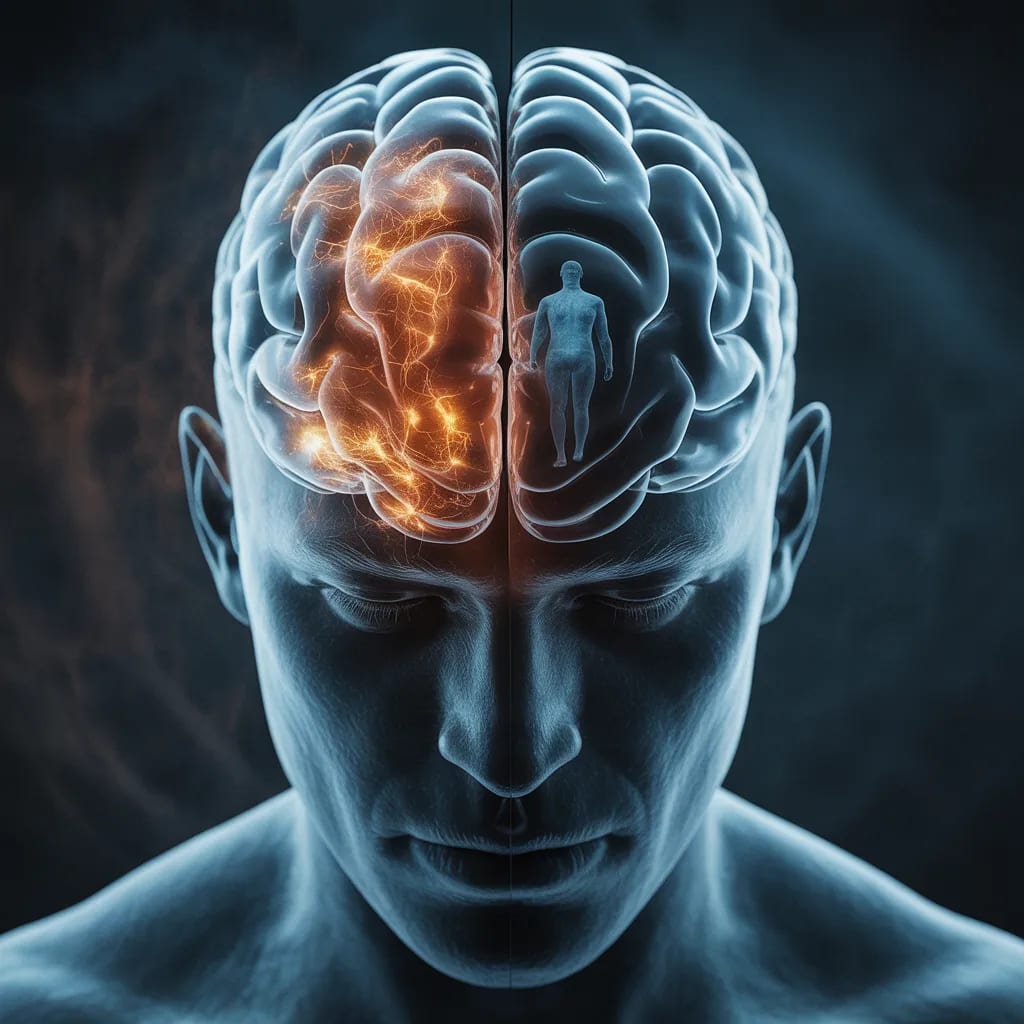
For most of human history, the question of why certain people commit acts of extraordinary cruelty without remorse was answered in moral terms. They were wicked. Corrupted. Evil in some fundamental, almost theological sense. The law reflected this understanding and, to a large extent, still does. We try, convict, and punish on the assumption that the person standing before the court made a choice and that the capacity for choice implies the capacity for guilt.
Neuroscience is beginning to complicate that assumption in ways the legal and ethical systems have yet to fully absorb.
Over the past three decades, advances in neuroimaging technology, particularly functional magnetic resonance imaging, or fMRI have allowed researchers to observe the living brain in unprecedented detail. What they have found in the brains of individuals diagnosed with psychopathy is not merely interesting. It is, in the truest sense of the word, structural. The psychopathic brain is not simply a normal brain making abnormal choices. In several measurable, reproducible ways, it is a different kind of brain.
What Psychopathy Actually Is
Before examining the neuroscience, it is worth clarifying what psychopathy is and what it is not.
Psychopathy is not a formal diagnosis in the Diagnostic and Statistical Manual of Mental Disorders (DSM-5). It is most closely associated with antisocial personality disorder, but the two are not synonymous. Psychopathy is a specific constellation of traits, most precisely measured by the Hare Psychopathy Checklist-Revised (PCL-R), developed by Canadian psychologist Robert Hare over four decades of clinical research.
Those traits fall into two broad clusters. The first is interpersonal and affective: superficial charm, grandiosity, pathological lying, manipulation, shallow emotional affect, lack of empathy, and absence of remorse or guilt. The second is behavioral: impulsivity, poor behavioral controls, a parasitic lifestyle, juvenile delinquency, and criminal versatility.
Critically, not all psychopaths are violent. Research consistently estimates that approximately one percent of the general population meets the clinical criteria for psychopathy. Many of these individuals never commit violent crimes. Some function at high levels in competitive professional environments like corporate leadership, law, finance, and surgery, where certain psychopathic traits, particularly fearlessness, emotional detachment, and charm, can confer advantages. The overlap between psychopathy and serial killing is real but limited. What psychopaths share is not necessarily violence; it is the structural absence of the emotional architecture that normally regulates human behavior toward others.
The Neuroscience: What the Brain Scans Reveal
The most consistent neurological finding in psychopathy research concerns the amygdala, a small, almond-shaped structure deep within the brain's temporal lobe that plays a central role in processing emotion, particularly fear and threat responses.
In healthy individuals, the amygdala activates reliably in response to emotional stimuli, distressed faces, threatening situations, and morally charged scenarios. It is a core component of what neuroscientists call the affective empathy system: the neural machinery that allows us to feel something in response to what others feel. When you wince watching someone else stub their toe or feel a reflexive discomfort at the sight of a child crying, your amygdala is doing much of that work.
In individuals with psychopathy, this response is measurably reduced. Studies by neuroscientist James Blair, currently at the National Institute of Mental Health, have documented significantly lower amygdala activation in psychopathic individuals when exposed to images of fearful or sad faces, images of people in pain, and morally distressing scenarios. This is not a subtle statistical difference; in some studies, the reduction in amygdala response is dramatic.
Equally significant is what happens in the ventromedial prefrontal cortex (vmPFC), a region of the frontal lobe deeply involved in moral decision-making, the integration of emotion into rational judgment, and the inhibition of socially harmful behavior. Neuroimaging studies have found both structural abnormalities and reduced functional connectivity between the vmPFC and the amygdala in psychopathic individuals. In effect, two systems that normally work in concert to produce morally regulated behavior are, in the psychopathic brain, poorly connected.
Research published in the journal Archives of General Psychiatry found that the vmPFC in psychopathic individuals showed significantly reduced gray matter volume compared to control populations. Reduced gray matter means fewer neurons and synaptic connections, a structural difference that is not the result of a decision or a character failing. It is anatomy.
The Empathy Deficit in Detail
Empathy is not a single faculty. Neuroscientists distinguish between cognitive empathy, the ability to understand what another person is thinking or feeling, and affective empathy, the ability to share or resonate with what another person is feeling. These two systems are neurologically distinct.
Psychopaths typically show relatively intact cognitive empathy. They can accurately read emotional states in others, identify fear, sadness, or vulnerability with precision, and model what another person is likely to feel in a given situation. What they appear to lack is affective empathy, the automatic, visceral resonance that normally makes another person's pain aversive to witness.
This distinction is important because it helps explain one of the more counterintuitive features of psychopathy: the ability to be simultaneously charming, perceptive, and completely indifferent to the suffering they cause. The psychopath is not failing to notice emotional signals. In many cases, they are reading them with unusual accuracy. What is absent is the automatic emotional response that, in most people, converts that reading into a constraint on behavior.
Neuroscientist Jean Decety at the University of Chicago has conducted extensive research on this distinction. In one widely cited study, psychopathic inmates shown images of people in pain demonstrated normal or even heightened activation in cognitive processing regions; they were paying attention, modeling the scenario accurately, but significantly reduced activation in the regions associated with shared emotional experience. They understood the pain. They simply did not feel it.
The Role of Genetics and Environment
The evidence for a heritable component to psychopathy is substantial. Twin studies, which compare trait concordance between identical twins, who share all their DNA, and fraternal twins, who share approximately half, consistently find higher concordance for psychopathic traits in identical twins. A landmark meta-analysis of twin studies published in Psychological Medicine estimated the heritability of psychopathic traits at approximately 50 percent, meaning that roughly half the variance in psychopathic traits across a population can be attributed to genetic factors.
Specific genetic variants associated with serotonin and dopamine regulation neurotransmitter systems central to emotional processing, reward sensitivity, and impulse control have been implicated in psychopathy research, though the genetics are complex, and no single gene determines the outcome.
The environment, however, remains critically important. Severe early childhood trauma, neglect, and abuse are strongly overrepresented in the histories of individuals who develop full psychopathic profiles. Current developmental models suggest that genetic predispositions interact with early environmental conditions in determining outcomes. A child with a genetic predisposition toward reduced amygdala reactivity, raised in a stable, nurturing environment, may develop quite differently from the same child raised in an environment of chronic threat and neglect.
This interaction model has significant implications for how society approaches the prevention and treatment of psychopathic behavior, particularly in children, where certain interventions have shown measurable results.
The Question of Moral Responsibility
The neurological evidence for structural differences in the psychopathic brain raises a question that sits uncomfortably at the intersection of science, law, and ethics: if the brain of a psychopath is measurably different in the regions responsible for guilt, empathy, and moral regulation, to what degree is that individual morally responsible for acts committed in the absence of those faculties?
This is not a question neuroscience alone can answer. But it is a question neuroscience is forcing into the open.
The traditional legal framework for criminal responsibility rests on two pillars: the act itself and the mental state accompanying it, what legal tradition calls "mens rea," or guilty mind. The system assumes that the capacity for a guilty mind is more or less uniformly distributed across the adult population, except in cases of severe mental illness. Psychopathy, which does not typically meet the legal threshold for insanity, falls into an unresolved space.
Legal scholars and forensic psychiatrists have argued both sides. Some contend that neurological differences in psychopathy should mitigate culpability, at least in degree, since the individual lacks the affective architecture that makes moral regulation possible in the typical sense. Others argue, with equal force, that mitigation based on neurological difference creates a perverse incentive structure and that incapacitation and public safety, not moral desert, should drive sentencing decisions for violent psychopathic offenders regardless.
What is not defensible, in light of current neuroscience, is the continued insistence that psychopathy is simply a moral failing, a choice to be selfish, cruel, or indifferent that a sufficiently strong character could overcome. The evidence does not support that framing.
What This Means for How We Think About Evil
The cultural category of evil has always served a function. It names something real, acts of cruelty so extreme, so apparently indifferent to human suffering, that ordinary explanatory frameworks seem inadequate. The impulse to invoke evil is understandable. It is also, increasingly, scientifically insufficient.
Understanding the neurological substrate of psychopathy does not require us to excuse the harm psychopathic individuals cause. Victims of violent crime are not made whole by the knowledge that their attacker had reduced gray matter in the vmPFC. Justice still matters. Public safety still matters. The suffering of victims is not diminished by neuroscience.
What neuroscience does demand is a more precise and honest account of what we are actually dealing with, one that distinguishes between the satisfactions of moral condemnation and the harder, more practical work of prevention, early intervention, and evidence-based management of individuals who pose genuine risks to others.
If a child shows early markers of callous-unemotional traits, the developmental precursor to adult psychopathy, and we respond with punishment and moral instruction alone, we are applying the wrong tools to a neurological problem. Research by psychologist Paul Frick and others has demonstrated that early intervention programs specifically designed for children with callous-unemotional traits, which emphasize reward-based learning and positive emotional engagement rather than punishment, can produce measurable improvements in empathic response.
The brain, particularly the developing brain, is not fixed. Neuroplasticity, the brain's capacity to reorganize itself in response to experience, means that early, targeted intervention may be capable of partially compensating for neurological vulnerabilities before they harden into adult psychopathic profiles.
That is not a guarantee. It is not a solution. But it is a more honest engagement with the problem than invoking evil and walking away.
Conclusion
The brain that feels no guilt is not a brain that chose indifference. It is, in measurable and reproducible ways, a brain that is differently constructed with a quieter amygdala, a thinner vmPFC, and a weakened connection between the systems that, in most people, make another's suffering feel like a reason to stop.
This finding does not resolve the ethical questions it raises. It deepens them. It asks us to hold, simultaneously, the reality of the harm psychopathic individuals can cause and the reality that the architecture of moral feeling is not equally distributed across all human minds.
That is an uncomfortable place to stand. But it is, given the evidence, where intellectual honesty requires us to be.
The Hare Psychopathy Checklist-Revised (PCL-R) remains the gold standard clinical instrument for psychopathy assessment. Robert Hare's research is documented extensively at hare.org. The Endangered Language Project's work on early intervention for callous-unemotional traits in children is ongoing through multiple research institutions including the University of New Orleans and King's College London.
About the Creator
Enjoyed the story? Support the Creator.
Subscribe for free to receive all their stories in your feed.
Comments
There are no comments for this story
Be the first to respond and start the conversation.