
The Boy in the Box: After 65 Years, He Finally Had a Name
A little boy's body was found in a cardboard box by the roadside. No one came looking for him, no one claimed him, and for decades no one knew his name.
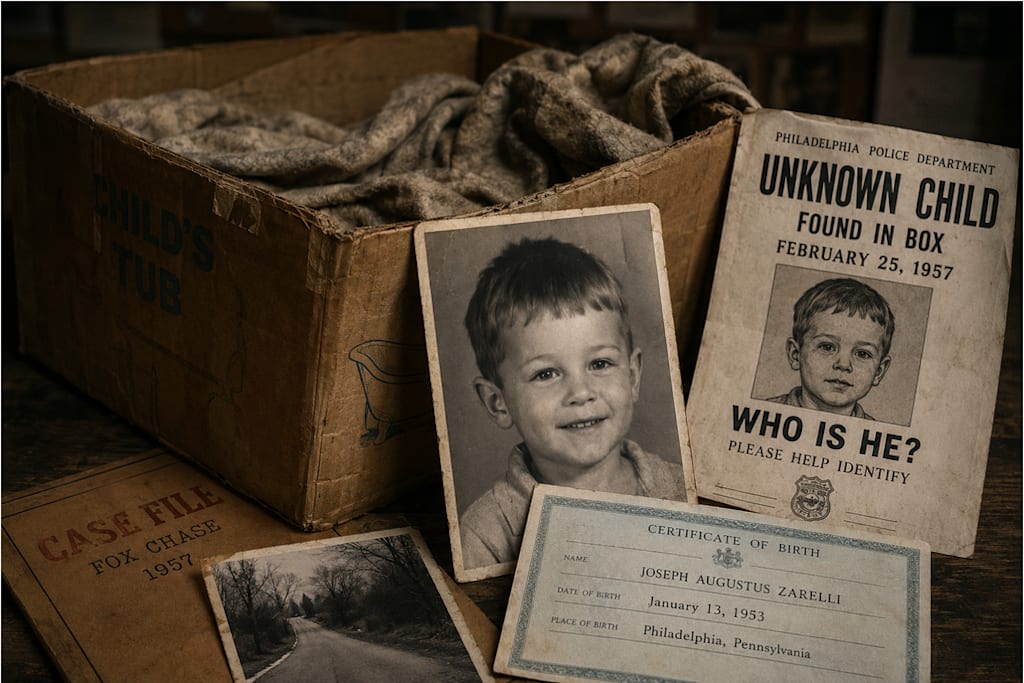
On February 25, 1957, a man in Philadelphia discovered something he would probably remember for the rest of his life.
An ordinary cardboard box was lying beside a road in the Fox Chase neighborhood.
It did not look unusual. But inside was not merchandise, rubbish, or something someone had simply thrown away.
There was the body of a little boy.
The child was naked, wrapped in a blanket, and had suffered severe injuries. He was believed to be about four years old. Investigators later determined that he had died from blunt-force trauma.
The police had a dead child.
But they did not have his name.
And that was the beginning of one of Philadelphia's most notorious unsolved cases.
For the next 65 years, he would simply be known as the Boy in the Box.
Then, in 2022, someone finally said his real name.
Joseph Augustus Zarelli.
A child who seemed never to have existed
From the very beginning, investigators were trying to answer the most basic question:
Who was this boy?
They distributed photographs, created posters, and appealed to the public. They asked anyone who might recognize the child to come forward.
But no one did.
That was perhaps the most disturbing part of the case.
A child of this age had to have lived somewhere. Someone had to know him. He must have had a family, neighbors, perhaps friends.
And yet it was as though he had never existed.
Investigators discovered that the boy had apparently been given a haircut shortly before his death. His body also bore older scars, including signs that may have been connected to medical treatment.
He was a small human being who had already lived four years.
But no one could say who those four years belonged to.
The box provided the first clues
Investigators naturally examined the box itself.
It was a cardboard box that had originally contained a baby bathtub and was believed to have come from a department store in Upper Darby.
It was one of the few concrete clues the case offered.
But Philadelphia in 1957 was a very different place from the city we know today.
There were no DNA databases. No genetic genealogy. No mobile phones, security cameras, or digital records that could be searched within hours.
Police had witnesses, fingerprints, photographs, interviews, and their own experience.
And above all, they had a dead child without a name.
The years passed.
And the boy still had no identity.
The years went by, but the case did not disappear
Generations of police officers worked on the case.
Some became involved when decades had already passed since the boy was found. For others, the investigation became almost a personal mission.
One of the greatest difficulties was that investigators did not know whom they were looking for.
If the child had never officially been reported missing, there was no family desperately searching for him. There was no parent walking into a police station and saying:
"That's my son."
There was no one who could show investigators a birthday photograph or tell them where the boy had lived.
So the investigators had to work backwards.
First, they had a dead child.
Then they had to find his life.
In 1998, another major attempt was made
Joseph's remains were exhumed in 1998 so that investigators could obtain DNA.
But the technology available at the time could not provide the answer they needed.
The sample did not lead police to his family.
The boy was buried again.
The case remained unsolved.
But the world was changing.
And the biggest change was taking place in a field that did not even exist in 1957.
Genetics.
DNA gave investigators a chance they had never had before
In April 2019, Joseph's remains were exhumed again.
This time, forensic science had advanced dramatically.
Forensic genetic genealogy can use DNA in a different way from traditional police testing. Instead of looking only for a direct match with a specific person, it can help identify relatives whose genetic profiles appear in genealogy databases.
And that was where, after more than six decades, the case finally began to move.
Investigators obtained a genetic lead.
And that lead pointed toward relatives.
Suddenly, they were no longer dealing with an anonymous boy found in a box.
They were beginning to see a family.
One distant relative changed everything
The genetic genealogy investigation gradually revealed Joseph's family connections.
Investigators traced relatives on his mother's side and eventually identified additional members of the family.
Then came one of the most important documents in the entire case.
A birth certificate.
Joseph had been born on January 13, 1953.
His name was Joseph Augustus Zarelli.
The child who had been known for decades as "America's Unknown Child" was no longer unknown.
He had a date of birth.
He had parents.
He had a family.
And finally, he had a name.
Joseph had lived for only four years
Police later said that Joseph had lived in West Philadelphia, near 61st and Market Streets.
The place where his body was found was roughly fifteen miles away, in what was then a much less developed part of Fox Chase.
Investigators believed the distance could be significant.
Whoever had taken the child there had apparently wanted him far away from the place where he had lived.
And yet one question remains perhaps even more painful:
Why did no one report him missing?
Police said Joseph had never officially been reported missing.
That means that when his body was discovered in February 1957, no one came forward to say:
"We are looking for four-year-old Joseph Zarelli."
His identity was solved. His murder was not.
Identifying the child was an extraordinary breakthrough.
But it was not the end of the story.
It was the beginning of another investigation.
Police determined that Joseph had died from blunt-force trauma.
Investigators also indicated that they had an idea who might have been responsible for his death. However, they did not release specific names because the case remained an active investigation.
And that is why the story of the Boy in the Box still has no final chapter.
Police finally know who died.
They still need to determine who killed him.
Can a murderer still be found after all these years?
At first glance, it may seem impossible.
More than six decades have passed.
People who might have known something could be dead.
Witnesses' memories may have disappeared with time.
Documents may have been lost.
And anyone who was responsible for a four-year-old child in 1957 would now be very old—if they are still alive at all.
Yet Joseph's case has demonstrated just how dramatically forensic science has changed.
In 1957, DNA was not part of criminal investigations.
In 1998, police attempted to obtain genetic material, but the technology was not sufficient.
In 2019, Joseph's remains were examined again with far more advanced methods.
And in 2022, after 65 years, the boy finally received his name.
Something that had seemed permanently lost was not completely lost after all.
After 65 years, he finally had a name
When police announced Joseph's identity in December 2022, something happened that might seem like a small detail.
An anonymous victim became a person.
He was no longer simply "the Boy in the Box."
He was Joseph.
He was born on January 13, 1953.
He had relatives.
He had a family.
He had a life, even though that life lasted only four years.
And finally, he could be buried under his own name.
For the investigators who had worked on the case for years, it was an extraordinary moment.
One of Philadelphia's oldest unsolved cases had finally received its first major answer.
But not its last.
The box is no longer the only thing that remains of him
For decades, Joseph was known only because of the circumstances of his death.
The Boy in the Box.
The nickname was born from tragedy.
From something someone had done to him.
After 2022, however, his real name returned to where it belonged.
Joseph Augustus Zarelli.
Perhaps that is the most important result of the decades-long investigation.
Because the murder remains unsolved.
No one has been brought to trial.
The case cannot yet be marked as closed.
But the child who was found in 1957 without a single person able to say who he was is no longer anonymous.
After 65 years, investigators were able to give him back his name.
And with it, part of the life that someone had taken from him.
Joseph Augustus Zarelli.
A four-year-old boy from Philadelphia.
His story is still waiting for its final answer.
Who killed him?
foto: https://chatgpt.com/c/
AI Disclosure
AI was used to assist with the English translation and language editing of this article. The original article was written by the author in Czech. The English version was reviewed, edited and adapted by the author before publication.
About the Creator
Enjoyed the story? Support the Creator.
Subscribe for free to receive all their stories in your feed.
Comments
There are no comments for this story
Be the first to respond and start the conversation.