
The AI Face Was Open-Sourced. The Law Still Has to Prove It Was Yours.
AI short dramas can borrow a likeness without copying a single pixel. The hard part starts when the creator stays silent and the burden falls on the person whose face appears on screen.
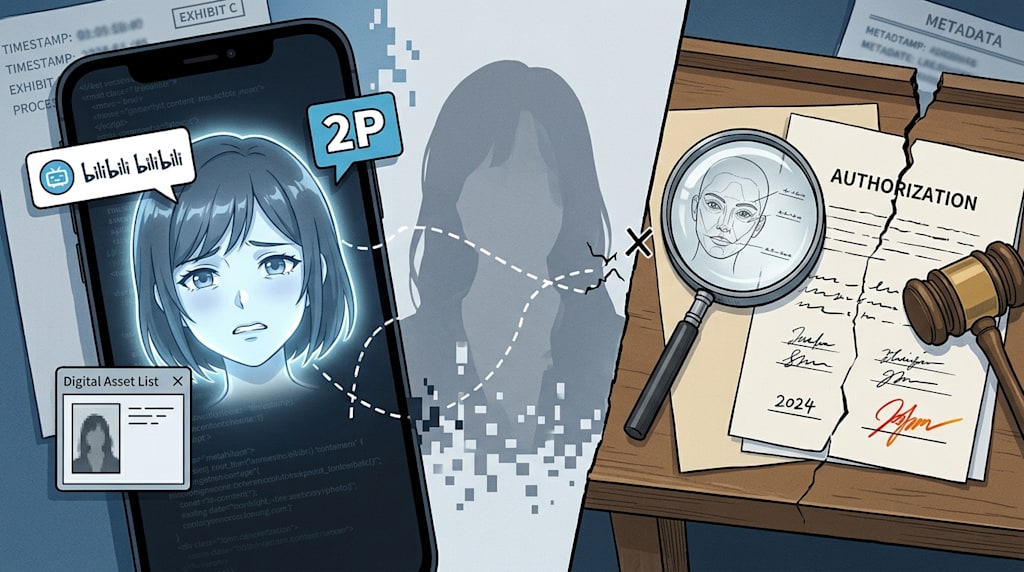
When that AI short drama took off on Bilibili, no one noticed who the virtual DeepSeek character resembled. Only after the creator posted a new video and open-sourced the production process did the danmu comments fill with a question: “Isn’t that the cosplayer?” Photos of Yuzijiang had appeared in the asset list. The creator did not hide it. He contacted the rights holder, got consent, and left the work online. The sequence looked like a clean classroom example: unintentional infringement, frank acknowledgment, free authorization, and the work kept its audience.
But that outcome depended on one choice. The creator disclosed his source material. If he had not open-sourced the process, or if he had deleted the production video and left only the finished short, how would the person whose likeness was borrowed prove that the face was hers?
This is not an abstract worry. AI short-drama production makes it hard for a rights holder to reverse-engineer training material from the final product. The model learns front faces, side profiles, expressions, and postures. The output will differ from the real person. That technical gap gives the defendant a ready defense: the image was AI-generated, virtual, randomly sampled, not your portrait.
Legal doctrine is clear enough. Article 1019 of the Civil Code bars using information technology to forge another person’s portrait. Portrait-right protection turns on identifiability. If ordinary viewers can reliably identify a specific person, the image falls inside the protected zone. The Beijing Internet Court applied that standard in the AI face-swap short-drama case. The court compared facial contours and features, weighed recognition by ordinary viewers and fan communities, and found that the plaintiff’s portrait had been used. If the defendant claimed “AI random generation,” it had to reproduce the creation process in court. Failure to reproduce carried the consequences of failed proof.
The rule moves the test from technical identity to public recognition. That direction is correct. The weak point is the threshold. The burden shifts only after the rights holder makes the court and the public recognize “this is you.” For a famous face, that step may be easy. For an ordinary UP host, proving that ordinary viewers can reliably identify her is a fight. Does fan recognition count as ordinary public recognition? How many matching features make “high similarity”? No standard answers exist. The ambiguous middle is where the crack opens.
More polished workarounds have appeared. One route uses a real person who resembles the celebrity. The producer signs a portrait-right authorization with that person, then samples and revises the face. In court, the defendant shows the agreement and says it used the authorized person’s likeness. To rebut that, the rights holder must show that the authorized person was a pass-through. The generated image must be far closer to the celebrity than to the authorized person, and the agreement must look like formal cover. That requires a complex comparison in court. The defendant only has to put the agreement on the table.
Another route goes further. The producer draws the celebrity’s face by hand or uses prompts to steer the model toward a “similar but not identical” image. If sued, the defendant can reproduce the process in court and claim independent creation. The Beijing Internet Court’s “reproduce or lose” rule can be sidestepped by a defendant who can draw the face on the spot. A court cannot stop at “can you draw it?” It also has to examine prompt design, consistency across repeated tests, and why a commercial short drama chose a face so close to one specific real person instead of any other face. That review requires technical judgment. Most courtrooms do not have it.
Technical tracing cannot solve the whole problem. The labeling rules require implicit markers, but open-source models, local deployment, and metadata deletion can cut the trail. Labels can help a rights holder find a starting point. They cannot carry the burden of proof.
Return to the Bilibili video. It ended well because the creator chose candor. The law cannot assume that every infringer will be candid. It must keep dishonest infringers from exploiting the evidentiary crack. It must also keep the infringed from having to become a detective before becoming a plaintiff.
Portrait-right protection does not turn on how unique a face is. AI can generate endless handsome faces. The scarcity of any single face is fading. Portrait rights protect something else. No one may place you, without consent, in an image or situation you did not choose. That embedding matters regardless of how many features the model copied at the pixel level. When a person is placed inside a narrative she never joined, that presence without consent is the injury to personality rights.
The video is still on Bilibili. The description includes a line: “The DeepSeek image has been authorized by Yuzijiang.” The line does not soar. It does not sigh. It states a fact. The law must make works without that line unable to hide behind “it looks like me, but it isn’t me.”
About the Creator
Jin
Writer of reamstories
https://reamstories.com/jin
Enjoyed the story? Support the Creator.
Subscribe for free to receive all their stories in your feed. You could also become a paid subscriber, letting them know you appreciate their work.
Comments
There are no comments for this story
Be the first to respond and start the conversation.