
The $500 Million Ghosts of Boston: 81 Minutes That Left Empty Frames on the Wall for 35 Years
On March 18, 1990, two men in police uniforms walked into America's most eccentric museum. They left with 13 masterpieces. The frames are still hanging empty today.

On March 18, 1990, at 1:24 AM, a buzzer rang inside the Isabella Stewart Gardner Museum in Boston.
It should have been an uneventful night shift. St. Patrick's Day crowds were stumbling home. Two young security guards, both music students, were on duty.
Outside stood two men in Boston Police uniforms. "We're responding to a disturbance," they said.
The guard broke the museum's number one rule: never open the door after hours.
That decision became the largest property crime in U.S. history.
What Happened Inside
Once inside, the "policemen" quickly overpowered the guards. They were handcuffed, duct-taped, and taken to the basement, tied to a pipe and a workbench.
For the next 81 minutes, the thieves moved methodically through the museum.
They didn't take the most valuable paintings in terms of size or fame. They took what they could carry. And they made strange choices.
They cut Rembrandt's "The Storm on the Sea of Galilee" — his only seascape — straight out of its frame with a blade.
They took Vermeer's "The Concert." Only 36 Vermeers exist in the entire world. This one alone is valued today at over $250 million.
They took five Degas sketches so small they could fit in a pocket.
In total: 13 works. Valued at over $500 million in 1990. Today, over $1 billion.
The Empty Frames
Why The Museum Never Took Them Down
When you walk into the Dutch Room on the second floor today, you will see something chilling.
Large, ornate, gilded frames. Hanging completely empty.
In 1994, four years after the heist, the museum made a deliberate decision: leave the empty frames as they are.
As Director Anne Hawley said at the time: "It is as if there'd been a death in the family."
Isabella Stewart Gardner herself had designed the museum in 1903 as a work of art. Her will stated that nothing could be moved. So the empty frames remain — a silent message that they are waiting.
The FBI Knows Who Did It (But Can't Prove It)
This is not a cold case. The FBI Boston Field Office is still actively investigating.
In 2013, the FBI announced they knew who was responsible. They traced the art to the Boston underworld, to associates of a criminal organization in the Dorchester area.
The problem: both suspects identified by the FBI are now dead. And the art has vanished into the black market.
The theories:
1. The Mafia Theory: The Boston mafia used the art as collateral for drug deals.
2. The Inside Job Theory: Someone who knew the museum's security flaws — the guards were underpaid students with no panic button.
3. The IRA Theory: The theft happened while the IRA was actively fundraising in Boston.
The museum still offers a $10 million reward for information leading to the recovery in good condition.
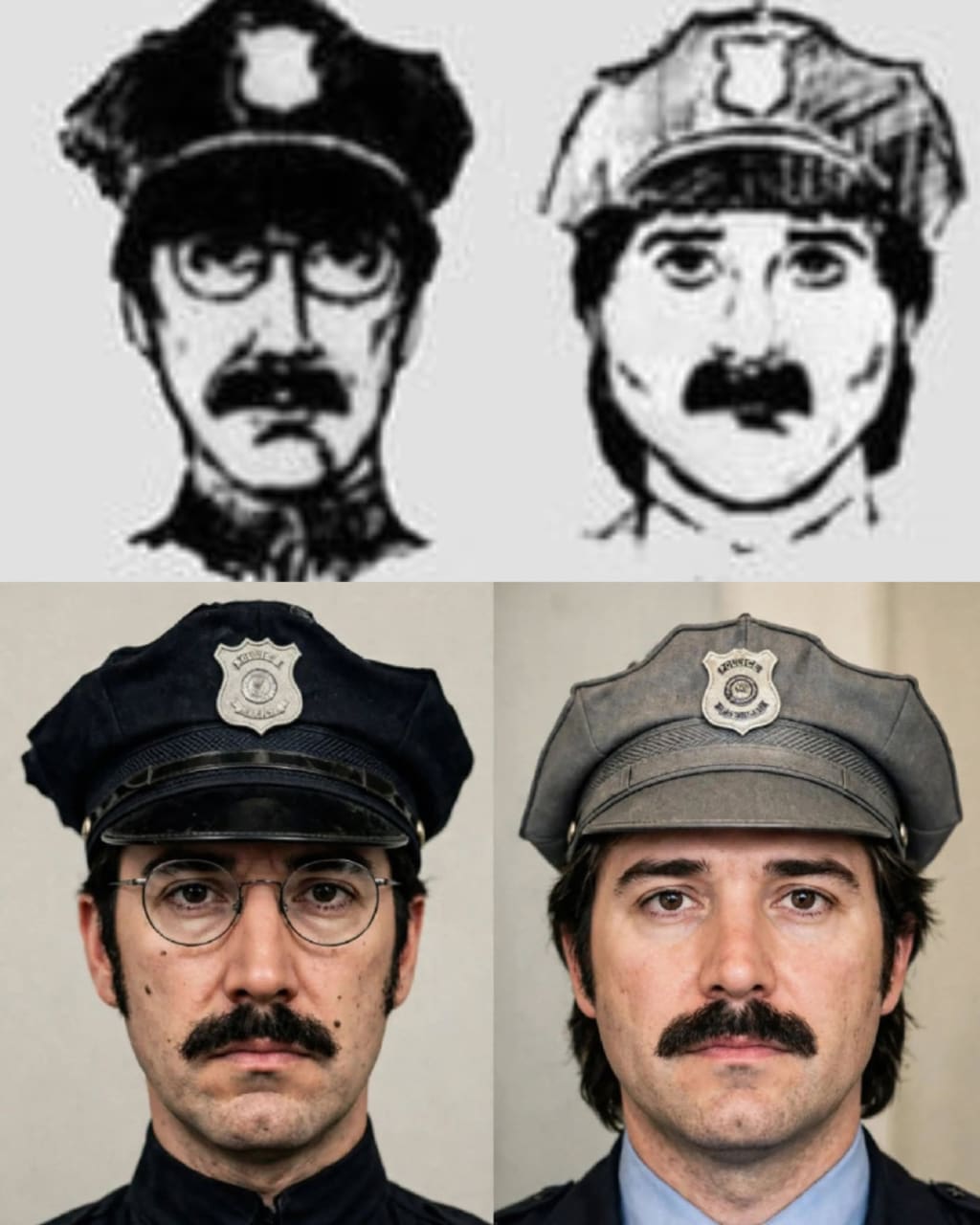
The sketches you see at the top of this article are the original FBI composite drawings released in 1990. For 35 years, these two faces were just pencil lines. Humanized, they could be your neighbor.
Could You Recognize Them?
Look again at the two men in police caps. One with round glasses and a thick mustache. The other with longer dark hair and a mustache.
They walked out of that museum with half a billion dollars and disappeared into the Boston night.
The art is still out there. Somewhere. Perhaps in a basement. Perhaps destroyed.
Or perhaps hanging on a private collector's wall, who knows exactly what he has.
Have you ever seen these empty frames in person? What do you think happened to the art?
About the Creator
V.S Ferreira
Storyteller & Reader. I read trending books so you don't have to. No spoilers. No hype. Just honest reviews.
Enjoyed the story? Support the Creator.
Subscribe for free to receive all their stories in your feed.
Comments
There are no comments for this story
Be the first to respond and start the conversation.