
The 300-Yuan Mercedes Gas Scam That Still Works
A dead phone, a borrowed “gas fee,” and a con that survives because most victims decide not to report it.
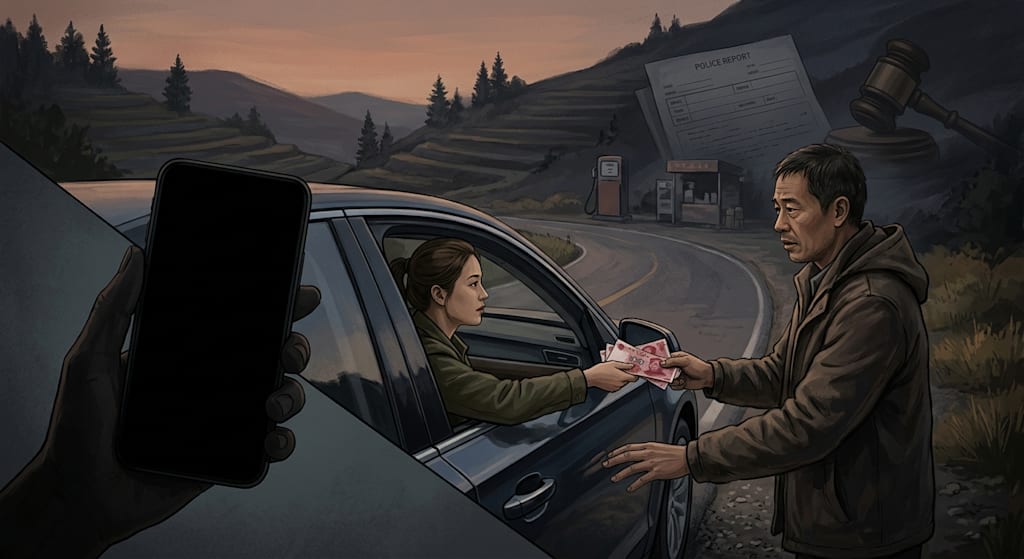
On November 10, in Liangshan, Sichuan, Ms. Chen was driving to pick up goods when a Mercedes flagged her down. The female driver said her car was out of gas and her phone was dead, and asked to borrow 300 yuan for fuel. Ms. Chen gave her the money, and the other woman left a phone number. As soon as she got the money, the phone was off. Call again, and it was hung up. A complete routine, start to finish.
When Ms. Chen later told people about it, there wasn’t much anger in her tone. It was more like she was recounting a moment she hadn’t fully processed. When she rolled down the window, she saw the three-pointed star badge. The phone the other woman handed over had a black screen. It was out of battery, couldn’t turn on, and even the number was given verbally. What she thought at the time was: someone driving a Mercedes wouldn’t welch on 300 yuan.
The scammer had made that judgment earlier than she did.
The number 300 was calculated.
It wasn’t a random price. Three hundred yuan is just enough for half a tank of gas. In the script of a luxury car breaking down temporarily, that amount is so reasonable it needs no explanation. An ordinary person glances at the badge, and the mind fills in the logic: she isn’t short of money; she’s just temporarily in trouble; helping is a small favor.
But the scammer was calculating a different account: the victim’s cost of defending her rights. Three hundred yuan is a pity to lose, but not enough to make someone immediately turn around and go to the police station. Making a statement, pulling surveillance, waiting for case filing, losing half a day’s wages. Most people run through that process in their heads and then choose “forget it.” The scammer bets on exactly that “forget it.”
A single 300 yuan doesn’t meet the 3,000-yuan criminal filing threshold for fraud. But not meeting the criminal threshold doesn’t mean nothing happens. The Public Security Administration Punishments Law has explicit provisions on fraud: five to fifteen days of detention, possibly with a fine. The problem is that the scammer bets you won’t report it. Once the police get involved, pulling roadside surveillance, checking transfer records, checking call logs, laying out the timeline, things change.
A similar case was decided in Jingde, Anhui. Cai and Zhang rented a Mercedes and moved across four provinces, using “borrowing gas money” to defraud a few hundred yuan each time, totaling 30,795 yuan. The court sentenced each of them to nearly two years for fraud and fined them. One line in the judgment is key: where multiple frauds have not been handled, the amounts are calculated cumulatively. A single 300 is a public-security case. Ten of them are a criminal case. Scammers move from place to place, betting that no one will check her driving route over a single 300 yuan.
Some people ask: Ms. Chen voluntarily gave the money, and the other woman left a phone number. Doesn’t this count as private lending?
The distinction between lending and fraud doesn’t depend on whether a phone number was left. It depends on whether there was a subjective intent to illegally possess. The phone was switched off immediately after the money was handed over. When called, it was hung up directly. The path to recovery was cut off from the first second. The so-called “borrowing gas money” was a fabricated purpose. The so-called “leaving a phone number” was a prop to make the scam look credible. Legally, this is obtaining property by fraud under the guise of borrowing. It is not a civil dispute.
But more worth discussing than the legal characterization is another thing: why this script still works.
A normal luxury car owner’s commercial insurance comes with free roadside assistance and fuel delivery every year. If the car runs out of gas, one phone call and official rescue arrives. Not using the free service and instead stopping strangers on the road for cash goes against common sense. But the scammer bets that most people won’t invoke that common sense at that moment. The three-pointed star is bright enough to outshine logic.
If you want to help but are afraid of being the sucker, the method is simple: turn cash into scenario verification.
“I don’t have cash. I’ll call 110 and have the traffic police deliver gas.” A stranded driver will breathe a sigh of relief. A scammer will find an excuse to leave. Once the police arrive, identity, vehicle, and reason all have to be checked. The script can’t go on.
“Come with me to the gas station ahead. I’ll pay by card.” Someone who needs gas will agree, as long as the problem gets solved. A scammer will refuse, because her car may not be stranded at all, or because she doesn’t want to leave any consumption record.
Both sentences do the same job: they don’t refuse help, but they raise the other person’s exposure cost. Kindness isn’t wrong. It just needs a verification step.
Ms. Chen’s 300 yuan most likely won’t be recovered. But the uncomfortable part of this isn’t the money.
It’s the next time. The next time she sees someone waving by the roadside, her hand on the window button will pause for a second. In that second she’ll wonder: is this real, or another phone-off, hang-up? That second of hesitation is what the scam leaves behind. The scammer took 300 yuan and left this.
In the Jingde case, the two scammers moved across four provinces, scammed for three years, and accumulated 30,000 yuan. Split among hundreds of kind people, that’s a few hundred each. Each person’s loss wasn’t big. No one reported it. Everyone said “forget it” in their hearts. Three years later, the cumulative amount was enough, and the handcuffs went on.
So when this happens, report it. Three hundred yuan isn’t worth a trip, but your report record is. One person’s 300 is a public-security case. Ten people’s 300 is a criminal clue. The scammer’s safety line is held up by everyone’s “forget it.”
As for the person waving by the roadside, you can stop, ask, and help. But don’t help by directly handing over cash. Roll down the window and say, “I’ll call 110 for you.” Someone who needs help will thank you. Someone acting out a script will hit the gas. That sentence isn’t expensive, but it filters out most scripts.
Kindness doesn’t need to be put away. It needs a verification step.
About the Creator
Jin
Writer of reamstories
https://reamstories.com/jin
Enjoyed the story? Support the Creator.
Subscribe for free to receive all their stories in your feed. You could also become a paid subscriber, letting them know you appreciate their work.
Comments
There are no comments for this story
Be the first to respond and start the conversation.