mafia
Don’t mess with the mob; a look into organized crime networks and mafia families, the real-life gangsters that inspired The Godfather.
Donald Trump Withdrawing U.S. Forces From Qatar Amid Fears of Iranian Escalation
Donald Trump Considers Withdrawing U.S. Forces From Qatar Amid Fears of Iranian Escalation The recent killing of approximately 2400 protesters in Iran has once again drawn global attention to the deep political and security crisis inside the country. These deaths, linked to widespread demonstrations against economic hardship, political repression, and government authority, have intensified regional tensions and raised serious concerns about Iran’s internal stability. As unrest grows and the risk of external escalation increases, the security balance in the Middle East has come under renewed scrutiny. Against this backdrop, former U.S. President Donald Trump has reportedly considered the possibility of withdrawing American forces from the U.S. military base in Qatar. The move is described as a precautionary step driven by fears of potential Iranian retaliation or escalation that could place U.S. troops at risk. This development highlights how domestic unrest in Iran can quickly evolve into a broader regional and international security issue.
By America today 9 months ago in Criminal
Donald Trump and the Iranian File: Policies, Tensions, and Public Questions
Donald Trump and the Iranian File: Policies, Tensions, and Public Questions Donald Trump’s approach to the Iranian file marked one of the most controversial chapters in modern US foreign policy. During his presidency, relations between the United States and Iran shifted dramatically, moving away from diplomacy toward pressure and confrontation. Trump’s decisions reshaped the Middle East landscape, affected global energy markets, and sparked intense debate both inside and outside the United States. Understanding Trump and the Iranian file requires examining his strategy, its consequences, and the questions people most frequently ask. **What Was Donald Trump’s Policy Toward Iran** Donald Trump adopted a policy of maximum pressure toward Iran. This strategy aimed to weaken Iran economically and politically in order to force changes in its behavior. The administration focused on limiting Iran’s influence in the Middle East, reducing its financial resources, and pushing it to renegotiate key agreements. Supporters viewed this approach as firm and necessary, while critics argued it increased instability. **Why Did Trump Withdraw From the Iran Nuclear Deal** One of the most searched questions concerns Trump’s decision to withdraw from the Iran nuclear deal. Trump argued that the agreement was flawed and failed to address Iran’s regional activities and missile program. He believed the deal gave Iran economic relief without permanently preventing it from pursuing nuclear capabilities. This withdrawal became a defining moment in US Iran relations and significantly escalated tensions. **How Did Sanctions Affect Iran Under Trump** Sanctions were a central tool in Trump’s Iran strategy. The reimposition of economic sanctions targeted Iran’s oil exports, banking system, and key industries. These measures placed significant pressure on Iran’s economy and daily life. Many people search for information about how these sanctions influenced Iran’s currency, employment, and political decisions, as well as how they affected ordinary citizens. **Did Trump’s Iran Policy Increase Regional Tensions** Another common question is whether Trump’s approach increased tensions in the Middle East. Relations between the US and Iran became more hostile, with incidents involving military forces, threats, and diplomatic standoffs. Supporters argue the pressure deterred Iran, while critics believe it brought the region closer to conflict. The period was marked by uncertainty and heightened security concerns. **How Did Trump Justify His Tough Stance on Iran** Trump often justified his position by emphasizing national security and protecting US allies. He argued that a strong stance would prevent Iran from becoming more powerful and reduce its ability to support armed groups in the region. His messaging focused on strength, deterrence, and economic leverage rather than compromise. This rhetoric resonated with some voters while alarming others. **What Was the International Reaction to Trump’s Iran Policy** The international response to Trump’s handling of the Iranian file was mixed. Some countries supported a tougher line, while others favored continued diplomacy. Differences emerged between the United States and its traditional allies, creating debates about leadership and global cooperation. These reactions are frequently searched by people trying to understand how global politics shifted during this period. **Did Trump’s Policy Change Iran’s Behavior** Many people ask whether Trump’s strategy actually changed Iran’s behavior. While economic pressure increased, Iran continued to assert its regional influence. Critics argue that the policy failed to achieve clear long-term results, while supporters claim it limited Iran’s financial capacity. The effectiveness of this approach remains a subject of ongoing debate. **What Is the Long Term Impact of Trump and the Iranian File** The long-term impact of Trump’s decisions continues to influence US Iran relations. His presidency reshaped expectations about diplomacy, sanctions, and the use of pressure in foreign policy. Future administrations inherited a complex situation shaped by years of mistrust and confrontation.
By America today 9 months ago in Criminal
Donald Trump Threatens to Strike Mexico: A New Escalation in Political Rhetoric
Donald Trump Threatens to Strike Mexico: A New Escalation in Political Rhetoric Recent statements attributed to former US President Donald Trump have sparked widespread debate after he suggested the possibility of military action against Mexico. The comments, framed around combating drug cartels and cross-border crime, immediately drew attention from media outlets, political analysts, and the public. While such remarks are not entirely new in Trump’s political style, the idea of striking a neighboring sovereign nation has raised serious concerns about diplomacy, international law, and regional stability. WHY DID TRUMP THREATEN TO STRIKE MEXICO Trump’s threat is rooted in his long-standing criticism of Mexico’s handling of drug trafficking and illegal immigration. He has repeatedly accused Mexican authorities of failing to stop powerful drug cartels that smuggle fentanyl and other narcotics into the United States. According to Trump, these cartels represent a direct national security threat, and extraordinary measures may be necessary to confront them. By floating the idea of military action, he positions himself as tough on crime and uncompromising on border security, themes that strongly resonate with his political base. IS TRUMP SERIOUS ABOUT MILITARY ACTION Many experts believe Trump’s comments are more rhetorical than operational. Historically, Trump has used provocative language to dominate headlines and frame himself as a decisive leader. However, even rhetorical threats carry weight, especially when they involve military force. While launching strikes against Mexico would face enormous legal, political, and logistical barriers, the seriousness lies in how such statements normalize extreme solutions and shift public discourse toward confrontation rather than cooperation. HOW DID MEXICO RESPOND TO THE THREAT Mexican officials have firmly rejected any suggestion of foreign military intervention. Leaders emphasized national sovereignty and stated that security challenges must be addressed through bilateral cooperation, intelligence sharing, and economic development. Mexico has consistently argued that drug consumption within the United States is a major driver of cartel power, making it a shared responsibility rather than a unilateral failure. Trump’s remarks were viewed by many in Mexico as disrespectful and politically motivated. WHAT WOULD A STRIKE MEAN FOR US MEXICO RELATIONS Any military action against Mexico would severely damage diplomatic relations between the two countries. The United States and Mexico share one of the most important trade relationships in the world, along with deep cultural, economic, and security ties. A strike would likely end security cooperation agreements, disrupt trade, and fuel anti-American sentiment across Latin America. Even discussing such a move creates uncertainty that can affect markets, migration policy, and regional alliances. CAN A US PRESIDENT LEGALLY ATTACK MEXICO Under international law, attacking another country without its consent or a clear act of self-defense would violate established norms. Domestically, a US president would face strong opposition from Congress, the military, and the intelligence community. Mexico is not officially considered an enemy state, and launching attacks on its territory would require extraordinary justification. Legal experts argue that targeting cartels inside Mexico without approval would set a dangerous precedent. HOW DID AMERICANS REACT TO TRUMP’S COMMENTS Public reaction in the United States has been sharply divided. Supporters praised Trump’s aggressive stance, arguing that traditional approaches have failed to stop drug trafficking. Critics, however, warned that such threats are reckless and could lead to unnecessary conflict. Many Americans expressed concern about escalating violence and the potential loss of life, both civilian and military. The comments also reignited debates about border policy, immigration, and the limits of presidential power. WHAT DOES THIS MEAN FOR THE 2024 ELECTION AND BEYOND Trump’s threat fits into a broader campaign strategy focused on law and order, national strength, and border control. By proposing extreme measures, he distinguishes himself from political rivals and keeps media attention focused on his agenda. Regardless of whether such actions ever materialize, the rhetoric itself influences public opinion and international perceptions of US foreign policy. It signals a willingness to challenge norms and could shape future debates about how the United States addresses transnational crime. In conclusion, Trump’s threat to strike Mexico represents more than a controversial soundbite. It highlights deep frustrations over drug trafficking, exposes fragile diplomatic balances, and underscores how powerful political language can be. Even without action, the consequences of such statements ripple far beyond campaign speeches, affecting trust, stability, and the future of US-Mexico relations.
By America today 9 months ago in Criminal
Minneapolis ICE Shooting Updates. AI-Generated.
In recent weeks, Minneapolis has found itself at the center of a growing legal and political controversy following a shooting involving Immigration and Customs Enforcement (ICE) agents. What initially appeared to be a straightforward federal use-of-force investigation has evolved into a broader dispute between state authorities and federal officials, raising serious questions about transparency, jurisdiction, and accountability. The most significant development so far is the state’s claim that it has been denied access to key evidence related to the incident. As public attention intensifies, the case is no longer just about what happened during the shooting. It is increasingly about who controls the facts, who gets to investigate them, and how justice is supposed to function when federal and state systems collide. What We Know About the Minneapolis ICE Shooting The shooting occurred during a federal immigration enforcement operation in Minneapolis. ICE agents were reportedly conducting official duties when gunfire erupted, resulting in injuries and immediate emergency response. Federal authorities confirmed the incident and stated that internal protocols were activated, including an automatic review by federal oversight bodies. From the beginning, details were limited. Officials cited the ongoing nature of the investigation and concerns about officer safety. This lack of information, while not unusual in federal cases, quickly became a point of friction for Minnesota state authorities, who argued that the public deserved clarity and that the state had a legal role to play in examining the incident. State Authorities Push for Transparency Minnesota state officials, including investigators and legal representatives, formally requested access to evidence connected to the shooting. This evidence reportedly includes body camera footage, surveillance recordings, forensic reports, and internal communication logs from the operation. According to state representatives, these requests were either delayed or denied outright. The state has since gone on record stating that it cannot independently assess the legality of the shooting without full access to the materials. This denial has fueled concerns that federal agencies are operating without sufficient external oversight, especially in incidents involving potential civilian harm. State leaders emphasized that their position is not adversarial by default. Rather, they argue that cooperation between federal and state agencies is essential to maintain public trust, particularly in communities already wary of immigration enforcement. Federal Response and Jurisdictional Limits Federal officials, for their part, maintain that the investigation falls squarely under federal jurisdiction. ICE operates as a federal agency, and shootings involving federal officers are typically reviewed internally and, when appropriate, by federal prosecutors or inspectors general. In statements released following the controversy, federal representatives cited legal restrictions that limit the sharing of evidence during an active investigation. They also stressed that premature disclosure could compromise witness testimony or investigative integrity. This explanation, while legally grounded, has done little to ease state frustrations. Critics argue that “ongoing investigation” has too often been used as a blanket justification for withholding information, even in cases where transparency could prevent misinformation and public unrest. Community Reaction and Public Trust The Minneapolis community has responded with a mix of concern, anger, and fatigue. For many residents, particularly in immigrant and marginalized communities, the shooting has reopened long-standing fears about aggressive enforcement tactics and lack of accountability. Community leaders and advocacy groups have called for the immediate release of non-sensitive evidence, arguing that transparency is a prerequisite for trust. Peaceful demonstrations and public forums have highlighted a broader demand: that no law enforcement agency, federal or otherwise, should be beyond scrutiny. Local officials echoed these concerns, noting that Minneapolis has spent years attempting to rebuild trust between residents and law enforcement. The perception that evidence is being withheld threatens to undermine that progress. Legal Implications of Denied Evidence From a legal standpoint, the state’s inability to access evidence raises complex questions. While federal agencies do have authority over their operations, states also have a responsibility to investigate deaths or injuries occurring within their borders. Legal experts suggest that this dispute could set a precedent. If states are routinely blocked from reviewing evidence in federal use-of-force cases, it may limit their ability to pursue independent inquiries or bring charges under state law when applicable. Some analysts believe the issue could ultimately be resolved in court, with judges determining whether the state has a legal right to access certain materials. Such a ruling could have national implications, influencing how future federal-state conflicts are handled. Political Dimensions of the Case The Minneapolis ICE shooting has also taken on a political dimension. Immigration enforcement remains a deeply divisive issue, and incidents like this tend to amplify existing ideological divides. State officials critical of federal immigration policies view the denial of evidence as symptomatic of a larger lack of accountability. Meanwhile, supporters of strict federal enforcement argue that state interference could hinder effective operations and put officers at risk. This political tension complicates the path forward. What might otherwise be a procedural disagreement risks becoming a symbolic battle over immigration, law enforcement authority, and states’ rights. What Happens Next? As of now, the investigation continues under federal oversight, while the state explores its legal options. Negotiations between state and federal officials have reportedly not been ruled out, suggesting that a compromise could still be reached. Potential next steps include limited evidence sharing under confidentiality agreements, congressional inquiries, or judicial review. Each option carries its own risks and consequences, both legally and politically. What remains clear is that public pressure is unlikely to fade. Minneapolis residents, like many Americans, are demanding clarity, fairness, and accountability in cases involving law enforcement use of force. A Broader Conversation About Accountability The Minneapolis ICE shooting is no longer just a single incident under investigation. It has become a lens through which broader issues are being examined: the balance of power between federal and state authorities, the limits of transparency, and the role of public oversight in a democratic society. Whether or not the state ultimately gains access to the evidence, the controversy has already sparked an important conversation. How that conversation translates into policy, practice, or reform remains to be seen, but its impact will likely extend far beyond Minneapolis. In the end, accountability is not only about assigning blame. It is about ensuring that systems function openly and fairly, especially when lives are affected. The outcome of this case may help determine how well those principles are upheld in the future.
By Saboor Brohi 9 months ago in Criminal
Federal Law Enforcement Shooting in Minneapolis Sparks National Debat
## **Federal Law Enforcement Shooting in Minneapolis Sparks National Debate** In early 2026, a serious incident unfolded in Minneapolis when federal law enforcement officers shot a civilian during a large-scale operation in the city. The event immediately drew public attention and ignited widespread discussion about the role of federal agencies, public safety, and accountability. The shooting occurred in a residential area, creating fear and confusion among residents and prompting strong reactions from local leaders and community groups. The presence of federal agents in Minneapolis was already controversial before the shooting took place. Their operation involved a significant number of officers and vehicles, transforming parts of the city into heavily monitored zones. When news broke that a civilian had been shot, the incident quickly became a focal point of national concern, especially given Minneapolis’s history with high-profile law enforcement encounters. **What Exactly Happened During the Minneapolis Incident?** According to initial accounts, federal officers were conducting an enforcement operation when gunfire was discharged, striking a civilian who was inside a vehicle. The precise sequence of events leading up to the shooting was not immediately clear, and conflicting reports circulated in the hours that followed. Witnesses described a tense atmosphere, with officers moving rapidly through the area and residents struggling to understand what was happening around them. **Why Were Federal Law Enforcement Officers in Minneapolis?** Federal agents were deployed as part of a broader enforcement action led by national authorities. The operation was described as one of the largest in the region, involving multiple federal agencies working together. Officials stated that the mission focused on enforcing federal law, while critics argued that the scale and visibility of the operation unnecessarily escalated tensions within local communities. **Who Was the Civilian Who Was Shot?** One of the most common questions from the public concerns the identity and condition of the civilian involved. Early reports confirmed that the individual was a woman who sustained gunshot wounds while inside a vehicle. Details about her identity and long-term condition were initially limited as authorities notified family members and medical teams provided treatment. The lack of immediate information contributed to public anxiety and speculation. **Was the Shooting Justified?** The question of justification remains central to the ongoing debate. Federal authorities indicated that the shooting occurred during an active operation and suggested that officers acted according to their training. However, local officials and civil rights advocates have called for a thorough and transparent investigation to determine whether the use of force was necessary or excessive. This debate reflects broader national concerns about when and how law enforcement should use lethal force. **How Did Local Leaders Respond?** City leaders reacted strongly to the incident. Minneapolis officials criticized the federal presence and expressed anger that such an operation took place without sufficient coordination with local authorities. Some leaders publicly demanded answers and accountability, while others called for federal agencies to reconsider how they operate within cities. These responses highlighted tensions between local governments and federal enforcement bodies. **How Did the Community React to the Shooting?** Residents near the scene reported fear, shock, and frustration. Protests quickly emerged, with community members demanding justice and transparency. Many expressed concern about the safety of civilians during large law enforcement operations, especially in densely populated neighborhoods. The shooting intensified existing mistrust between parts of the community and law enforcement institutions. **Is There an Ongoing Investigation?** Yes, investigations were launched to examine the circumstances surrounding the shooting. Multiple agencies became involved to ensure an independent review of the incident. Investigators are expected to analyze body camera footage, witness statements, and operational procedures to establish a clear timeline and determine responsibility. **What Does This Incident Mean for the Future?** The Minneapolis shooting has reignited national conversations about federal law enforcement practices, the use of force, and community safety. Many observers believe the incident could influence future policies, including how large-scale operations are planned and how federal agencies coordinate with local governments. It also raises questions about trust, transparency, and accountability in law enforcement. In conclusion, the federal law enforcement shooting in Minneapolis is more than a single incident. It represents a broader challenge facing cities across the United States as they navigate the balance between enforcing the law and protecting civilian lives. As investigations continue, the outcome may shape public policy and law enforcement practices for years to come.
By America today 9 months ago in Criminal
Tensions at Sea: The Russian Oil Tanker Seized by the United States in 2026
Tensions at Sea: The Russian Oil Tanker Seized by the United States in 2026 In early 2026, a Russian-flagged oil tanker was seized by the United States in the North Atlantic, attracting global attention. The vessel, originally called *Bella 1* and later renamed *Marinera*, had been monitored for weeks as it attempted to evade U.S. sanctions enforcement. This event has raised questions about international maritime law, geopolitical tensions, and the enforcement of economic restrictions on oil shipments. **Why Did the United States Target This Specific Tanker?** The primary reason the United States seized this tanker was due to its involvement in transporting oil from countries under sanctions, including Venezuela and Iran. The vessel had repeatedly changed flags and attempted to conceal its identity to avoid detection, making it part of what experts call a “shadow fleet.” U.S. authorities viewed these actions as deliberate attempts to bypass sanctions, threatening the effectiveness of economic restrictions and national security policies. The tanker became a high-priority target because its capture sends a message to other operators engaged in illicit oil transport. **Was the Tanker Carrying Oil at the Time of Seizure?** Reports indicate that the tanker was empty when intercepted. While this minimized immediate economic losses, it did not reduce the symbolic and strategic significance of the operation. The seizure demonstrated the U.S.’s determination to enforce sanctions rigorously and highlighted the risks faced by vessels attempting to circumvent international restrictions. Analysts note that even empty, the vessel represented a potential threat because of its history of sanctioned shipments. **Is the Seizure Legal Under International Law?** International maritime law generally protects ships under a nation’s flag. However, vessels operating under false registrations or engaged in illegal activities such as sanctions evasion may be subject to interception. U.S. authorities justified the seizure by citing the tanker’s use of a false flag and its history of sanction violations. Critics, including Russian officials, have condemned the action as an overreach that violates international norms. The legal debate underscores the tension between enforcing economic sanctions and respecting international maritime law. **Who Owns the Tanker, and Does Russia Claim It?** Ownership of the tanker is complex. The ship had been previously registered under another flag and operated under a different name before adopting Russian registration. Moscow publicly supported the vessel’s claim of affiliation, yet experts argue the flag change was largely strategic to avoid capture rather than a straightforward declaration of ownership. This situation complicates legal responsibility and emphasizes how vessel registrations can be manipulated to evade sanctions enforcement. **What Are the Geopolitical Implications of the Seizure?** The capture of the tanker has heightened tensions between the United States and Russia. It occurred amid ongoing debates over U.S. sanctions on Venezuela and other countries, demonstrating the willingness of the U.S. to act decisively against perceived sanction violations. The incident has drawn international scrutiny, with other nations closely monitoring how maritime sanctions are enforced and whether similar actions could escalate conflicts or provoke diplomatic disputes. **Could This Seizure Be Part of a Larger Pattern?** Yes. Observers note that the U.S. has increasingly pursued vessels suspected of sanctions evasion, tracking them across international waters. This is part of a broader strategy to limit revenue streams to sanctioned countries and entities while disrupting networks involved in illicit oil transport. Experts suggest that similar operations could continue, particularly against vessels suspected of moving oil illegally or attempting to conceal cargo from authorities. **What Happens to the Crew of the Tanker?** The fate of the tanker’s crew is another common question. U.S. authorities typically detain crews for questioning to determine involvement in illegal activity, but in many cases, they are treated according to international law and may be released after investigation if no direct wrongdoing is found. The crew’s experience underscores the personal risks associated with operating vessels engaged in sanctioned or illicit activities. **How Does This Affect Global Oil Markets?** Although the tanker was empty, its capture sends a clear signal to operators worldwide. It may deter other vessels from attempting to evade sanctions and reinforce the United States’ enforcement measures. While there is minimal immediate impact on global oil supply, the strategic message could influence future trading behaviors, shipping decisions, and compliance with international sanctions. In conclusion, the 2026 seizure of the Russian oil tanker reflects a complex intersection of maritime law, sanctions enforcement, and geopolitics. The operation highlights the challenges of regulating global oil shipments, the legal ambiguities of vessel registration and ownership, and the strategic importance of controlling revenue flows to sanctioned entities. As this story develops, it continues to spark debate and attention worldwide, illustrating the evolving nature of international sanctions enforcement and maritime security.
By America today 9 months ago in Criminal
Was His Abduction Caused by His Support for the Palestinian Cause or the Theft of Oil?
Was His Abduction Caused by His Support for the Palestinian Cause or the Theft of Oil?** The controversy surrounding the alleged targeting or attempted abduction of Venezuela’s president has sparked intense debate across political and media circles. At the center of this debate lies a critical question: was he targeted because of his outspoken support for the Palestinian cause, or was the real motive an effort to seize control of Venezuela’s vast oil wealth? To understand this issue, it is necessary to examine how ideology and economic interests intersect in modern geopolitics. Venezuela holds the largest proven oil reserves in the world, making it one of the most strategically important countries in global energy politics. Oil has long been the backbone of the Venezuelan economy and a source of both power and vulnerability. Any government that seeks to fully control its oil resources inevitably challenges foreign corporations and governments that rely on access to cheap and stable energy supplies. When Venezuela limited foreign involvement and asserted national sovereignty over its oil sector, it directly confronted powerful international interests. At the same time, Venezuela’s leadership adopted a clear and unapologetic stance in support of the Palestinian cause. Unlike many governments that choose neutral language or diplomatic silence, the president publicly condemned Israeli actions against Palestinians, expressed strong support for Gaza, and framed the issue as a matter of human rights and justice. This position placed Venezuela in direct opposition to influential Western powers that strongly support Israel, particularly the United States. Supporting the Palestinian cause on the international stage is not without consequences. Global politics often punishes leaders who challenge dominant narratives or align themselves with causes considered controversial by powerful states. Venezuela’s stance was not symbolic or occasional; it became a consistent element of its foreign policy. This moral positioning turned the country into an ideological opponent, especially during periods of heightened tension in the Middle East. However, history suggests that ideology alone rarely triggers extreme political actions such as destabilization or removal attempts. Moral opposition is often tolerated until it interferes with material interests. This is where oil becomes central to the discussion. Venezuela’s control over its oil resources provided it with leverage and independence, reducing its vulnerability to external pressure. For nations seeking greater influence over global energy markets, regaining control or access to Venezuelan oil would be a significant strategic gain. During times of global energy instability, oil-producing countries become focal points of international competition. Sanctions, political isolation, and support for opposition movements are frequently used as tools to weaken governments that resist external demands. In such contexts, narratives involving coups, forced removals, or abductions often emerge as part of broader pressure campaigns rather than isolated events. Internally, Venezuela faced serious economic and social challenges. Inflation, shortages, declining oil production, and political polarization weakened public trust and state institutions. These conditions increased instability and made the country more susceptible to both internal unrest and external interference. In fragile political environments, allegations of kidnapping or overthrow can gain traction quickly, regardless of whether they are fully proven. Media coverage further complicated the situation. International outlets often focused heavily on economic mismanagement and governance issues while paying less attention to Venezuela’s foreign policy positions, including its support for the Palestinian cause. On the other hand, supporters of the government emphasized foreign conspiracies and economic warfare. Both perspectives presented partial truths, obscuring how ideology and economic interests worked together. Ultimately, framing the issue as a choice between support for Palestine or oil theft oversimplifies a complex reality. The president became a target because he combined moral defiance with control over a strategic resource. His support for the Palestinian cause challenged powerful political narratives, while Venezuela’s oil represented immense economic and strategic value. Together, these factors created a situation in which pressure, destabilization, and targeting became increasingly likely. In modern geopolitics, leaders are rarely challenged for their beliefs alone. They become targets when their beliefs are backed by resources that grant them independence and influence. Venezuela’s case illustrates how the collision of principle and profit can place a nation’s leadership at the center of global confrontation.
By America today 9 months ago in Criminal
Drums Are Beating: Russia and China Align With Venezuela Amid Rising Tensions
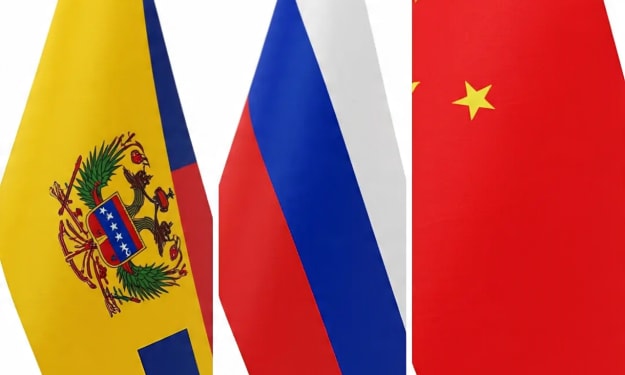
**War Drums Are Beating: Russia and China Align With Venezuela Amid Rising Tensions** In recent weeks, global attention has turned sharply toward Venezuela as alarming headlines and rumors have fueled fears of a major international crisis. Claims of an emerging alliance between Russia, China, and Venezuela, combined with reports circulating online about the kidnapping of the Venezuelan president and his wife, have intensified public anxiety. While not all information has been officially confirmed, the situation reflects deep geopolitical tensions and a fragile regional balance that could have serious global consequences. At the heart of the crisis is Venezuela’s long standing confrontation with the United States. Years of economic sanctions, political isolation, and internal instability have left the country economically weakened and diplomatically polarized. The Venezuelan government views Washington’s pressure as a direct threat to its survival, while the United States argues that its actions are aimed at restoring democracy and accountability. This clash has created fertile ground for foreign powers to expand their influence. Russia and China have emerged as Venezuela’s most important international backers. Both countries have provided political support, economic cooperation, and strategic partnerships, though in different ways. Russia’s involvement has focused on military cooperation, arms deals, and symbolic demonstrations of support. China, on the other hand, has emphasized financial ties, energy investments, and long term economic interests. Together, their presence has fueled speculation that a new geopolitical front is forming in the Western Hemisphere. Tensions escalated dramatically after unverified reports spread across social media and some alternative outlets claiming that Venezuela’s president and his wife were kidnapped during a sudden security incident. These reports triggered confusion, panic, and intense international speculation. Official channels in Venezuela denied any confirmed kidnapping, but the rapid spread of the story revealed how unstable and opaque the situation has become. In an environment of distrust and political warfare, rumors can quickly feel as powerful as facts. The reasons behind the growing tension are complex. Venezuela’s vast oil reserves remain a critical factor. Control over energy resources has always played a central role in global power struggles, and Venezuela represents a strategic asset. For Russia and China, supporting Caracas helps challenge US influence near its traditional sphere of power. For the United States, preventing rival powers from gaining a foothold in the region is a core strategic concern. Another driver of instability is internal division within Venezuela itself. Economic hardship, migration, political opposition, and public dissatisfaction have weakened state institutions. This internal fragility increases the risk of sudden crises, coups, or misinformation campaigns that can spiral into international incidents. In such conditions, even false or exaggerated claims can push nations toward dangerous decisions. Looking ahead, several scenarios are possible. One likely outcome is a continuation of the current standoff, where Russia and China provide diplomatic and economic backing while avoiding direct military confrontation. This scenario would resemble a cold conflict marked by sanctions, rhetoric, and strategic posturing rather than open war. A more dangerous scenario involves miscalculation. An internal security breakdown, an accidental clash, or a provocation based on false intelligence could escalate tensions rapidly. In this case, Venezuela could become a flashpoint for a broader geopolitical crisis, even if no side initially intends a full scale conflict. There is also a possibility of de escalation. Behind closed doors, diplomatic negotiations could reduce pressure, especially if economic realities push all sides toward compromise. History shows that even the most heated standoffs can cool when the costs of conflict become too high. In conclusion, while the drums of war may sound loud, the reality is shaped by uncertainty, strategy, and restraint. Russia and China’s alignment with Venezuela is real, but it is driven more by influence and leverage than by a desire for war. The rumors surrounding the president highlight how volatile the situation has become. Whether this crisis deepens or fades will depend on decisions made in the shadows of diplomacy, not just the noise of headlines.
By America today 9 months ago in Criminal
America and Venezuela: How Decades of Tension Turned Into Open Confrontation
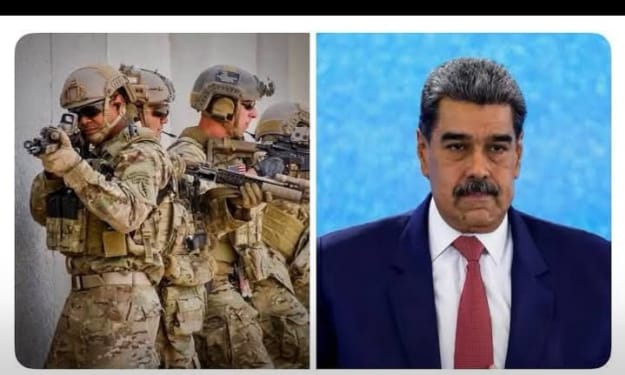
relationship between the United States and Venezuela has entered one of the most volatile periods in recent history, characterized by escalating tensions, military operations, diplomatic rupture, and international debate. What began as long-standing political and economic disagreement has now evolved into an open confrontation that carries major implications for regional stability, international law, and global geopolitics. Historical Roots of Tension The U.S.–Venezuela relationship has been fraught for decades, shaped by ideological differences, energy politics, and mutual distrust. Venezuela’s oil wealth historically made it a key partner for Washington, particularly throughout the 20th century. However, relations began cooling significantly in the late 1990s and early 2000s after Hugo Chávez rose to power with a project rooted in Bolivarian socialism and resistance to U.S. influence. Over the years, successive Venezuelan administrations under Chávez and later Nicolás Maduro adopted increasingly antagonistic foreign policies toward the United States, while the U.S. grew critical of Venezuela’s democratic backsliding and human rights record. The result was a heavily polarized bilateral relationship, with occasional cooperation overshadowed by frequent clashes, sanctions, and accusations of interference. These structural tensions widened after Venezuela’s disputed 2024 presidential election. The United States and several Western countries rejected the legitimacy of Nicolás Maduro’s victory, citing fraud and lack of transparency. Washington instead recognized opposition leader Edmundo González as interim president, deepening the diplomatic rupture at a time when both nations already had limited official channels of communication. � Encyclopedia Britannica +1 2025: From Sanctions to Military Escalation 2025 marked a dramatic escalation in the U.S.–Venezuelan conflict. Early in the year, the United States intensified pressure on Caracas through a combination of severe sanctions, economic coercion, and targeted counter-narcotics actions. The Trump administration designated Venezuela’s ruling elite and alleged criminal networks—most notably the so-called “Cartel de los Soles”—as terrorist organizations, a step that expanded U.S. legal authority to pursue punitive measures against individuals and assets linked to the Venezuelan government. � CRBC News These sanctions coincided with a significant military buildup in the Caribbean. Beginning in mid-2025, the United States deployed thousands of personnel, warships, aircraft, and surveillance assets near Venezuelan waters in an operation officially framed as a counter-narcotics and maritime security campaign. U.S. officials described these measures as necessary to disrupt smuggling networks and cartel operations alleged to be operating with Venezuelan complicity. Critics, however, interpreted the moves as coercive acts that blurred the line between counter-drug missions and preparations for conflict. � RTVE Throughout 2025, U.S. forces carried out a series of lethal maritime strikes on vessels in the Caribbean and eastern Pacific, which Washington claimed were involved in transporting drugs toward the United States. These operations reportedly resulted in dozens of deaths and drew harsh criticism from human rights organizations and foreign governments who condemned them as disproportionate and in violation of international norms. � Encyclopedia Britannica Oil Seizures and Naval Blockade Compounding the tension were dramatic economic and naval measures. In December 2025, U.S. forces seized a Venezuelan-linked oil tanker, accusing it of carrying sanctioned oil destined for unauthorized markets. Shortly afterward, President Trump announced a “total and complete blockade” of sanctioned Venezuelan tankers entering or exiting the country, a step aimed at crippling Venezuela’s oil-dependent economy and cutting off the government’s primary source of revenue. Venezuela denounced these actions as “piracy” and called on international bodies to condemn what it saw as blatant theft and aggression. � Wikipedia +1 Such measures intensified the humanitarian and economic crisis in Venezuela, where hyperinflation, shortages of basic goods, and a collapsed healthcare system already plagued the population. Critics of U.S. policy argue that the blockade’s economic impact disproportionately affects ordinary Venezuelans, exacerbating suffering without offering a clear path to political resolution. The 2026 Military Operation and Capture of Maduro The culmination of these escalating tensions occurred on January 3, 2026, when U.S. special operations forces conducted a high-profile raid in Caracas, capturing President Nicolás Maduro and his wife, Cilia Flores. The operation, described by critics as a violation of national sovereignty and international law, involved coordinated airstrikes and a covert helicopter insertion into Venezuelan territory. Maduro was transported to New York to face charges related to alleged drug trafficking and “narcoterrorism.” � AP News +1 President Trump proclaimed the raid a major victory, asserting that it would allow the United States to “run” Venezuela and stabilize the country, even opening the door for American oil companies to reenter the market. Yet, the legal basis for the operation remains fiercely disputed, and many observers liken it to the 1989 U.S. invasion of Panama. Venezuela’s vice president, Delcy Rodríguez, was appointed interim president by Caracas’s high court, but the country remains deeply divided, with ongoing protests and resistance from segments of the military. � The Guardian International Reaction and Future Prospects The global response has been sharply divided. Many Latin American countries, along with major powers like Russia and China, condemned the U.S. action as an unlawful intervention and breach of sovereignty. The United Nations has raised concerns about setting a dangerous precedent that could undermine international law and regional stability. Some European nations have called for de-escalation and respect for diplomatic solutions. � TIME As of early 2026, the future of U.S.–Venezuela relations is uncertain. Both nations stand at a crossroads: the United States insists it is acting to combat drug trafficking and restore democratic norms, while Venezuela decries foreign aggression and an attempt at regime change. The profound mistrust built up over years of political antagonism will make dialogue difficult, and the deepening humanitarian crisis adds urgency to finding pathways toward peace. In an era marked by rising geopolitical competition and domestic polarization, the U.S.–Venezuela conflict serves as a stark reminder of how historical grievances, economic interests, and ideological divides can spiral into open confrontation with ramifications far beyond their borders. If you’d like, I can tailor this further for a specific audience or format (e.g., blog style, opinion piece, or news report).
By Hasbanullah9 months ago in Criminal